On this page
- 01Key takeaways
- 02What is the difference between lab and field data?
- 03Why do lab and field results disagree?
- 04Which one does Google use?
- 05How should a business use each?
- 06What if your site has no field data?
- 07What does this look like in practice?
- 08Lab and field data checklist
- 09Next step
- 10Sources and further reading
- 11Frequently asked questions
Key takeaways
Lab data is a speed test run once on a simulated device. Field data is what real visitors experienced over the past 28 days. When they disagree, believe field data about how your site is doing and use lab data to work out why. Google's ranking systems use field data. Most reports sent to business owners quote the lab score, which is why the two are so often confused.
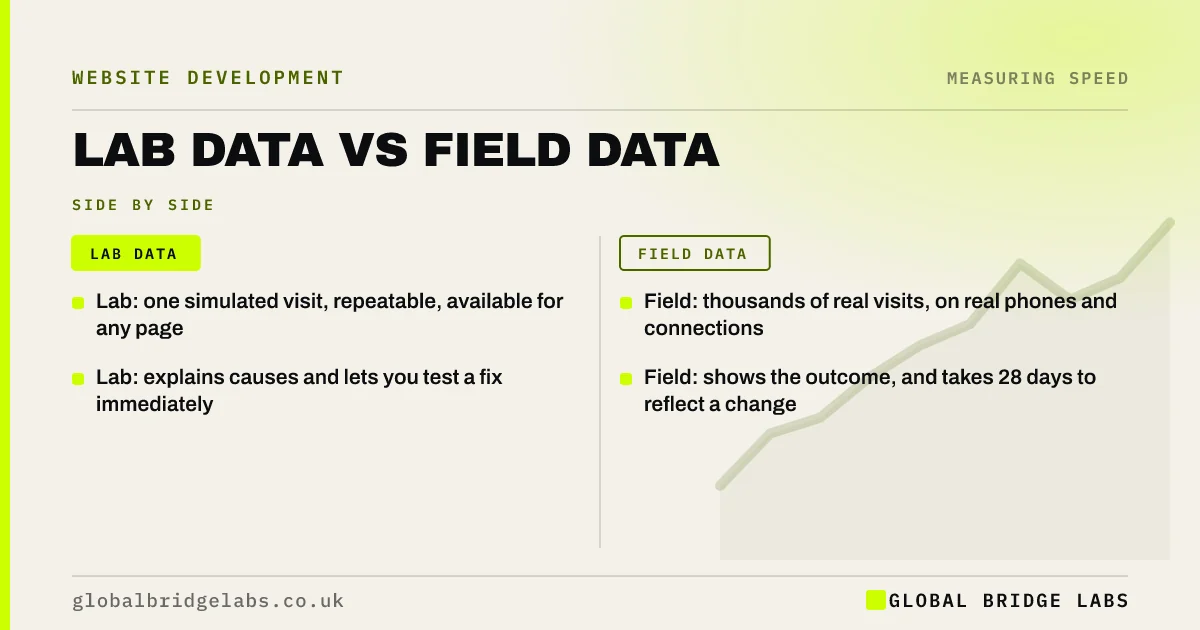
- Lab: one simulated visit, repeatable, available for any page.
- Field: thousands of real visits, on real phones and connections.
- Lab: explains causes and lets you test a fix immediately.
- Field: shows the outcome, and takes 28 days to reflect a change.
Reports saying fast while customers say slow? Send us the URL on WhatsApp.
Chat on WhatsApp →What is the difference between lab and field data?
Lab data is performance measured in a controlled test, using a fixed device and network setting. Field data is performance recorded from real users as they visit, on whatever device and connection they have.
In PageSpeed Insights, the top section labelled as what real users are experiencing is field data from the Chrome User Experience Report. The lower section, with the performance score and diagnostics, is a lab test run by Lighthouse.
Why do lab and field results disagree?
They disagree because they measure different visits. A lab test loads the page once, from the top, with nothing stored, on a simulated mid-range phone, and does not scroll or tap. Real visitors have a range of phones and connections, often have parts of your site stored already, and interact with the page.
- Real devices may be faster or slower than the simulated one.
- Returning visitors load less, so field loading can look better.
- Field data includes taps and scrolling, which reveal slow responses and late shifts.
- Cookie banners and personalised content appear for some visitors and not others.
- The lab test runs from a data centre, not from your customers' locations.
Which one does Google use?
Google uses field data. The Core Web Vitals that its ranking systems consider are measured from real Chrome users and judged at the 75th percentile, meaning three quarters of visits must meet the threshold. The lab performance score is not a ranking input.
This matters when someone promises a score of 95. A high lab score on a site whose real visitors have slow phones and a heavy consent banner can still fail in the field.
Want to know whether your site passes in the field? Ask us on WhatsApp.
Chat on WhatsApp →How should a business use each?
Use them for different jobs. Field data is the scoreboard. Lab data is the workshop.
- 1. Check field data to see whether real visitors have a problem.
- 2. Use lab diagnostics to find what is causing it.
- 3. Make a change and re-run the lab test to confirm it helped.
- 4. Wait 28 days and check field data to confirm visitors felt it.
- 5. Report field results to the business, and lab findings to the developer.
What if your site has no field data?
Small sites often have none, because the Chrome User Experience Report only publishes results where enough visits have been recorded. PageSpeed Insights may show data for the whole site when a single page has too little, or nothing at all.
In that case, lab results and real-phone testing are your evidence. You can also collect your own field data by adding a small measurement script, though for most small businesses a quarterly test by hand is enough.
What does this look like in practice?
A pattern we see in agency reports: a green lab score for the homepage is presented each month as proof the site is fast. Search Console, which nobody opened, shows most mobile pages as needing improvement in the field, because real visitors meet a late-loading banner and slow taps the lab test never triggers.
Reporting field results first, and using the lab only to explain them, changes which work gets done. Global Bridge Labs (GBL) reports both and labels them clearly.
Lab and field data checklist
- Find the field data section for each key page.
- Note LCP, INP and CLS and whether each passes.
- Use the lab diagnostics to list causes.
- Re-run the lab test after each fix.
- Re-check field data after 28 days.
- Ask any supplier which kind of data their report shows.
Next step
If you have only ever been shown one speed number, you have probably been shown the wrong one. We will pull both for your site and explain what they mean together.
Message us on WhatsApp for a lab and field data review.
Chat on WhatsApp →Sources and further reading
- Why lab and field data can be different · web.dev (Google)
- About PageSpeed Insights · Google for Developers
- Chrome User Experience Report · Chrome for Developers
- Understanding Core Web Vitals and Google search results · Google Search Central
Frequently asked questions
What is the difference between lab data and field data?
Lab data comes from a single test on a simulated device and connection. Field data comes from real visitors over the previous 28 days. Lab data is useful for finding causes and testing fixes. Field data shows what customers experienced.
Which is more accurate, lab or field data?
Field data is the more accurate picture of real experience, because it covers actual devices, connections and behaviour. Lab data is more consistent and available for any page, which makes it better for diagnosis. Neither is wrong. They answer different questions.
Does Google use lab data for rankings?
No. Google's ranking systems use field data from real Chrome users for the Core Web Vitals, judged at the 75th percentile. The Lighthouse performance score shown in lab tests is not used for ranking.
How long does field data take to update after a fix?
Field data covers a rolling 28-day period, so a change takes up to 28 days to be fully reflected. Use a lab test to confirm a fix straight away, then check the field figures a month later.
Written by

Global Bridge Labs (GBL) is a UK–Sri Lanka partner for social media, websites and BPO. Everything here comes from client delivery, not theory.