On this page
- 01Key takeaways
- 02Is page speed a Google ranking factor?
- 03How much does speed matter against content?
- 04Which speed measures does Google use?
- 05How does speed help SEO indirectly?
- 06When will speed work not improve rankings?
- 07What does this look like in practice?
- 08Speed and SEO checklist
- 09Next step
- 10Sources and further reading
- 11Frequently asked questions
Key takeaways
Yes, website speed affects SEO, but less than most people are told. Google's ranking systems use Core Web Vitals as part of page experience, and relevance still comes first. Speed will not lift a weak page above a better answer. Between two similar pages, the one that loads and responds well has the edge, and it keeps more of the visitors that search sends.
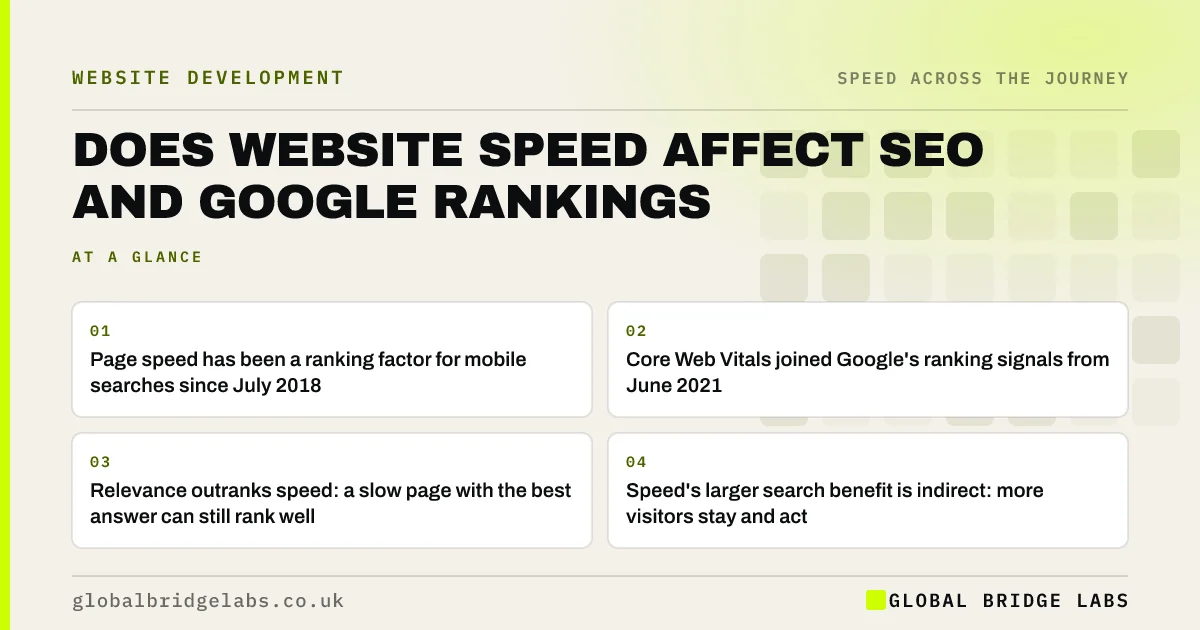
- Page speed has been a ranking factor for mobile searches since July 2018.
- Core Web Vitals joined Google's ranking signals from June 2021.
- Relevance outranks speed: a slow page with the best answer can still rank well.
- Speed's larger search benefit is indirect: more visitors stay and act.
Want to know whether speed is holding back your rankings? Send us the URL on WhatsApp.
Chat on WhatsApp →Is page speed a Google ranking factor?
Yes. Google announced that page speed would be a ranking factor for mobile searches from July 2018, in what it called the Speed Update, and said it would only affect pages delivering the slowest experience and a small percentage of queries. From mid-June 2021, the page experience update added Core Web Vitals to the signals its systems consider.
Google's current guidance says its core ranking systems look to reward content that provides a good page experience, and that Core Web Vitals are used by those systems. It also says there is no single page experience signal, and that great content can rank despite a weaker experience.
How much does speed matter against content?
Speed matters far less than relevance and far more than nothing. Google describes page experience as one of many things its systems weigh, most useful as a way of choosing between pages of similar quality. For a local service business competing with a handful of similar firms, that tie-breaker is in play more often than it is for a unique article.
The practical reading: get key pages into the 'good' range for Core Web Vitals and then stop treating speed as an SEO project. Beyond that threshold, better content and clearer pages will move rankings more.
Which speed measures does Google use?
Google uses field data from real Chrome users, not the lab score you see at the top of a test. The three Core Web Vitals are Largest Contentful Paint (LCP) within 2.5 seconds, Interaction to Next Paint (INP) within 200 milliseconds and Cumulative Layout Shift (CLS) below 0.1, each judged at the 75th percentile of visits. INP replaced First Input Delay in March 2024.
Search Console's Core Web Vitals report groups your pages as good, needs improvement or poor using this data. Small sites sometimes have too few visits for field data to exist, in which case Google has less to go on and lab results are your guide.
Want your Search Console speed report explained? Ask us on WhatsApp.
Chat on WhatsApp →How does speed help SEO indirectly?
Speed helps search results most by protecting the visits you already earn. A visitor from Google who meets a blank screen goes back to the results and picks another business. A faster page turns more of your existing impressions and clicks into people who read the page and enquire.
Server speed also affects crawling. Google's guidance on crawl budget says a site that responds quickly can be crawled more, and one that slows down is crawled less. That matters for very large sites. A typical small business site with a few hundred pages is not limited by it.
When will speed work not improve rankings?
Speed work will not improve rankings when the pages already pass, when the content does not match what people search for, or when the site lacks the reviews, links and local signals competitors have. A page that moves from 2.2 to 1.8 seconds will not rank higher for it. Be wary of any proposal that promises ranking gains from speed alone.
What does this look like in practice?
A pattern we see in SEO retainers: months of work on a performance score while the service pages still say very little about the service. Rankings do not move, and speed gets the blame for not delivering.
Bringing key pages into the good range once, then putting the effort into clear service content, locations and reviews, usually does more for visibility. Global Bridge Labs (GBL) treats speed as a threshold in search work, not the strategy.
Speed and SEO checklist
- Open the Core Web Vitals report in Search Console.
- List pages marked poor or needs improvement on mobile.
- Fix the templates behind those pages, not single URLs.
- Confirm the change in field data after 28 days.
- Then return to content, structure and local signals.
Next step
Speed is one of the easier search signals to get right, because it has a clear pass mark. We will tell you whether your key pages clear it and what to work on once they do.
Message us on WhatsApp for a Core Web Vitals and search check on your key pages.
Chat on WhatsApp →Sources and further reading
- Using page speed in mobile search ranking · Google Search Central Blog
- Understanding page experience in Google Search results · Google Search Central
- Understanding Core Web Vitals and Google search results · Google Search Central
- Large site owner's guide to managing your crawl budget · Google Search Central
- Core Web Vitals report · Search Console Help
Frequently asked questions
Does website speed affect SEO?
Yes. Google's ranking systems use Core Web Vitals as part of page experience, and page speed has been a mobile ranking factor since July 2018. Relevance still matters more. Speed helps most as a tie-breaker between similar pages and by keeping the visitors search sends you.
Will a faster website rank higher on Google?
Only if speed was holding it back. Moving pages from poor to good Core Web Vitals can help where competitors are similar. Making an already acceptable page slightly faster will not change rankings. Content, relevance and local signals carry more weight.
Does Google use my PageSpeed Insights score for ranking?
No. The performance score is a lab estimate. Google's systems use field data from real Chrome users for the three Core Web Vitals, measured at the 75th percentile. A page can have a modest lab score and still pass in the field.
Does site speed affect how Google crawls a website?
It can. Google says a server that responds quickly can be crawled more, and one that slows down is crawled less. This matters for large sites with many thousands of pages. Small business sites are rarely limited by crawl capacity.
Written by

Global Bridge Labs (GBL) is a UK–Sri Lanka partner for social media, websites and BPO. Everything here comes from client delivery, not theory.