On this page
- 01Short answer
- 02What is on-page SEO?
- 03Why does on-page SEO still matter with AI search?
- 04How should you write titles and meta descriptions?
- 05What does the rest of the page need?
- 06How do you avoid pages competing with each other?
- 07When will on-page SEO not move rankings?
- 08What does this look like in practice?
- 09On-page SEO checklist
- 10Next step
- 11Sources and further reading
- 12Frequently asked questions
Short answer
An on-page SEO checklist makes sure each page clearly targets one search topic and gives search engines and AI systems what they need to understand it: a descriptive title, a useful meta description, a single clear main heading, helpful content that answers the searcher's questions, internal links, optimised images and structured data.
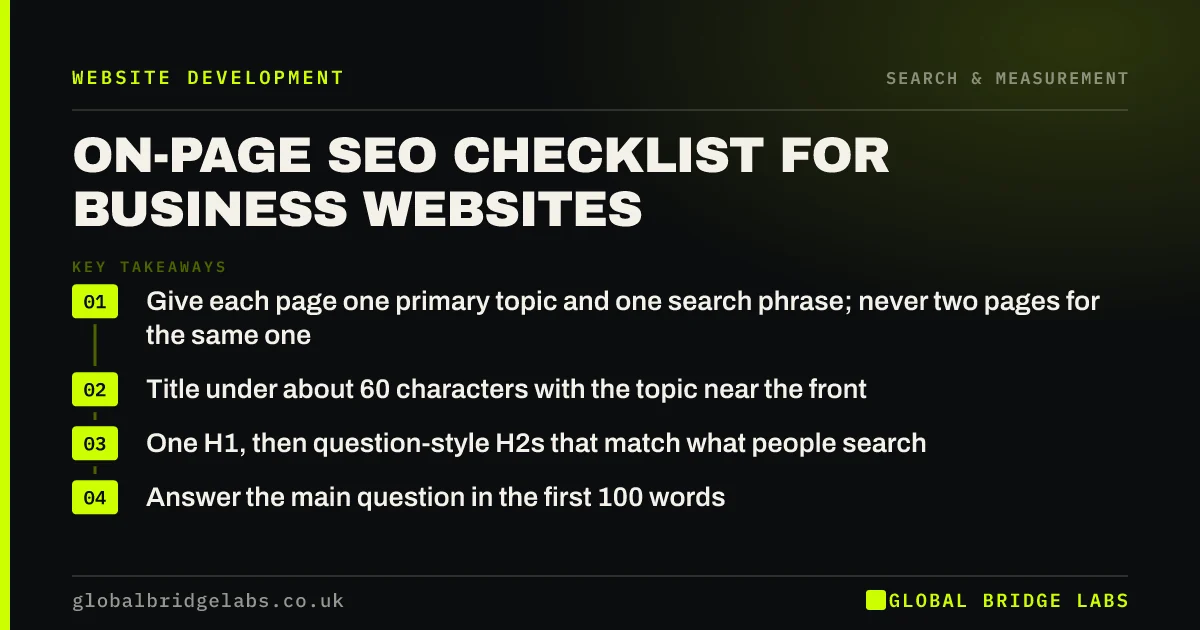
- Give each page one primary topic and one search phrase; never two pages for the same one.
- Title under about 60 characters with the topic near the front.
- One H1, then question-style H2s that match what people search.
- Answer the main question in the first 100 words.
- Link to and from related pages with descriptive anchor text.
Want your top page checked against this list? Send us the URL on WhatsApp.
Chat on WhatsApp →What is on-page SEO?
On-page SEO is the practice of optimising the content and HTML of individual web pages, including titles, headings, text, links, images and structured data, so that search engines can understand them and rank them for relevant searches.
It sits alongside technical SEO, which covers crawling, indexing and speed, and off-page SEO, which covers links and reputation. For small business sites, on-page work is usually where the quickest gains are.
Why does on-page SEO still matter with AI search?
AI answers in Google, Bing and other assistants draw on pages that search engines have indexed and understood. Google's documentation on AI features says the same SEO best practices apply. Pages with clear topics, direct answers and good structure are easier to rank, quote and cite.
What has changed is the value of answer-first writing. Short, self-contained answers under question-style headings are easier for AI systems to lift and for featured snippets to display.
How should you write titles and meta descriptions?
The title tag is the strongest on-page signal and the headline in search results. Keep it descriptive and unique, put the main topic near the front, and aim for roughly 50 to 60 characters so it is not truncated. Google may rewrite titles that are vague or stuffed with keywords.
The meta description does not directly affect rankings, but it influences whether people click. Write 120 to 155 characters that state the answer or benefit and include the topic naturally. Google sometimes shows other text from the page instead.
What does the rest of the page need?
Once the title and description are right, work down the page.
- One H1 that states the page topic clearly.
- H2s phrased as the questions people search, each answered directly beneath.
- The primary phrase in the first 100 words and naturally throughout, never forced.
- Content that covers what top-ranking pages cover, plus what they lack.
- Descriptive internal links to related services and articles.
- Images with descriptive file names and alt text.
- Structured data for the page type: LocalBusiness, Service, Product, Article.
- A clean, readable URL with the topic in it.
How do you avoid pages competing with each other?
Keyword cannibalisation happens when two of your pages target the same search, splitting signals so both rank lower. Keep a simple list of pages and the primary phrase each one owns, and check it before creating anything new.
If two pages already overlap, merge them into the stronger one and redirect the weaker URL. Link consistently: always use the same anchor text when linking to the page that owns a topic.
Want a keyword-to-page map for your site so pages stop competing? Message us on WhatsApp.
Chat on WhatsApp →When will on-page SEO not move rankings?
On-page work cannot overcome a site that cannot be crawled or indexed, a topic where competitors have far more authority, or content that simply is not as helpful as what already ranks. Check indexing in Search Console first.
The trade-off is time. On-page changes can show effect within weeks, but competitive terms may need links, reviews and months of consistent content before rankings move.
What does this look like in practice?
A pattern in small business sites: every page titled with the business name only, service pages with no H1, and three pages all loosely targeting the same main service.
Rewriting titles around each page's topic, adding clear H1s and question-style H2s, and merging the overlapping pages into one strong service page gives search engines a much clearer picture of what each page is for.
On-page SEO checklist
Run this for every important page.
- Assign one primary phrase per page.
- Write a unique, descriptive title under about 60 characters.
- Write a 120 to 155 character meta description.
- Use one H1 and question-style H2s.
- Answer the main question in the first 100 words.
- Add descriptive internal links.
- Optimise images and alt text.
- Add relevant structured data.
- Check the page is indexed in Search Console.
Next step
If your pages are not ranking for the services you sell, we will run this checklist on your top three pages with you in 30 minutes.
Message us on WhatsApp for an on-page SEO review, or book a 30-minute consultation.
Chat on WhatsApp →Sources and further reading
- SEO Starter Guide · Google Search Central
- Influencing your title links in search results · Google Search Central
- Control your snippets in search results · Google Search Central
Frequently asked questions
What is included in on-page SEO?
On-page SEO covers the title tag, meta description, headings, body content, internal links, image file names and alt text, URL and structured data of each page. The aim is to make each page's topic clear to search engines and genuinely useful to the people searching for it.
How long should a title tag be?
Aim for roughly 50 to 60 characters so it displays fully in most search results, with the main topic near the front. Make every title unique and descriptive. Google may rewrite titles that are vague, repetitive or stuffed with keywords, using other text from your page.
Do meta descriptions affect rankings?
Not directly. Meta descriptions influence whether people click your result, which matters for traffic. Write 120 to 155 characters stating the answer or benefit, with the topic included naturally. Google sometimes replaces your description with text from the page that better matches the search.
How many keywords should a page target?
One primary phrase, supported by a few closely related variations and questions that belong on the same page. Targeting unrelated phrases on one page weakens it, and targeting the same phrase on several pages makes them compete. Keep a map of which page owns which phrase.
Written by

Global Bridge Labs (GBL) is a UK–Sri Lanka partner for social media, websites and BPO. Everything here comes from client delivery, not theory.