On this page
- 01Short answer
- 02What is a website brief?
- 03Why do vague briefs lead to bad projects?
- 04What should a website brief include?
- 05Should you include a budget in the brief?
- 06What should you ask suppliers to include in proposals?
- 07When is a long brief counterproductive?
- 08What does this look like in practice?
- 09Brief checklist
- 10Next step
- 11Sources and further reading
- 12Frequently asked questions
Short answer
A website brief template should give suppliers enough to quote accurately and comparably: the business goal and success measures, the audiences, the pages and features needed, who provides content, required integrations, existing site and SEO, budget range, timeline and decision-makers. A two to four-page brief is enough for most SMEs.
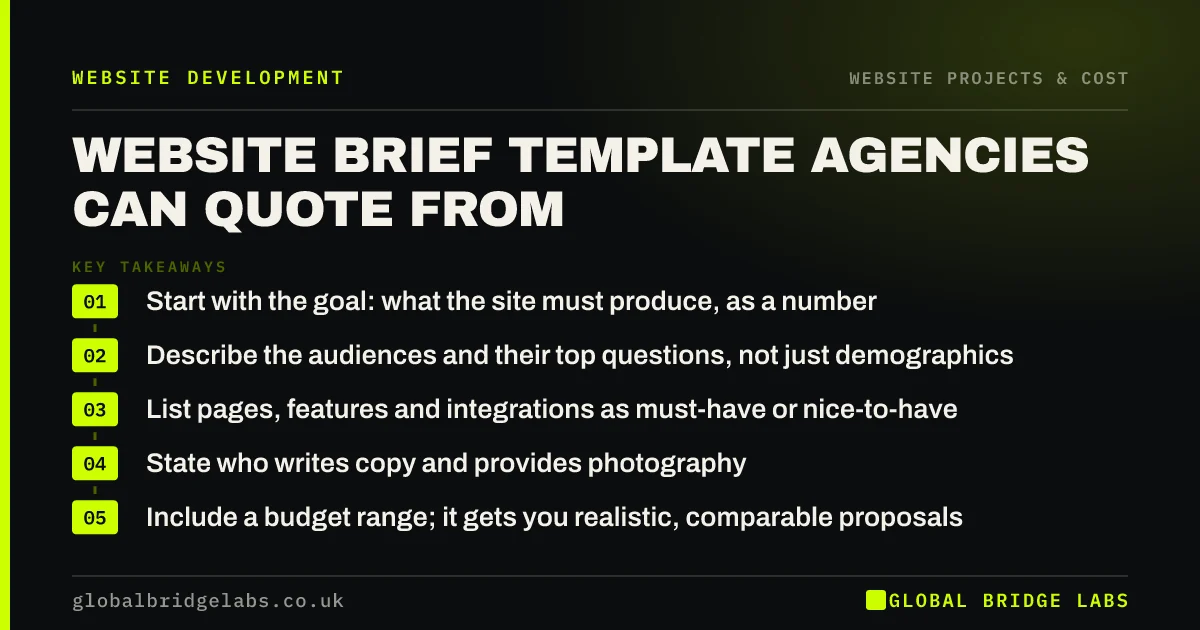
- Start with the goal: what the site must produce, as a number.
- Describe the audiences and their top questions, not just demographics.
- List pages, features and integrations as must-have or nice-to-have.
- State who writes copy and provides photography.
- Include a budget range; it gets you realistic, comparable proposals.
Want a brief drafted with you so suppliers can quote properly? Message us on WhatsApp.
Chat on WhatsApp →What is a website brief?
A website brief is a document that describes what a business needs from a new or improved website, including goals, audiences, content, features, constraints, budget and timeline, so that suppliers can propose and price a solution.
It is also a decision tool for the business. Writing it forces agreement internally on what the site is for before anyone spends money designing it.
A good brief is specific about outcomes and open about methods. It says the site must produce 40 qualified enquiries a month and take online bookings for three services. It does not say the homepage must have a blue banner and a slider, because design decisions are what you are paying the supplier to get right.
Why do vague briefs lead to bad projects?
Vague briefs produce quotes that cannot be compared, because each supplier fills the gaps with different assumptions. One quote includes copywriting and SEO migration, another assumes you provide them. The cheapest quote often just assumed the least.
They also produce sites designed around looks rather than outcomes, because the only clear instruction was modern and clean.
- Quotes that vary by five times for apparently the same site.
- Scope disputes once work starts.
- Missing features discovered after launch.
- No agreed measure of success.
What should a website brief include?
Use these sections, in this order. Keep each short and specific.
- 1. Business summary: what you sell, to whom, where, and what makes you different.
- 2. Goal and success measures: e.g. 40 qualified enquiries a month within six months.
- 3. Audiences: two or three buyer types and their top five questions.
- 4. Current site: URL, what works, what does not, traffic and enquiry data if available.
- 5. Pages: a proposed sitemap, marking must-have and nice-to-have.
- 6. Features and integrations: booking, payments, CRM, WhatsApp, forms.
- 7. Content: who writes copy, supplies photography and migrates existing content.
- 8. Technical: platform preferences, hosting, accessibility and performance standards.
- 9. Budget range and timeline, including any fixed launch date.
- 10. Decision-makers and how proposals will be judged.
Should you include a budget in the brief?
Yes. A budget range lets suppliers propose the best solution for what you can spend, rather than guessing. Without one, you receive proposals for very different projects and cannot compare them.
Give a range rather than a single figure, and say whether it includes running costs for the first year. If you genuinely do not know, ask for proposals at two levels, such as essential and recommended.
Not sure what budget range to put in your brief? Message us on WhatsApp and we will help you set one.
Chat on WhatsApp →What should you ask suppliers to include in proposals?
Ask every supplier to respond in the same format so proposals can be compared. Request a scope list matching your brief, a timeline with milestones, a fixed or capped price with what is excluded, three-year running costs, the team who will do the work, and relevant examples.
Ask specifically how they will handle SEO migration, tracking set-up, accessibility and ownership of the finished site.
When is a long brief counterproductive?
A 30-page brief with every detail specified leaves suppliers no room to suggest better solutions, and takes longer to write than the site takes to plan. For most SMEs, two to four pages is the sweet spot.
The trade-off is precision against expertise. Specify goals, constraints and must-haves firmly. Leave design and technical approach open for suppliers to propose.
What does this look like in practice?
A pattern we see when businesses tender a website: a one-paragraph email asking for a modern, mobile-friendly site with SEO, and five quotes ranging from £1,500 to £18,000 with no way to compare them.
Rewriting the request as a three-page brief with a goal, sitemap, content responsibilities, integrations and budget range usually narrows the quotes and makes the differences visible. The conversation moves from price to approach.
Brief checklist
Tick these before sending your brief.
- Goal written as a number with a date.
- Two or three audiences with their questions.
- Proposed sitemap with priorities.
- Features and integrations listed.
- Content responsibilities agreed.
- Budget range and timeline stated.
- Proposal format specified.
- Decision-makers named.
Next step
If you are about to request quotes, we will draft your brief with you in 30 minutes, so the proposals you receive are accurate and comparable.
Message us on WhatsApp for help with your website brief, or book a 30-minute consultation.
Chat on WhatsApp →Sources and further reading
- User research · GOV.UK Service Manual
- SEO Starter Guide · Google Search Central
- Web Content Accessibility Guidelines (WCAG) 2.2 · W3C
Frequently asked questions
What should a website brief include?
A business summary, goals and success measures, target audiences and their questions, the current site's performance, a proposed sitemap, features and integrations, content responsibilities, technical requirements, budget range, timeline and decision-makers. Two to four pages is enough for most small businesses.
How long should a website brief be?
Two to four pages for most small and medium businesses. That is enough to state goals, audiences, pages, features, content responsibilities, budget and timeline clearly, while leaving suppliers room to propose the best design and technical approach for your needs.
Should I tell web designers my budget?
Yes. A budget range lets suppliers propose what they can realistically deliver for it, making proposals comparable. Without one, quotes describe very different projects. Give a range and say whether it covers only the build or also the first year of running costs.
Who should write the website brief?
The business should own it, because it depends on knowing your goals, customers and constraints. Involve whoever handles sales and customer questions. A supplier or consultant can help structure it, but the decisions about goals, audiences and budget must come from the business.
Written by

Global Bridge Labs (GBL) is a UK–Sri Lanka partner for social media, websites and BPO. Everything here comes from client delivery, not theory.