On this page
- 01Key takeaways
- 02Why do website redesigns fail?
- 03What are the most common mistakes?
- 04Why does designing before content go wrong?
- 05How do redesigns lose search traffic?
- 06What about approving on desktop?
- 07How do you avoid scope creep?
- 08What mistakes happen after launch?
- 09What does this look like in practice?
- 10Redesign mistake checklist
- 11Next step
- 12Sources and further reading
- 13Frequently asked questions
Key takeaways
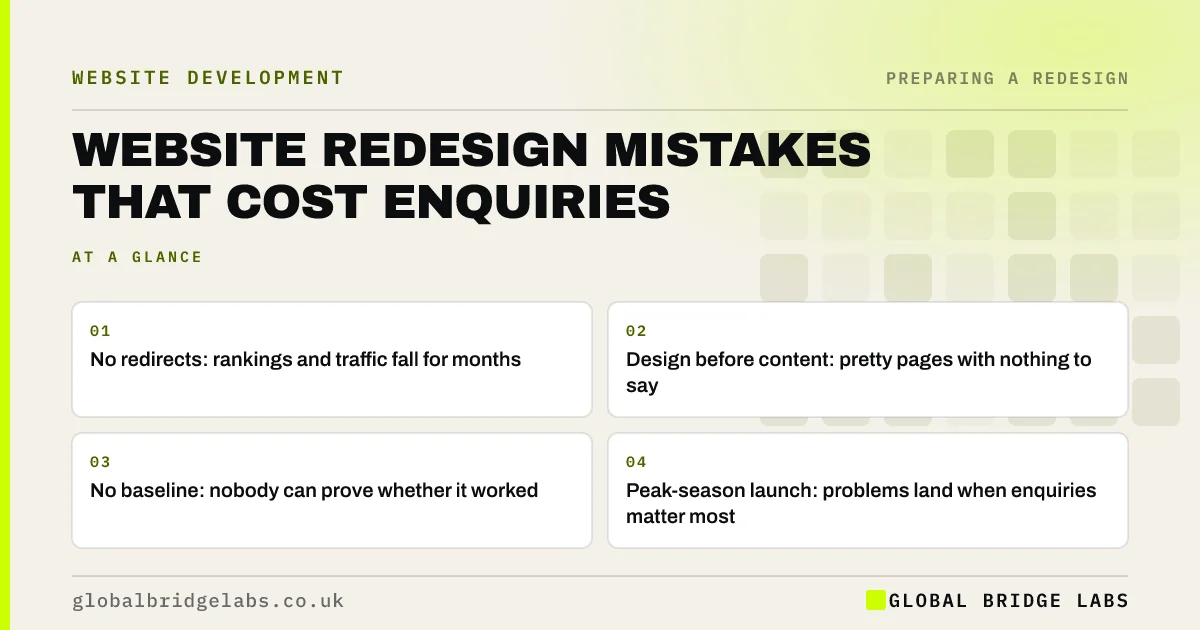
The costliest website redesign mistakes are launching without redirects, starting design before content, having no baseline or goal, and launching during peak season. Each one is avoidable with a few hours of planning. Most failed redesigns fail on process, not on design.
- No redirects: rankings and traffic fall for months.
- Design before content: pretty pages with nothing to say.
- No baseline: nobody can prove whether it worked.
- Peak-season launch: problems land when enquiries matter most.
Planning a redesign? We will check it for these mistakes on WhatsApp.
Chat on WhatsApp →Why do website redesigns fail?
Website redesigns usually fail because of process, not design: no clear goal, content written last, URLs changed without redirects, tracking not carried over, or a launch at the worst time. The new site may look better and still produce fewer enquiries than the old one.
What are the most common mistakes?
These appear in failed redesigns again and again.
- Changing URLs without a full redirect map.
- Designing pages before the content exists.
- No goal, no baseline, no review date.
- Removing pages that ranked or converted.
- Forgetting to move analytics and conversion tracking.
- Launching in peak season or before a holiday.
- Approving designs on desktop only.
Want your redesign plan checked against this list? Ask us on WhatsApp.
Chat on WhatsApp →Why does designing before content go wrong?
Because the design is shaped around placeholder text, and real content either does not fit or never arrives. Pages launch with generic copy, sections are left empty, and the buyer's questions still go unanswered. Write or at least outline key content before design starts.
How do redesigns lose search traffic?
Through changed URLs without redirects, removed content, new pages blocked from indexing, and slower templates. Google's site move documentation stresses URL mapping and redirects. Check Search Console daily for the first fortnight after launch.
What about approving on desktop?
Most small business visitors arrive on phones, and Google uses mobile-first indexing. Designs approved on a large monitor often launch with cramped mobile layouts and buried calls to action. Review every template on a phone before signing off.
How do you avoid scope creep?
Tie every feature to the primary goal, agree a fixed first release, and put new ideas on a list for after launch. Scope creep delays launch, raises cost and often adds features nobody uses.
What mistakes happen after launch?
Treating launch as the end. The most common post-launch mistakes are not checking Search Console for errors, not testing forms on the live site, leaving staging settings such as noindex in place, and not reviewing results at 30 and 90 days.
Another is making many changes in the first weeks in response to opinions, which makes it impossible to tell what is working. Fix genuine problems immediately, but hold back on redesigning pages again until there is enough data to judge them.
- Check Search Console daily for two weeks.
- Test every form and tracking tag on the live site.
- Remove staging noindex settings.
- Wait for data before changing pages again.
What does this look like in practice?
A pattern we see: a new site launches with a new URL structure and no redirects. Enquiries fall and the owner blames the design. The actual cause is dozens of ranking pages now returning 404 errors. Adding the redirects recovers much of the traffic over the following weeks, but the lost month does not come back.
Redesign mistake checklist
Confirm each before launch.
- Goal, baseline and review date recorded.
- Content written or outlined before design.
- Full URL map and redirects in place.
- Analytics and conversion tracking moved and tested.
- Every template reviewed on a phone.
- Launch date outside peak season.
Next step
If you are planning a redesign, we will review your plan with you in 30 minutes and flag the mistakes most likely to cost you enquiries.
Message us on WhatsApp for a redesign plan review, or book a 30-minute consultation.
Chat on WhatsApp →Sources and further reading
- Site moves with URL changes · Google Search Central
- Mobile-first indexing best practices · Google Search Central
- Google Search Console · Google
Frequently asked questions
What is the biggest mistake in a website redesign?
Changing URLs without redirecting the old ones. Pages that ranked return errors, search traffic falls and enquiries follow. A full URL map with 301 redirects, checked before launch, prevents most redesign traffic losses. Check them before launch, not after traffic falls.
Why did my website redesign fail?
Common causes are lost search traffic from missing redirects, removed content that ranked, tracking not carried over, generic content, poor mobile layouts or a peak-season launch. Check Search Console and your enquiry tracking to find which applies. Review Search Console daily for the first fortnight.
Should content or design come first in a redesign?
Content, or at least a detailed outline of it. Designing around placeholder text produces pages that do not fit real content and often launch with generic copy. Knowing what each page must say lets the design serve it. Outline each page before any design work starts.
How do I avoid scope creep in a website redesign?
Tie every feature to the primary goal, agree a fixed first release in writing, and keep a list of ideas for after launch. Review any change request against the goal, cost and launch date before accepting it. Record changes and their cost in a simple log.
Written by

Global Bridge Labs (GBL) is a UK–Sri Lanka partner for social media, websites and BPO. Everything here comes from client delivery, not theory.