On this page
- 01Short answer
- 02What is website copywriting?
- 03Why does most small business website copy fall flat?
- 04How do you find the words buyers actually use?
- 05What are the rules of clear website copy?
- 06How should you handle objections in the copy?
- 07Should you use AI to write website copy?
- 08What does this look like in practice?
- 09Website copy checklist
- 10Next step
- 11Sources and further reading
- 12Frequently asked questions
Short answer
Website copywriting for a small business works when it answers the buyer's questions in their own words, uses specific facts instead of adjectives, deals with objections before they are raised, and ends every page with a clear next step. Good website copy is closer to a helpful sales conversation than to a brochure.
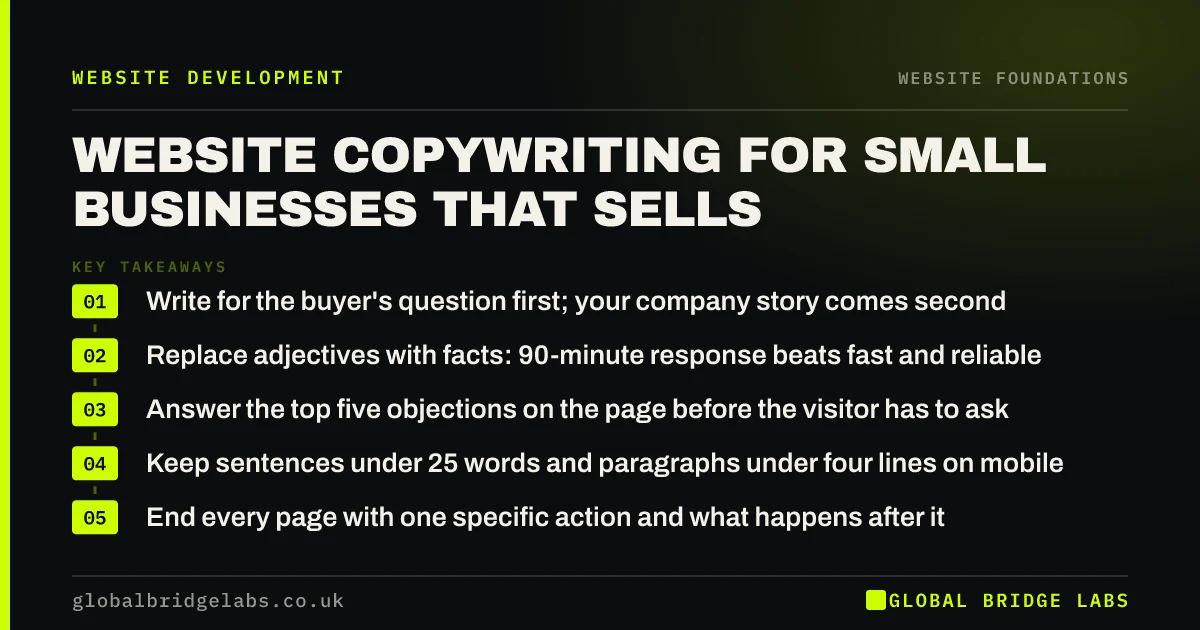
- Write for the buyer's question first; your company story comes second.
- Replace adjectives with facts: 90-minute response beats fast and reliable.
- Answer the top five objections on the page before the visitor has to ask.
- Keep sentences under 25 words and paragraphs under four lines on mobile.
- End every page with one specific action and what happens after it.
Want a page of your site rewritten as a sample? Send us the link on WhatsApp.
Chat on WhatsApp →What is website copywriting?
Website copywriting is the writing of the words on a website, including headlines, service descriptions, calls to action and FAQs, with the aim of helping the right visitors understand an offer and take a specific action.
It differs from other writing because people scan rather than read online, arrive on any page from search, and leave the moment they feel lost. Copy has to work in fragments: every heading and first sentence should make sense on its own.
Why does most small business website copy fall flat?
Most small business copy falls flat because it describes the business from the inside. It lists what the company is proud of rather than what the customer is worried about, and it uses the same words as every competitor.
Buyers skim for evidence that you understand their problem and can solve it at a price and speed that works for them. Copy that does not show that quickly is skipped, however well written.
- We-focused copy: we are, we offer, we pride ourselves.
- Adjectives with no evidence: leading, bespoke, innovative, trusted.
- Jargon the buyer does not use.
- Long paragraphs that are unreadable on a phone.
How do you find the words buyers actually use?
Mine your own conversations. The questions customers ask on the phone, the words they use in enquiry emails, the phrases in your reviews, and the searches in Google Search Console are the best source of website copy you will ever have.
Write down the ten questions you answer on every first call. Each one becomes a heading, an FAQ or a line on a service page. This is also how the page earns search traffic, because those questions are what people type into Google and ask AI assistants.
What are the rules of clear website copy?
The GOV.UK content design guidance is written for public services, but its rules work for any business site: put the most important information first, use short sentences and common words, and write for people who are busy and scanning.
- Lead with the answer, then the detail.
- One idea per paragraph, three to four lines at most on mobile.
- Headings that are questions or specific claims, never Overview or Introduction.
- Numbers instead of adjectives: prices, times, quantities, years.
- Active voice: we fit the boiler, not the boiler will be fitted.
- Buttons that say what happens: Get my quote, not Submit.
How should you handle objections in the copy?
Handle objections on the page, close to the call to action. The common ones for UK service businesses are price, timing, trust, disruption and what happens if something goes wrong.
Answer each directly. If you cannot say a price, explain what drives it and give a range. If lead times are long, say so and explain why. Honest answers to objections convert better than silence, because silence is where buyers assume the worst.
Want your top five objections turned into on-page answers? Message us on WhatsApp.
Chat on WhatsApp →Should you use AI to write website copy?
AI tools are useful for first drafts, restructuring and tightening, but they cannot supply the thing that makes copy convert: specific knowledge of your customers, your prices, your process and your proof. Generic AI copy reads like every other site, which is exactly the problem you are trying to fix.
Google's guidance is that it rewards helpful, original content regardless of how it is produced, and that content made mainly to manipulate rankings is a problem whatever the method. Use AI as an editor, then add the specifics only you know, and have a person check every fact.
What does this look like in practice?
A pattern in e-commerce and professional services: a service or product page of 150 words, most of them adjectives, and an enquiry inbox full of the same five questions about delivery, returns, timescales and cost.
Moving those five answers onto the page, rewriting the opening to state the outcome and the price range, and changing the button from Submit to Get my quote typically reduces repetitive enquiries and increases the share that are ready to buy. The copy got longer and easier to read at the same time.
Website copy checklist
Run every page through these before publishing.
- Open with the answer or the outcome.
- Use the buyer's words, taken from calls, emails and reviews.
- Replace every adjective you can with a fact.
- Keep sentences short and paragraphs under four lines.
- Phrase headings as questions or specific claims.
- Answer the top five objections.
- Write button text that describes the result.
- Read it aloud; rewrite anything you stumble on.
Next step
If your copy sounds like everyone else's, we will rewrite one page with you as a sample in a 30-minute session, using your own customer questions as the raw material.
Message us on WhatsApp for a sample page rewrite, or book a 30-minute consultation.
Chat on WhatsApp →Sources and further reading
- Writing to GOV.UK standards: writing guidelines · GOV.UK
- Creating helpful, reliable, people-first content · Google Search Central
- Google Search Console · Google
Frequently asked questions
How do I write good website copy?
Start with the questions customers ask you, answer them in plain language, and lead each page with the outcome you deliver. Use facts and numbers instead of adjectives, keep sentences short, handle common objections on the page, and finish with one clear action that says what happens next.
How much text should a website page have?
Enough to answer the visitor's questions and no more. Homepages often run to 500 to 900 words across their sections, and service pages to 700 to 1,500 words. What matters is scannability: clear headings, short paragraphs and lists make longer pages easy to use.
Can I use ChatGPT to write my website?
You can use AI tools for drafts and editing, but the finished copy needs your specific prices, process, proof and customer language, which AI cannot know. Google rewards helpful, original content however it is produced. Generic AI copy tends to sound like every competitor, which weakens conversion.
Should website copy be formal or informal?
Write the way you would speak to a customer on a good first call: clear, direct and polite. Formality should match your market, so a law firm will read differently from a café, but every business benefits from short sentences, plain words and specific answers.
Written by

Global Bridge Labs (GBL) is a UK–Sri Lanka partner for social media, websites and BPO. Everything here comes from client delivery, not theory.