On this page
- 01Key takeaways
- 02What makes a good website redesign goal?
- 03What are good examples of redesign goals?
- 04Why do redesign goals fail?
- 05How do goals shape the project?
- 06What baseline do you need?
- 07When are softer goals acceptable?
- 08Should goals be in the supplier contract?
- 09What does this look like in practice?
- 10Redesign goals checklist
- 11Next step
- 12Sources and further reading
- 13Frequently asked questions
Key takeaways
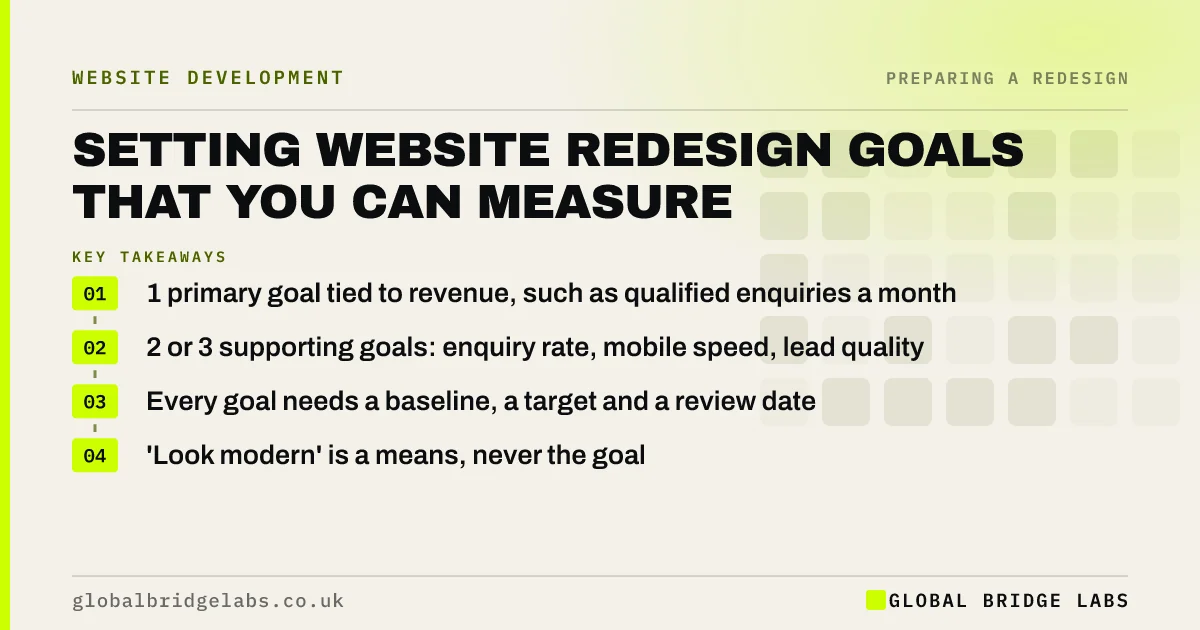
A website redesign needs one primary goal tied to revenue, such as qualified enquiries per month, plus two or three supporting goals. Each goal needs a baseline, a target and a date. 'Modern look' and 'better user experience' are not goals; they are ways of reaching one.
- 1 primary goal tied to revenue, such as qualified enquiries a month.
- 2 or 3 supporting goals: enquiry rate, mobile speed, lead quality.
- Every goal needs a baseline, a target and a review date.
- 'Look modern' is a means, never the goal.
Want your redesign goals set with your own numbers? Ask us on WhatsApp.
Chat on WhatsApp →What makes a good website redesign goal?
A good website redesign goal names a commercial outcome, a baseline, a target and a date: for example, raise qualified enquiries from 20 to 30 a month within 90 days of launch. It can be checked by anyone with access to the data, and the whole project can be judged against it.
What are good examples of redesign goals?
Pick one primary goal and support it with two or three others.
- Primary: qualified enquiries from 20 to 30 a month within 90 days.
- Enquiry rate on top service pages from 1% to 2%.
- Key templates passing Core Web Vitals on mobile at launch.
- Share of enquiries worth quoting from 50% to 70%.
- Owner can publish a case study without developer help.
Want a realistic target for your enquiry rate? Ask us on WhatsApp.
Chat on WhatsApp →Why do redesign goals fail?
Because they are vague, unmeasured or about the project rather than the business. 'Look more modern' cannot be checked. 'Increase traffic' can be met with irrelevant visitors. Goals with no baseline cannot show improvement at all.
- No baseline recorded before launch.
- Goals about appearance rather than outcomes.
- Traffic goals with no link to enquiries.
- Too many goals, so none drives decisions.
How do goals shape the project?
Every design and content decision should serve the primary goal. If the goal is qualified enquiries, the project prioritises service pages, proof, pricing guidance and the enquiry route, and treats visual polish as supporting work. Goals also give you a basis for saying no to features that do not serve them.
What baseline do you need?
Twelve months of data for each goal, recorded before any change. For enquiries, that means tracked form, call and WhatsApp enquiries by month. Without a year of data, seasonal swings can look like success or failure.
When are softer goals acceptable?
When the redesign is defensive, such as moving off an unsupported platform, the primary goal can be risk-based: live on supported software by a date, with no loss of rankings or enquiries. That is still measurable.
Should goals be in the supplier contract?
The goals should be in the brief and the contract should reference them, but tie payments to deliverables rather than results. A supplier controls the quality of the site; they do not control your pricing, sales follow-up or market demand, all of which affect enquiries.
What you can reasonably put in the contract are measurable deliverables that support the goals: key templates passing Core Web Vitals on mobile, tracking set up and tested for every enquiry route, redirects in place for every changed URL, and a post-launch review at 30 and 90 days.
- Put the goals in the brief.
- Contract for deliverables that support them.
- Include tracking, redirects and speed targets.
- Book 30 and 90 day reviews into the contract.
What does this look like in practice?
A pattern in UK professional services: a brief says 'modern, professional, easy to use'. Replacing it with 'qualified enquiries from 12 to 20 a month within 90 days, top five service pages passing Core Web Vitals' changes which pages get the budget and gives the partners a way to judge the result.
Redesign goals checklist
Write these down before briefing anyone.
- One primary goal tied to revenue.
- Two or three supporting goals.
- A 12-month baseline for each.
- A target and a review date for each.
- One person responsible for checking.
- Goals included in the brief and contract.
Next step
If you are planning a redesign, we will set measurable goals with you in 30 minutes using your own data.
Message us on WhatsApp for help setting redesign goals, or book a 30-minute consultation.
Chat on WhatsApp →Sources and further reading
- About key events · Google Analytics Help
- Understanding Core Web Vitals and Google search results · Google Search Central
- Google Search Console · Google
Frequently asked questions
What should the goal of a website redesign be?
Usually a commercial outcome such as more qualified enquiries or orders, with a baseline, target and date. Supporting goals might cover enquiry rate, mobile speed or lead quality. Appearance is a way of reaching the goal, not the goal itself.
How do I set measurable goals for my website?
Record 12 months of baseline data, choose one primary outcome and two or three supporting measures, set a realistic target for each, and fix a review date, usually 90 days after launch. Assign one person to check the results. Write the goals into the brief.
What are good KPIs for a website redesign?
Qualified enquiries per month, enquiry rate on key pages, share of enquiries worth quoting, and Core Web Vitals on mobile. Traffic and engagement are useful diagnostics but should not be the main measure of success. Keep the list short so it drives decisions.
How soon after a redesign should I see results?
Check at 90 days against the same months of the previous year. Conversion changes can appear within weeks; search-related changes can take longer, especially if URLs changed. Record the baseline before launch so the comparison is fair. Review search results again at six months.
Written by

Global Bridge Labs (GBL) is a UK–Sri Lanka partner for social media, websites and BPO. Everything here comes from client delivery, not theory.