On this page
- 01Key takeaways
- 02What do budget holders need to see?
- 03What objections should you prepare for?
- 04Why does a phased option help?
- 05What evidence carries the most weight?
- 06What budget range is realistic to ask for?
- 07When should you not push for approval?
- 08How should you present the request?
- 09What does this look like in practice?
- 10Approval pack checklist
- 11Next step
- 12Sources and further reading
- 13Frequently asked questions
Key takeaways
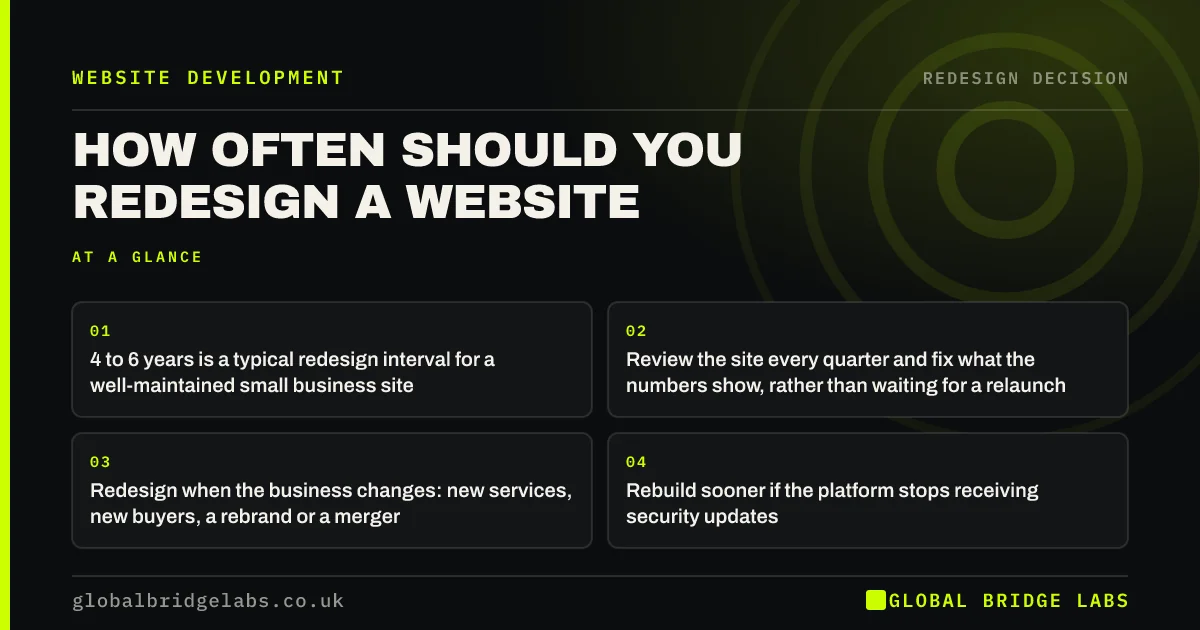
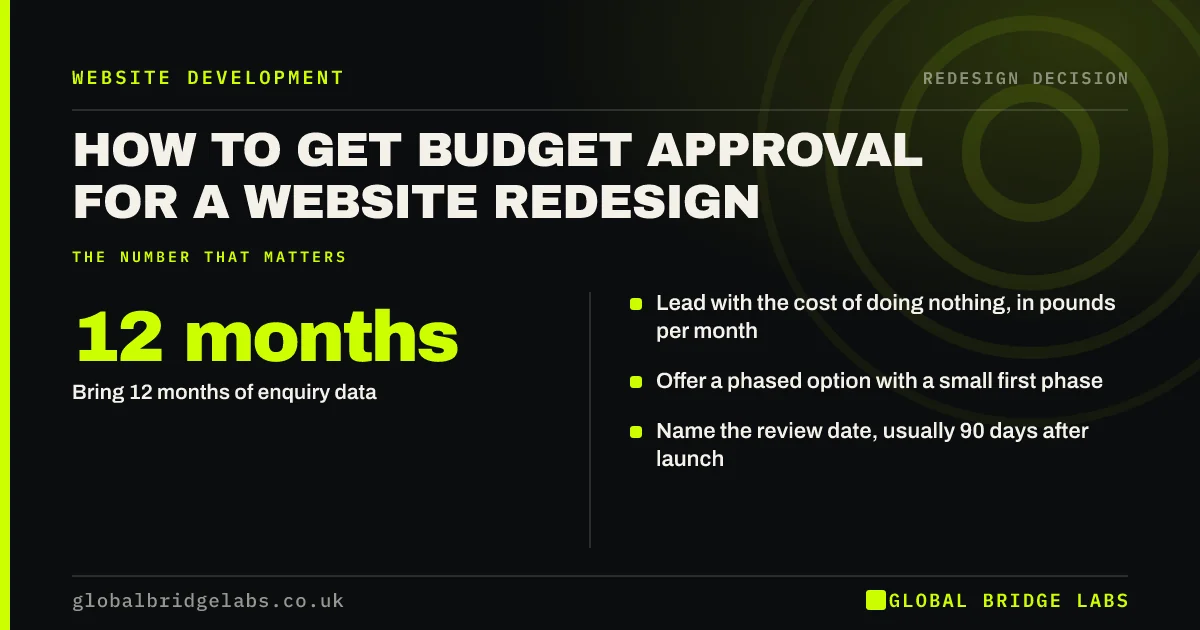
Budget holders approve website redesigns when they see the cost of doing nothing, a cheaper option considered, the risks named and a date when success will be checked. Arrive with 12 months of enquiry data and a phased option; that combination answers most objections before they are raised.
- Lead with the cost of doing nothing, in pounds per month.
- Bring 12 months of enquiry data. Opinions do not get budgets.
- Offer a phased option with a small first phase.
- Name the review date, usually 90 days after launch.
Preparing to ask for a redesign budget? We will help you shape it on WhatsApp.
Chat on WhatsApp →What do budget holders need to see?
Budget holders need four things before approving a website redesign: the commercial cost of the current site, evidence that the problem is the website rather than the offer or the market, a comparison of options including a cheaper one, and a clear measure of success with a review date.
What objections should you prepare for?
The same five questions come up in almost every partner or board discussion. Prepare a one-line answer to each.
- Why now? Answer with the monthly cost of the current site and any risk deadline.
- Why not fix it? Show which problems are blocked by the platform or structure.
- Will it definitely work? Show the cautious ROI case, not the hopeful one.
- What could go wrong? Name SEO, time and timing risks and their mitigations.
- How will we know? Name the success measure, baseline and review date.
Why does a phased option help?
A phased option lowers the first commitment and builds trust through results. Phase one fixes the homepage, top service pages and enquiry route; later phases follow once phase one has shown a measurable change. Budget holders who would refuse £12,000 at once will often approve £3,000 with a checkpoint.
Want the redesign split into phases you can get approved? Ask us on WhatsApp.
Chat on WhatsApp →What evidence carries the most weight?
Your own data carries more weight than any industry statistic. Twelve months of enquiries by source, the redesign scorecard result, and a short recording of a stranger failing to find your prices on a phone are far more persuasive than a mood board.
- Enquiries by month and source for the last 12 months.
- PageSpeed Insights results for key pages on mobile.
- Comments from customers or staff about the site.
- A side-by-side comparison with two competitors buyers mention.
What budget range is realistic to ask for?
Typical UK market ranges for small business sites are £500 to £3,000 for focused fixes, £3,000 to £12,000 for a redesign on an existing platform, and £5,000 to £20,000 or more for a rebuild. Include 12 months of maintenance, typically £50 to £500 a month, so nobody is surprised later.
When should you not push for approval?
When you have no enquiry data. Asking for budget without a baseline invites a no, and even a yes leaves you unable to prove the project worked. Spend a month setting up tracking first; it strengthens the case and costs very little.
How should you present the request?
In writing first, then in the meeting. Send a two-page pack a few days ahead so decision-makers can read the numbers, then use the meeting for questions. Lead with the problem and its cost, not the design, and end with the specific decision you need and the date you need it by.
Keep visuals to evidence: a chart of enquiries over 12 months, a screenshot of the site failing a mobile speed test, a side-by-side with a competitor. Mood boards and design concepts are best left until after approval, because they turn a business decision into a debate about taste.
- Send the pack at least three days before the meeting.
- Open with the cost of doing nothing.
- Show evidence, not design concepts.
- Close with the decision and deadline you need.
What does this look like in practice?
A pattern in UK partnerships: a marketing lead asks for a full redesign twice and is turned down twice. The third time they bring a month of tracked enquiries, a cost-of-inaction figure and a £3,000 first phase with a 90-day checkpoint. It is approved in one meeting.
Approval pack checklist
Bring these to the meeting, on no more than two pages.
- Monthly cost of the current site.
- Twelve months of enquiry data by source.
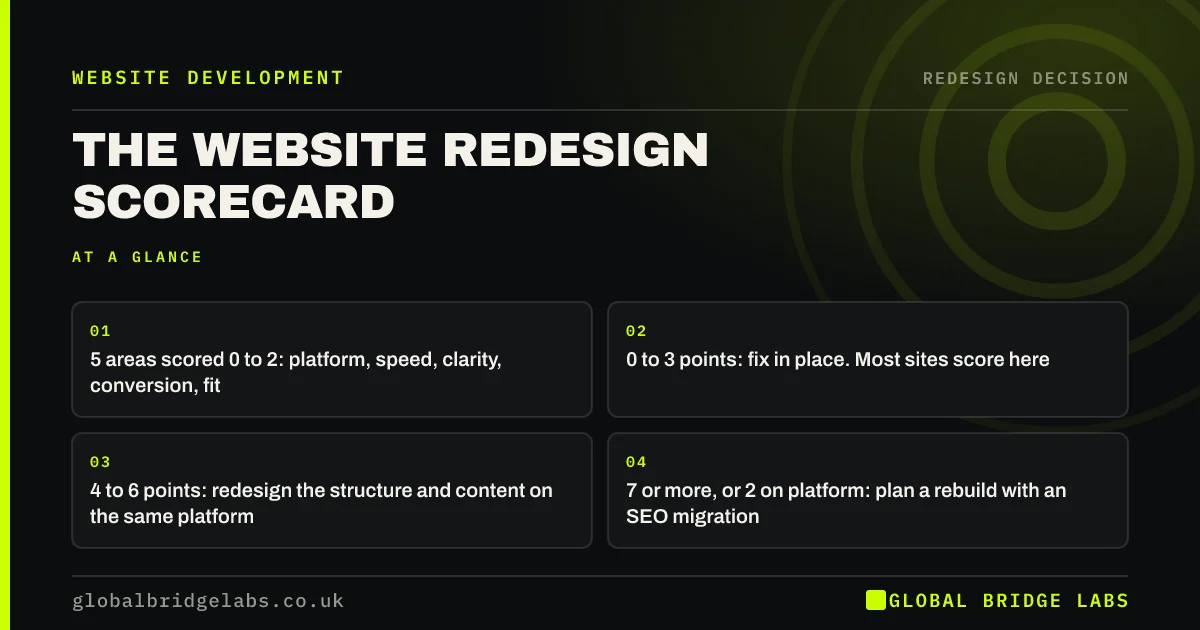
- Scorecard result with evidence.
- Three options with costs, including fixing in place.
- Named risks and mitigations.
- Success measure, baseline and review date.
Next step
If you need to get a website budget approved, we will help you build the approval pack in a 30-minute call, with a phased option that is easier to say yes to.
Message us on WhatsApp for help with your approval pack, or book a 30-minute consultation.
Chat on WhatsApp →Sources and further reading
- PageSpeed Insights · Google
- About key events · Google Analytics Help
- Google Search Console · Google
Frequently asked questions
How do I convince my business partners we need a new website?
Show the cost of the current site in pounds, using your own enquiry data, and compare three options including fixing in place. Offer a small first phase with a 90-day checkpoint. Partners usually resist uncertainty, not spending, so make the outcome measurable.
How much should a small business budget for a website redesign?
Typical UK ranges are £3,000 to £12,000 for a redesign on an existing platform and £5,000 to £20,000 or more for a rebuild. Add 12 months of maintenance, usually £50 to £500 a month, and allow for your own team's time on content and reviews.
What if my boss thinks the website is fine?
Test that belief with evidence. Track enquiries for a month, run key pages through PageSpeed Insights on mobile, and ask three recent customers how they found the site. If the evidence says the site is fine, they may be right, and a redesign is not the priority.
Should I ask for the full redesign budget at once?
Often not. A phased request with a small first phase and a checkpoint is easier to approve and lowers risk. If phase one improves enquiries, later phases are approved on evidence. If it does not, you have learned the problem lies elsewhere before spending the full budget.
Written by

Global Bridge Labs (GBL) is a UK–Sri Lanka partner for social media, websites and BPO. Everything here comes from client delivery, not theory.