
On this page
- 01Key takeaways
- 02Why compare your website with competitors?
- 03Which competitors should you compare?
- 04What should you score?
- 05How do you read the gap?
- 06Can you compare speed objectively?
- 07What should you not copy?
- 08How often should you repeat the comparison?
- 09What does this look like in practice?
- 10Competitor comparison checklist
- 11Next step
- 12Sources and further reading
- 13Frequently asked questions
Key takeaways
Compare your website with the three competitors buyers actually mention, on a phone, as a buyer would. Score eight things: clarity, proof, pricing guidance, speed, mobile ease, enquiry options, content depth and freshness. A gap in one or two areas needs fixes; a gap across most of them justifies a redesign.
- Pick the 3 competitors your buyers mention, not the biggest names.
- Score 8 areas from 0 to 2 on a phone.
- A gap in 1 or 2 areas: fix those pages.
- A gap across 5 or more: consider a redesign.
Want your site scored against your competitors? Message us on WhatsApp.
Chat on WhatsApp →Why compare your website with competitors?
Buyers rarely judge a website in isolation. They open several in tabs and compare them, often on a phone. A competitor website comparison shows your site as buyers see it: one option among several, judged on clarity, credibility and ease of enquiry.
Which competitors should you compare?
The ones buyers actually consider. Ask recent customers who else they looked at, and check who appears alongside you in local search results for your main service. National brands with large budgets are rarely the right comparison for a local SME.
What should you score?
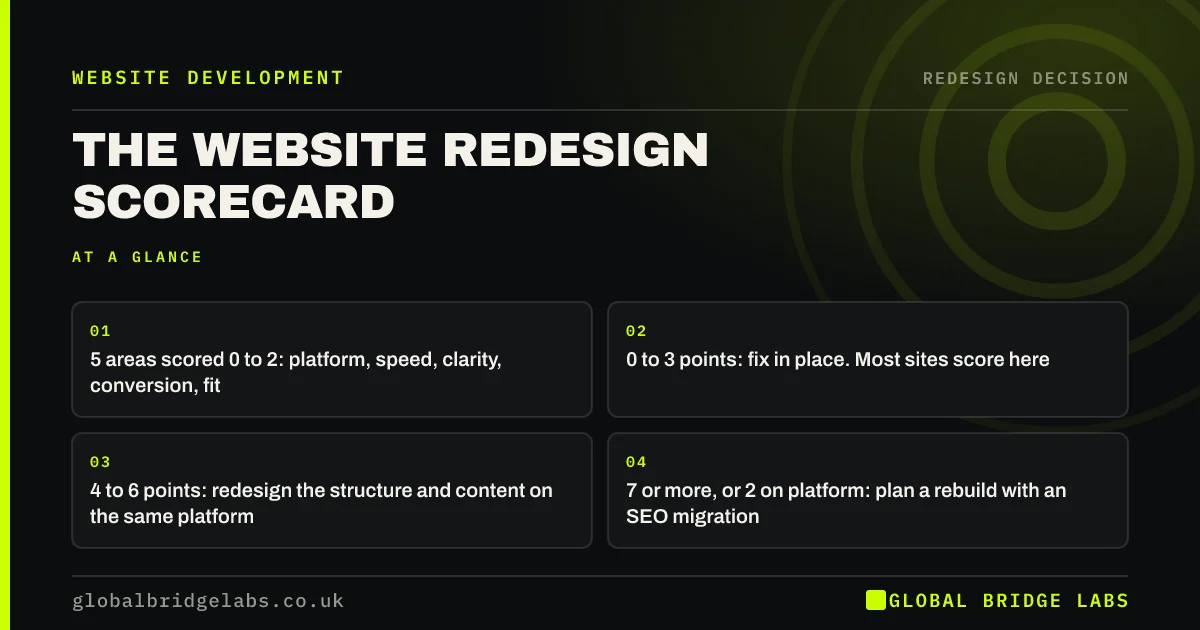
Score each area 0 (weak), 1 (adequate) or 2 (strong) for your site and each competitor, using a phone.
- Clarity: is it obvious what they do and for whom?
- Proof: reviews, case studies, accreditations near the call to action.
- Pricing guidance: ranges, minimums or 'from' prices.
- Speed: how quickly the main content appears on mobile data.
- Mobile ease: tap-friendly buttons, readable text, short forms.
- Enquiry options: phone, WhatsApp, form, booking.
- Content depth: dedicated pages for each service.
- Freshness: recent work, reviews and dates.
Want a competitor scorecard built for your market? Ask us on WhatsApp.
Chat on WhatsApp →How do you read the gap?
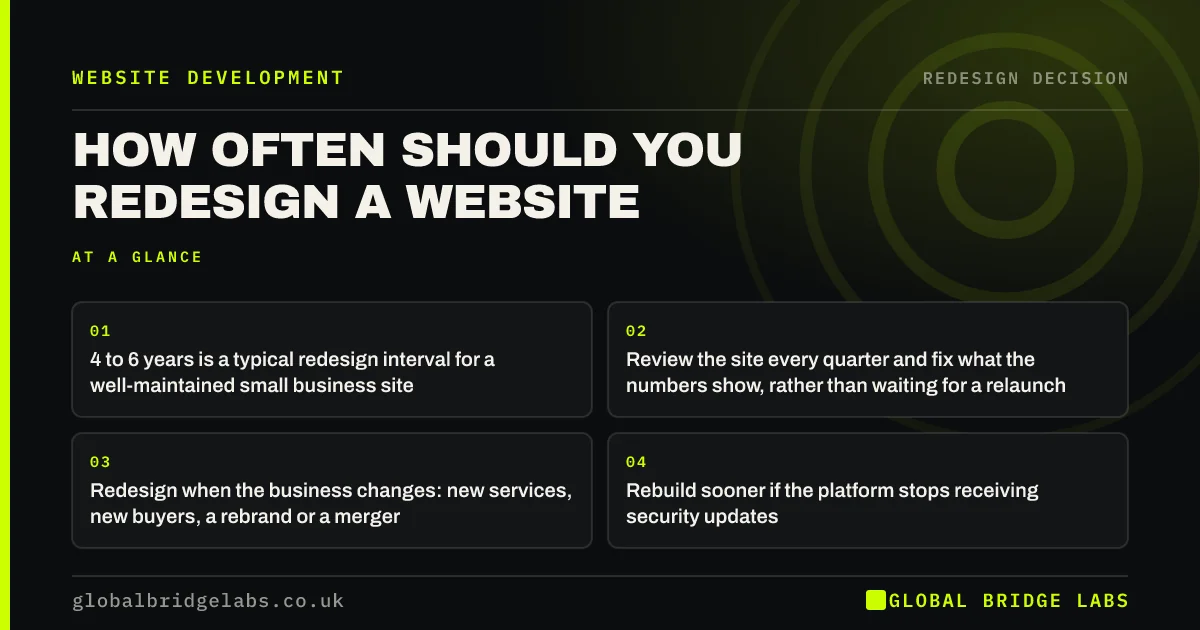
Look at where you score lower than the best competitor, not at the totals. A lower score in one or two areas, such as proof or pricing guidance, means fixing those pages. Lower scores across five or more, especially clarity, mobile ease and content depth, suggest the site's structure has fallen behind and a redesign is justified.
Can you compare speed objectively?
Yes. Run each competitor's homepage and main service page through PageSpeed Insights on mobile. Where field data from real Chrome users is shown, it gives a fair comparison against Google's Core Web Vitals thresholds, including Largest Contentful Paint within 2.5 seconds.
What should you not copy?
Their design. Copying a competitor's look makes you harder to tell apart and can raise copyright problems. Copy the principles that work, such as clear pricing or proof beside the form, and express them in your own brand and words.
How often should you repeat the comparison?
Once a year, and whenever a new competitor starts winning work you would expect to win. Competitor sites change, and a gap that did not exist last year can open quickly when a rival invests in its website, reviews or content.
Keep the scoring sheet from each round so you can see movement over time. If your scores hold steady while a competitor's rise across several areas, that is an early warning worth acting on before enquiries start to fall, and it gives you specific areas to improve rather than a general sense of being behind.
- Repeat the comparison annually.
- Repeat when a new competitor starts winning work.
- Keep each year's scoring sheet.
- Act on areas where a competitor improved.
What does this look like in practice?
A pattern in UK trades: a firm scores itself against three local rivals and finds it wins on reviews but loses on pricing guidance and on dedicated service pages. Adding 'typical jobs from £X' and splitting one long services page into five closes most of the gap without a redesign.
Competitor comparison checklist
Allow about 90 minutes.
- Ask 5 recent customers who else they considered.
- Pick the 3 most mentioned competitors.
- Score all 4 sites on the 8 areas using a phone.
- Run PageSpeed Insights on each homepage.
- Note where you trail the best competitor.
- Fix page by page, or plan a redesign if you trail on 5 or more.
Next step
If you want to see your site the way buyers compare it, we will score it against your three main competitors with you in 30 minutes.
Message us on WhatsApp for a competitor comparison, or book a 30-minute consultation.
Chat on WhatsApp →Sources and further reading
- PageSpeed Insights · Google
- Understanding Core Web Vitals and Google search results · Google Search Central
- Tips to improve your local ranking on Google · Google Business Profile Help
Frequently asked questions
How do I compare my website with a competitor's?
Pick the competitors your buyers actually consider, then score each site and yours on a phone across clarity, proof, pricing guidance, speed, mobile ease, enquiry options, content depth and freshness. Focus on the areas where you trail the strongest competitor.
Should my website look like my competitors?
No. Buyers need to tell you apart. Learn from what works on competitor sites, such as clear pricing or proof beside the enquiry form, but express it in your own brand, words and photography. Copying designs can also raise copyright issues.
What free tools can I use to analyse competitor websites?
PageSpeed Insights for speed and Core Web Vitals, a phone for hands-on testing, Google search results for local visibility, and competitors' review profiles for proof. A structured scoring sheet matters more than paid tools for a small business. Record results in a simple scoring sheet.
When does a competitor gap justify a redesign?
When you trail the strongest competitor in five or more of the eight areas, especially clarity, mobile ease and content depth. A gap in one or two areas is better closed by fixing those pages directly. Revisit the comparison once a year.
Written by

Global Bridge Labs (GBL) is a UK–Sri Lanka partner for social media, websites and BPO. Everything here comes from client delivery, not theory.