On this page
- 01Key takeaways
- 02What is a website redesign business case?
- 03How do you put the problem in pounds?
- 04Which options should the case compare?
- 05What risks belong in the case?
- 06How should success be measured?
- 07When should you not write the case at all?
- 08How detailed should the numbers be?
- 09What does this look like in practice?
- 10Business case template
- 11Next step
- 12Sources and further reading
- 13Frequently asked questions
Key takeaways
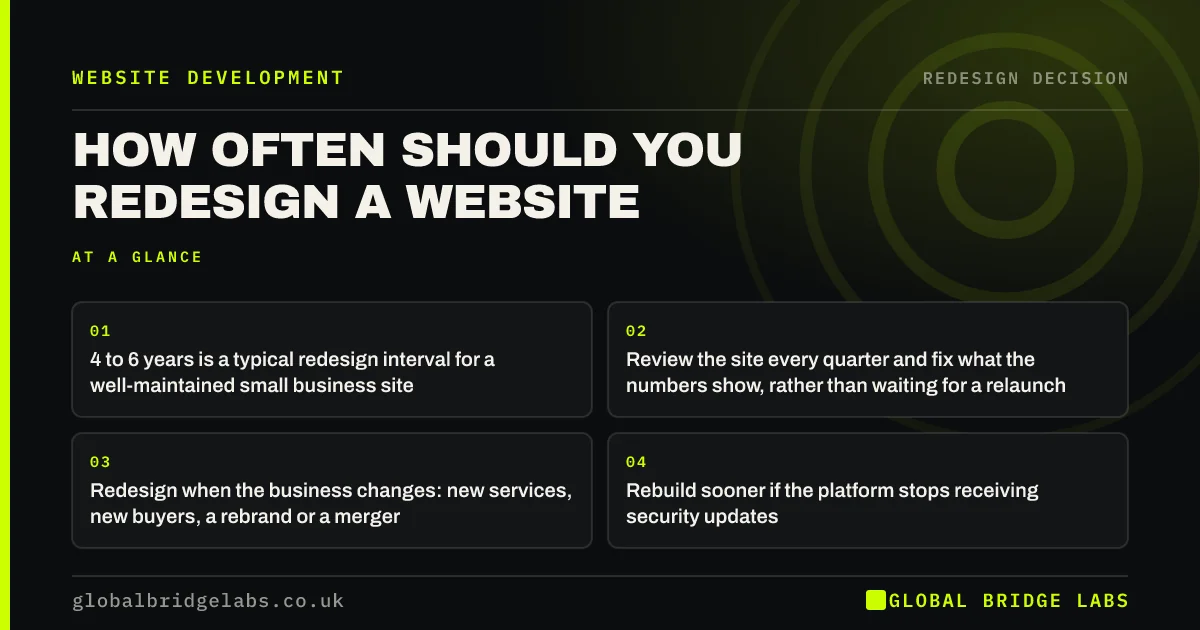
A website redesign business case fits on one page: the problem in pounds, three options with costs, the risks of each, and the single number that will show success. If you cannot put the problem in pounds, you do not yet have a case, you have a preference.
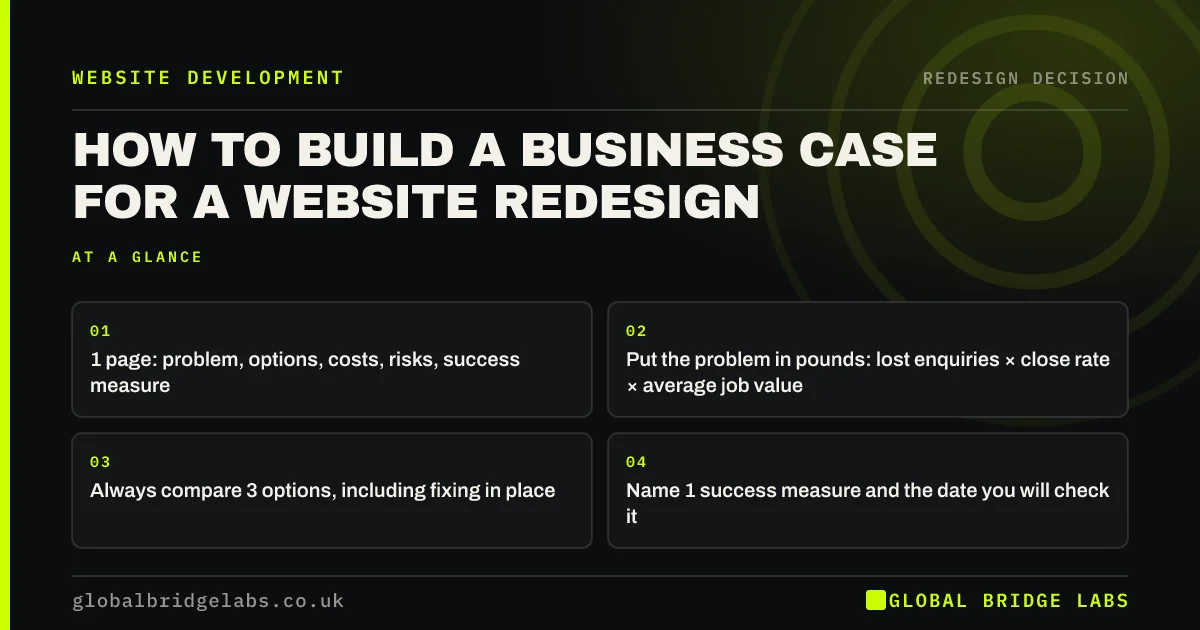
- 1 page: problem, options, costs, risks, success measure.
- Put the problem in pounds: lost enquiries × close rate × average job value.
- Always compare 3 options, including fixing in place.
- Name 1 success measure and the date you will check it.
Want help putting your website problem in pounds? Message us on WhatsApp.
Chat on WhatsApp →What is a website redesign business case?
A website redesign business case is a short document that shows why a redesign is worth its cost, by stating the commercial problem the current site causes, the options for fixing it, what each costs and risks, and how success will be measured after launch.
Its job is to move the conversation from opinion to numbers. Partners and finance directors rarely object to spending; they object to spending without a way to tell whether it worked.
How do you put the problem in pounds?
Estimate the enquiries the site is losing and turn them into revenue. Use your own numbers: monthly visits, current enquiry rate, a realistic improved rate, your close rate and your average job value. Keep every assumption visible so others can challenge it.
- Monthly visits from the right audience: for example 1,500.
- Current enquiry rate: for example 1%, so 15 enquiries a month.
- Realistic improved rate: for example 2%, so 30 enquiries a month.
- Close rate and average job value: for example 25% and £2,000.
- Extra revenue: 15 more enquiries × 25% × £2,000 = £7,500 a month.
Which options should the case compare?
Always compare at least three: fix in place, redesign on the current platform, and rebuild. Including the cheapest option makes the case more credible, and sometimes it wins.
- Fix in place: typically £500 to £3,000 in the UK market; fastest, lowest risk.
- Redesign: typically £3,000 to £12,000; new structure and content, same platform.
- Rebuild: typically £5,000 to £20,000 or more; new platform plus SEO migration.
Want the three options costed for your site? Ask us on WhatsApp.
Chat on WhatsApp →What risks belong in the case?
Every option carries risk, and naming it builds trust with the people approving the spend. The biggest risks in a redesign are search traffic loss from changed URLs, time taken from the team, and launching late into a busy season.
- SEO risk: changed URLs without redirects can cut traffic for months.
- Time risk: owners typically spend 15 to 30 hours on reviews and content.
- Timing risk: a launch during your peak season puts enquiries at risk.
- Supplier risk: check who owns the domain, hosting and files at the end.
How should success be measured?
Pick one commercial number, such as qualified enquiries per month, set the baseline before the project starts, and agree the date you will check it, usually 90 days after launch. Supporting numbers such as traffic and engagement explain the result but do not define it.
When should you not write the case at all?
When the business is about to change direction. A rebrand, merger or new service line in the next six months will reshape the site, so a case written now will be out of date by launch. Fix the costly leaks, such as broken forms and missing tracking, and wait.
How detailed should the numbers be?
Detailed enough to be challenged, simple enough to explain in two minutes. Use round numbers from your own data, show every assumption on the page, and give a cautious and a hopeful case. Budget holders trust a modest case they can check more than an impressive one they cannot.
Avoid false precision. A case that forecasts 23.7 extra enquiries a month invites argument about the decimal point rather than the decision. Ranges such as 10 to 15 extra enquiries a month are more honest and easier to defend. If a number is a guess, label it as a guess and say how you will check it after launch.
- Use your own 12-month figures, rounded.
- Show every assumption beside the number it drives.
- Give a cautious and a hopeful case.
- Label guesses and say how they will be tested.
What does this look like in practice?
A pattern in UK professional services firms: one partner wants a new website, another sees it as a vanity project. A one-page case showing 12 months of flat enquiries, the lost revenue at a realistic enquiry rate, and a phased option starting at the lowest cost usually settles it.
The phased option is often what gets approved, because it lets the firm see results from the first phase before committing the full budget.
Business case template
Use these headings, in this order, on one page.
- The problem: what the site costs the business today, in pounds.
- The evidence: 12 months of enquiries and the redesign scorecard result.
- The options: fix, redesign, rebuild, each with cost and timeline.
- The risks: SEO, time, timing and ownership, with mitigations.
- The recommendation and why.
- The success measure, the baseline and the review date.
Next step
If you need to take a redesign case to partners or a board, we will help you build the numbers in a 30-minute call, including the option to do less.
Message us on WhatsApp for help with your website business case, or book a 30-minute consultation.
Chat on WhatsApp →Sources and further reading
- About key events · Google Analytics Help
- Google Search Console · Google
- Site moves with URL changes · Google Search Central
Frequently asked questions
How do you justify a website redesign?
Show the commercial problem in pounds, compare at least three options including fixing in place, name the risks of each, and agree one success measure with a baseline and a review date. Decision-makers approve spending they can measure, not spending based on taste.
What should a website redesign proposal include?
The problem the current site causes, the evidence for it, the options with costs and timelines, the risks and how they will be managed, a recommendation, and the success measure. Keep it to one page so it gets read before the meeting rather than during it.
How do you calculate the value of a new website?
Multiply the extra enquiries you expect by your close rate and average job value, using your own visit and enquiry numbers. For example, 15 extra enquiries a month at a 25% close rate and £2,000 average value is £7,500 a month in additional revenue.
Who should approve a website redesign in a small business?
The owner or partners who control the budget, with input from whoever handles enquiries. Involving the person who answers the phone is important because they know which questions the site fails to answer and which enquiries are worth having. Their input keeps the case grounded in real buyer behaviour.
Written by

Global Bridge Labs (GBL) is a UK–Sri Lanka partner for social media, websites and BPO. Everything here comes from client delivery, not theory.