On this page
- 01Key takeaways
- 02What is a phased website redesign?
- 03What should each phase include?
- 04How do you measure each phase?
- 05What does a phased redesign cost compared with a relaunch?
- 06When is a full relaunch better?
- 07What are the drawbacks of phasing?
- 08How do you keep a phased site consistent?
- 09What does this look like in practice?
- 10Phased redesign plan
- 11Next step
- 12Sources and further reading
- 13Frequently asked questions
Key takeaways
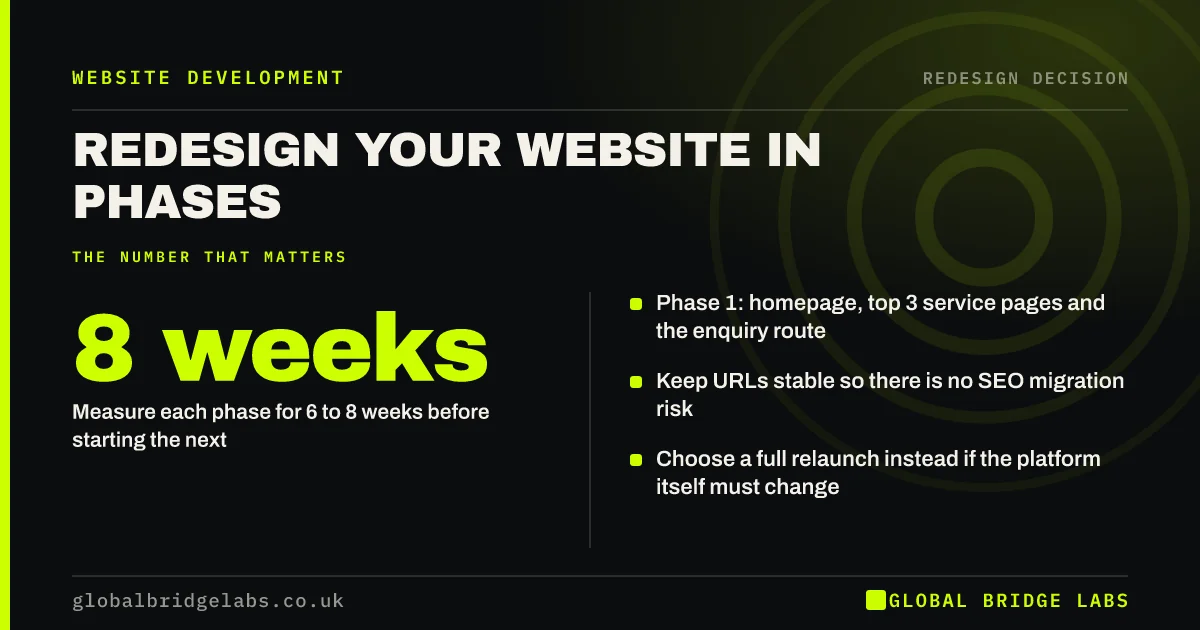
A phased website redesign changes the site in stages, starting with the pages that carry most traffic and enquiries, and measures each stage before the next. It lowers risk, spreads cost and produces evidence. It does not suit sites whose platform must be replaced, where a single migration is safer.
- Phase 1: homepage, top 3 service pages and the enquiry route.
- Measure each phase for 6 to 8 weeks before starting the next.
- Keep URLs stable so there is no SEO migration risk.
- Choose a full relaunch instead if the platform itself must change.
Want your redesign split into sensible phases? Message us on WhatsApp.
Chat on WhatsApp →What is a phased website redesign?
A phased website redesign is an approach where a site is improved in planned stages on its existing platform, each stage covering a defined group of pages or features, with results measured between stages instead of replacing the entire site in one launch.
It is sometimes called an iterative or incremental redesign. The principle is to change the parts that matter most first and let evidence decide the rest.
What should each phase include?
Order the phases by commercial impact. Most small business sites get most of their enquiries through a handful of pages, so the first phase should cover those.
- Phase 1: homepage message, top three service pages, contact form and tracking.
- Phase 2: proof, including case studies, testimonials and pricing guidance.
- Phase 3: navigation, remaining service pages and About page.
- Phase 4: visual refresh across the whole site for consistency.
How do you measure each phase?
Record the baseline before phase one, then compare qualified enquiries and enquiry rate for 6 to 8 weeks after each phase against the same weeks of the previous year where possible. That comparison controls for seasonality, which otherwise masks the effect of the change.
Want a measurement plan for each phase? We will set it up with you on WhatsApp.
Chat on WhatsApp →What does a phased redesign cost compared with a relaunch?
Total cost is often similar to a full redesign, in the typical UK range of £3,000 to £12,000, but it is spread across months and each phase can be stopped if the results do not justify the next. The first phase is commonly £1,500 to £4,000 for a small business site.
When is a full relaunch better?
When the platform must change. If the current system is unsupported, insecure, or cannot be edited, redesigning it in phases means investing in a foundation you are going to abandon. Migrate once, with a full URL map and redirects, and then improve in phases on the new platform.
A full relaunch also makes sense after a rebrand, when a site that is half old brand and half new would confuse visitors.
What are the drawbacks of phasing?
For a few months the site can look inconsistent, with new pages next to old ones. That is usually acceptable if phase one covers the pages most visitors see. The bigger risk is stalling: phase two never starts because phase one felt like enough. A dated plan with named owners prevents that.
How do you keep a phased site consistent?
Agree the visual rules at the start, even if they are applied gradually. A short style guide covering fonts, colours, buttons, spacing and photography lets each phase move the site towards the same end point, so new and old pages look related rather than like two different businesses.
Update shared elements first. The header, footer, navigation and buttons appear on every page, so refreshing them in phase one makes the whole site feel more current straight away, even before individual pages are rebuilt. The pages that still carry the old design then look dated in detail rather than in their overall frame.
- Write a one-page style guide before phase 1.
- Refresh header, footer and buttons first.
- Apply the style guide to every new page.
- Keep a list of old pages still to be updated.
What does this look like in practice?
A pattern in UK professional services: a firm with a sound WordPress site but vague service pages redesigns the homepage and top three services first, with fee guidance and case studies. Enquiries are measured for eight weeks, and the evidence decides whether phases two and three go ahead.
Because URLs stay the same, there is no migration risk, and the firm learns which changes moved enquiries before investing in the rest.
Phased redesign plan
Use these steps to set up the phases.
- Confirm the platform is supported; if not, migrate first.
- Record a 12-month baseline of enquiries and traffic.
- Rank pages by traffic and enquiries; put the top five in phase 1.
- Set a 6 to 8 week measurement window after each phase.
- Date every phase and name an owner.
- Review the results before approving the next phase.
Next step
If a full redesign feels too big a commitment, we will map a phased plan for your site in 30 minutes, with the first phase aimed at the pages that bring in most of your enquiries.
Message us on WhatsApp for a phased redesign plan, or book a 30-minute consultation.
Chat on WhatsApp →Sources and further reading
- Google Search Console · Google
- About key events · Google Analytics Help
- Site moves with URL changes · Google Search Central
Frequently asked questions
Can you redesign a website in stages?
Yes, if the platform is sound. Redesign the pages that carry most traffic and enquiries first, measure for six to eight weeks, then move to the next group. Keep URLs the same so there is no migration risk. If the platform must change, migrate once and then phase improvements.
Is a phased redesign cheaper than a full redesign?
The total is often similar, but the cost is spread out and each phase can be stopped if results do not justify the next. That usually means lower risk and sometimes lower total spend, because later phases are cut when earlier ones solve the problem.
Which pages should be redesigned first?
The pages that bring in most enquiries: usually the homepage, the top three service or product pages, and the contact route, plus tracking so the effect can be measured. Check your analytics for landing pages and the pages visited before an enquiry to confirm the order.
Does a phased redesign affect SEO?
Much less than a relaunch, provided URLs stay the same and content that ranks is improved rather than removed. Search engines see updated pages rather than a new site, so there is no migration period. Check Search Console after each phase for any drops.
Written by

Global Bridge Labs (GBL) is a UK–Sri Lanka partner for social media, websites and BPO. Everything here comes from client delivery, not theory.