On this page
- 01Key takeaways
- 02How do you calculate website redesign ROI?
- 03What does a worked example look like?
- 04Which assumptions are usually too optimistic?
- 05What numbers can you benchmark against?
- 06When is ROI the wrong way to decide?
- 07Should ROI include the cost of your own time?
- 08What does this look like in practice?
- 09ROI checklist
- 10Next step
- 11Sources and further reading
- 12Frequently asked questions
Key takeaways
Website redesign ROI is the extra gross profit the new site produces divided by what it cost. Estimate it before you spend, using your own visits, enquiry rate, close rate and margin. A realistic redesign for a UK SME should pay back within 6 to 18 months; if your numbers say longer, fix in place first.
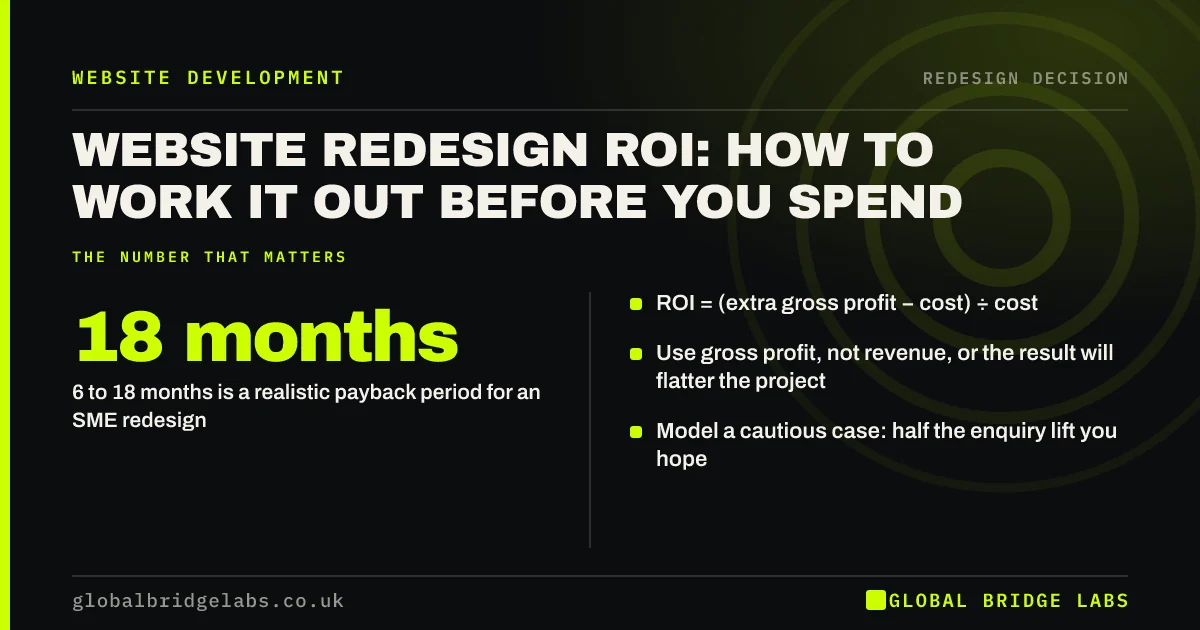
- ROI = (extra gross profit − cost) ÷ cost.
- 6 to 18 months is a realistic payback period for an SME redesign.
- Use gross profit, not revenue, or the result will flatter the project.
- Model a cautious case: half the enquiry lift you hope for.
Want your redesign ROI modelled with your numbers? Message us on WhatsApp.
Chat on WhatsApp →How do you calculate website redesign ROI?
Website redesign ROI is the additional gross profit a redesigned site generates over a period, minus the cost of the redesign, divided by that cost. Calculate it from five inputs you already know: monthly visits, current enquiry rate, expected enquiry rate, close rate and gross profit per job.
- Extra enquiries a month = visits × (new rate − current rate).
- Extra jobs a month = extra enquiries × close rate.
- Extra gross profit a month = extra jobs × gross profit per job.
- Payback in months = redesign cost ÷ extra gross profit a month.
What does a worked example look like?
Take a UK trades firm with 2,000 relevant visits a month, a 1% enquiry rate, a 30% close rate and £600 gross profit per job, considering an £8,000 redesign.
- Hoped-for enquiry rate of 2%: 20 extra enquiries, 6 extra jobs, £3,600 a month.
- Cautious case of 1.5%: 10 extra enquiries, 3 extra jobs, £1,800 a month.
- Payback: about 2 months on the hopeful case, about 4.5 months on the cautious case.
- First-year ROI on the cautious case: (£21,600 − £8,000) ÷ £8,000 = 170%.
Which assumptions are usually too optimistic?
The enquiry lift. Owners often assume a new site will double or triple enquiries, and agencies rarely argue. Model the lift you would accept as a disappointment, and check whether the project still pays back.
Traffic is the other common error. A redesign does not create traffic on its own, and a badly handled migration can reduce it for months. Assume flat traffic unless the project includes specific search work.
Not sure what enquiry lift is realistic for your sector? Ask us on WhatsApp.
Chat on WhatsApp →What numbers can you benchmark against?
Your own history is the best benchmark. Pull 12 months of enquiries and visits so seasonal swings do not distort the baseline. Across our client work we have seen a 2.4x website enquiry rate after a rebuild, but that came from content, proof and tracking changes, and a cautious model should assume far less.
Costs should use typical UK market ranges: £500 to £3,000 for optimisation, £3,000 to £12,000 for a redesign, £5,000 to £20,000 or more for a rebuild, plus ongoing maintenance of around £50 to £500 a month.
When is ROI the wrong way to decide?
When the redesign fixes a risk rather than chasing growth. Replacing an unsupported platform, securing a site after a breach, or regaining control from a supplier who holds your domain are defensive spends. Their return is the loss avoided, which is hard to model and easy to underrate.
Should ROI include the cost of your own time?
Yes. Owners typically spend 15 to 30 hours on a small business redesign, and that time has a cost even if no invoice is raised. Add it to the redesign cost at a realistic hourly value so the model reflects the full investment, not just the supplier's quote.
Include ongoing costs too: hosting, maintenance and any new subscriptions such as booking or chat tools. A redesign that adds £100 a month in tools needs to generate that much extra gross profit before it starts paying back. Leaving these out is the second most common reason ROI models look better than reality.
- Owner and team hours at a realistic hourly value.
- Supplier cost, including content and photography.
- 12 months of hosting, maintenance and new tools.
- Any temporary loss of enquiries during launch.
What does this look like in practice?
A pattern we see: an ROI model built on a hoped-for tripling of enquiries approves a £15,000 rebuild, and six months later nobody can say whether it paid back because no baseline was recorded.
The cautious model, run on 12 months of data, often shows that a £3,000 fix-in-place phase pays back faster, and gives real evidence for the size of the next phase.
ROI checklist
Work through these before any redesign quote is signed.
- Pull 12 months of visits and enquiries.
- Confirm your close rate and gross profit per job.
- Model a hopeful case and a cautious case at half the lift.
- Assume flat traffic unless search work is scoped and priced.
- Include 12 months of maintenance in the cost.
- Set the review date, usually 90 days after launch.
Next step
If you want to know whether a redesign would pay back, we will build the cautious model with your numbers in 30 minutes and tell you honestly if a smaller fix pays back faster.
Message us on WhatsApp for a redesign ROI model, or book a 30-minute consultation.
Chat on WhatsApp →Sources and further reading
- About key events · Google Analytics Help
- Google Search Console · Google
- Site moves with URL changes · Google Search Central
Frequently asked questions
Is a website redesign worth the money?
It is worth it when a cautious model, using your own visits, enquiry rate, close rate and gross profit, pays back within about 6 to 18 months. If it only pays back on optimistic assumptions, fix the biggest problems in place first and measure the result.
How do you measure the ROI of a website?
Track qualified enquiries and the jobs they become, then compare the additional gross profit with the cost of the site and its maintenance. Record a baseline before any change, and review 90 days after launch using the same definitions. Include maintenance costs in the calculation from the start.
How long does it take for a new website to pay for itself?
For a UK SME redesign with realistic assumptions, often 6 to 18 months. Sites with steady traffic and high job values pay back faster. Sites with little traffic may never pay back from conversion gains alone and need search or marketing work alongside.
Will a new website increase my sales?
Only if the current site is losing enquiries through unclear messaging, missing proof, poor mobile experience or broken forms. A redesign does not create demand or traffic on its own. If the offer or the audience is wrong, a new website will not fix it.
Written by

Global Bridge Labs (GBL) is a UK–Sri Lanka partner for social media, websites and BPO. Everything here comes from client delivery, not theory.