On this page
- 01Key takeaways
- 02What do visitors judge in the first few seconds?
- 03What must the first screen show?
- 04What builds credibility fastest?
- 05How do you test a first impression cheaply?
- 06Does speed affect the first impression?
- 07When does a poor first impression mean a redesign?
- 08Do first impressions differ on mobile?
- 09What does this look like in practice?
- 10First impression checklist
- 11Next step
- 12Sources and further reading
- 13Frequently asked questions
Key takeaways
Visitors decide in the first few seconds whether a site is relevant, credible and easy. The first screen must answer what you do, for whom, where, and what to do next. Test it with a five-second test on five people who match your buyers. If they cannot answer, fix the first screen before considering a redesign.
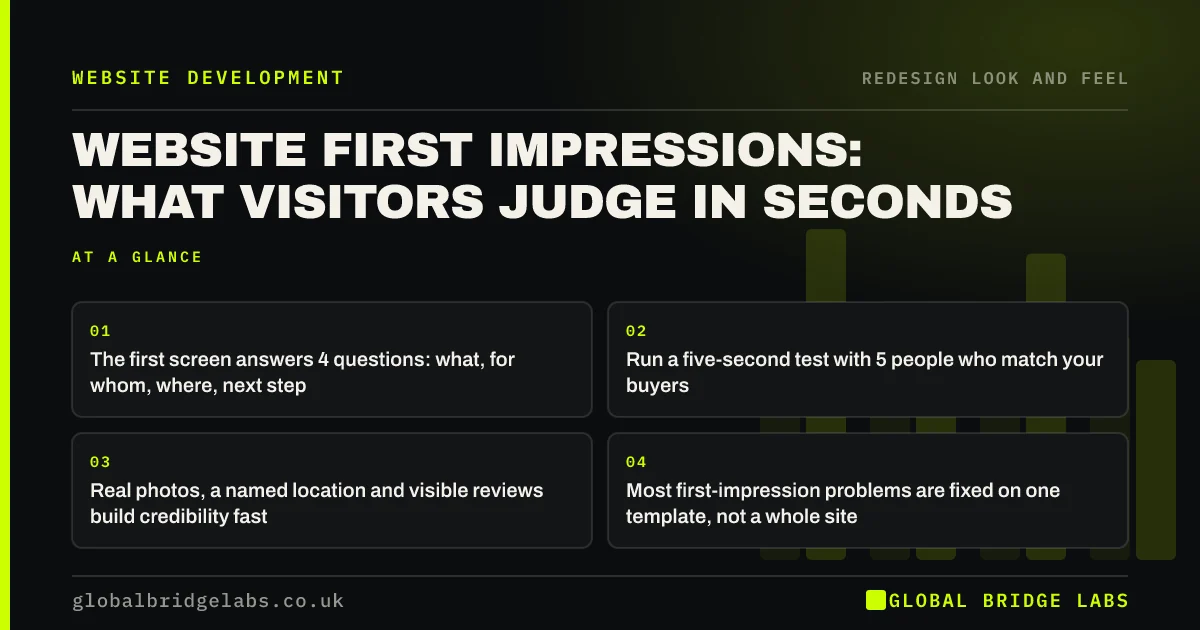
- The first screen answers 4 questions: what, for whom, where, next step.
- Run a five-second test with 5 people who match your buyers.
- Real photos, a named location and visible reviews build credibility fast.
- Most first-impression problems are fixed on one template, not a whole site.
Want a five-second test run on your homepage? Message us on WhatsApp.
Chat on WhatsApp →What do visitors judge in the first few seconds?
In the first few seconds on a website, visitors judge relevance (is this what I need?), credibility (is this a real, capable business?) and effort (will it be easy to get what I want?). They form that view from the headline, imagery, layout and the visibility of a next step, before reading any detail.
What must the first screen show?
On both mobile and desktop, the first screen should answer four questions without scrolling.
- What you do, in plain words, not a slogan.
- Who it is for, by type of customer or job.
- Where you work, if location matters to buyers.
- What to do next: a single clear call to action.
What builds credibility fastest?
Specific, verifiable signals. A star rating with the number of reviews, logos of recognisable clients where you are allowed to show them, real photographs of your team or work, and accreditations buyers recognise. Vague claims such as 'quality service' add nothing.
Want to know which trust signals your first screen is missing? Ask us on WhatsApp.
Chat on WhatsApp →How do you test a first impression cheaply?
Show the page for five seconds to five people who match your buyers, then ask what the business does, who it is for and what they would click. The GOV.UK Service Manual's user research guidance supports small, frequent tests like this. If fewer than four of five answer correctly, the first screen needs work.
Does speed affect the first impression?
Yes. A page that shows a blank screen or shifts as it loads creates a poor impression before any content appears. Google's Core Web Vitals set a good Largest Contentful Paint at 2.5 seconds or less and a Cumulative Layout Shift below 0.1.
When does a poor first impression mean a redesign?
When the problem is built into the templates: a design that always pushes content below a large image, a theme that cannot show a clear headline and button on mobile, or a visual style that signals the wrong price level for your market. Otherwise, rewriting and reorganising the first screen is enough.
Do first impressions differ on mobile?
Yes. On a phone the first screen is much smaller, so a large image or a long headline can push everything useful out of view. What looks balanced on a desktop monitor can show only a logo and a picture on a phone, with the message and the call to action below the fold.
Design and review the mobile first screen separately. Check that the headline, a trust signal and a call to action all appear without scrolling on a typical phone, and that nothing covers them: cookie banners, chat bubbles and pop-ups are the usual culprits.
- Review the first screen on a real phone.
- Keep the headline short enough to fit.
- Keep a call to action visible without scrolling.
- Make sure banners and chat bubbles do not cover it.
What does this look like in practice?
A pattern in UK professional services: a homepage opens with a full-screen stock photo of a city skyline and the line 'Excellence in everything we do'. In a five-second test, nobody can say what the firm does. Replacing it with a plain headline naming the services and clients, and a photo of the partners, changes that immediately.
First impression checklist
Check your homepage and top landing page on a phone.
- Headline says what you do in plain words.
- Audience and location are named.
- One clear call to action is visible without scrolling.
- A specific trust signal is visible, such as reviews.
- Main content appears within about 2.5 seconds.
- Five-second test: at least 4 of 5 people understand it.
Next step
If you want to know what visitors take from your first screen, we will run a five-second test with you and review the results in 30 minutes.
Message us on WhatsApp for a first impression test, or book a 30-minute consultation.
Chat on WhatsApp →Sources and further reading
- User research · GOV.UK Service Manual
- Understanding Core Web Vitals and Google search results · Google Search Central
- Writing to GOV.UK standards: writing guidelines · GOV.UK
Frequently asked questions
How long do you have to make a first impression on a website?
Only a few seconds. Visitors quickly decide whether a site is relevant, credible and easy to use, based on the headline, images, layout and visible next step. Make sure the first screen answers what you do, for whom, where and what to do next.
What is a five-second test?
A five-second test shows a page to someone for five seconds, then asks what they remember: what the business does, who it is for and what they would click. It is a quick, cheap way to check whether a first screen communicates clearly.
What should be above the fold on a business website?
A plain headline saying what you do, who it is for and, where relevant, where you work; one clear call to action; and a specific trust signal such as a review rating. On mobile, check that these appear before the visitor has to scroll.
Do website visitors judge a business by its website?
Yes. Buyers use the website to judge whether a business is real, capable and at the right price level before contacting it. A clear, fast and current site supports that judgement; a vague or neglected one undermines it. Test the first screen with real buyers to be sure.
Written by

Global Bridge Labs (GBL) is a UK–Sri Lanka partner for social media, websites and BPO. Everything here comes from client delivery, not theory.