On this page
- 01Short answer
- 02What is user testing?
- 03Why is user testing worth doing for a small site?
- 04How do you run a user test?
- 05Which tasks should you test?
- 06What other evidence complements user testing?
- 07When is user testing misleading?
- 08What does this look like in practice?
- 09User testing checklist
- 10Next step
- 11Sources and further reading
- 12Frequently asked questions
Short answer
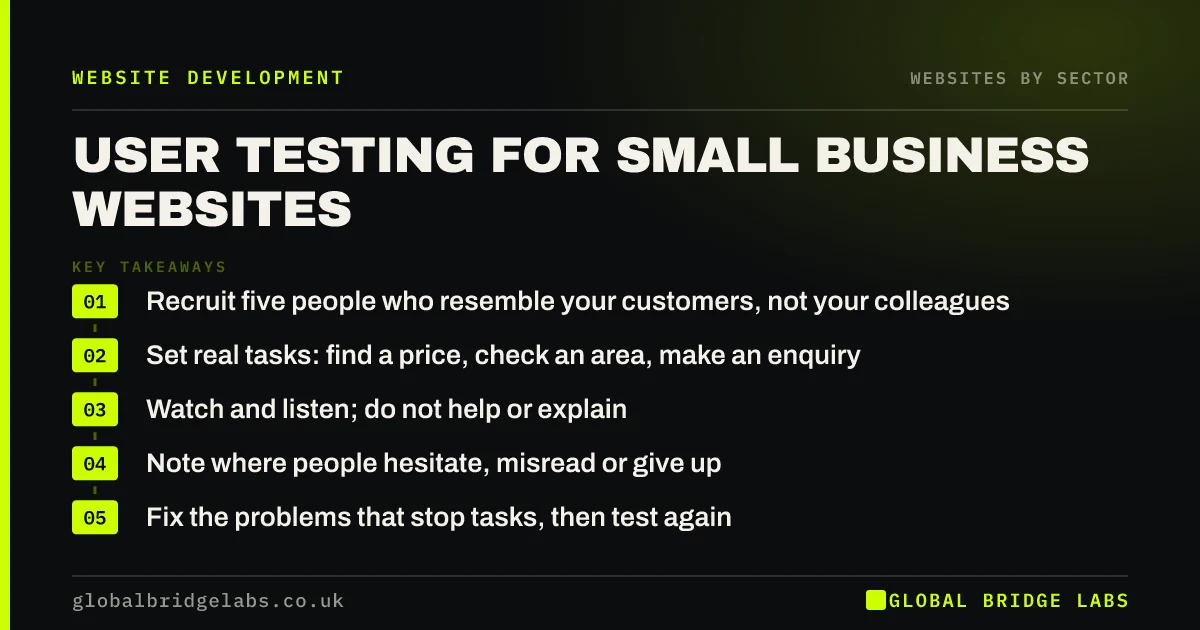
User testing for a small business website means watching real people try to complete real tasks on your site, such as finding a price or making an enquiry, and noting where they struggle. A handful of sessions with people who match your customers usually surfaces the most serious problems, costs little, and needs no special tools.
- Recruit five people who resemble your customers, not your colleagues.
- Set real tasks: find a price, check an area, make an enquiry.
- Watch and listen; do not help or explain.
- Note where people hesitate, misread or give up.
- Fix the problems that stop tasks, then test again.
Want a user test plan for your site? Message us on WhatsApp and we will draft the tasks with you.
Chat on WhatsApp →What is user testing?
User testing, also called usability testing, is a research method in which people representative of a website's audience attempt specific tasks while an observer watches, to identify where the design, content or functionality causes confusion or failure.
It shows what people do, not what they say they would do. The GOV.UK Service Manual treats user research as essential for exactly this reason: assumptions about users are often wrong.
Why is user testing worth doing for a small site?
Small sites rarely have enough traffic for statistically reliable A/B testing, but user testing needs no traffic at all. Watching a few people struggle to find your prices or complete your form produces clear, actionable findings in an afternoon.
It also settles internal debates. Instead of arguing about the homepage, you can watch five people use it and see what actually happens.
The findings are usually humbling and specific: a menu label nobody understands, a price hidden in a PDF, a form field people read the wrong way. None of these show up in analytics as clearly as they do when you watch someone hesitate, scroll back up and say they are not sure where to click.
How do you run a user test?
The process is simple and can be done in person or on a video call with screen sharing.
- 1. Recruit five people who resemble your buyers, offering a small thank-you.
- 2. Write three to five realistic tasks, such as find out what a boiler service costs.
- 3. Ask each person to think aloud as they use the site on their own phone.
- 4. Do not help, hint or explain. Note where they hesitate or go wrong.
- 5. Ask a few questions at the end: what was confusing, what was missing?
- 6. List problems by how many people hit them and how badly.
Want help recruiting testers and writing tasks? Message us on WhatsApp.
Chat on WhatsApp →Which tasks should you test?
Test the tasks that lead to money. For most small businesses these are finding the right service, understanding the price, checking you cover their area or need, trusting you enough to enquire, and completing the enquiry.
A five-second test on the homepage is a useful extra: show the first screen for five seconds and ask what the business does, who it is for and what to do next.
What other evidence complements user testing?
Combine testing with the data you already have. Search Console shows what people search before arriving. GA4 shows where visitors leave. Session recording tools, used with consent, show real behaviour at scale. And the questions customers ask on calls reveal what the site fails to answer.
Each source has limits. Together they show both what is happening and why.
When is user testing misleading?
Testing misleads when testers do not resemble your customers, when tasks are unrealistic, or when the observer leads the tester. Friends and colleagues know too much. People with no interest in your service behave differently from real buyers.
The trade-off is rigour against speed. Imperfect testing with real-ish users still beats no testing. Just treat single opinions cautiously and act on patterns.
What does this look like in practice?
A pattern we see in first user tests: the owner expects feedback on design, but three of five testers cannot find prices, and two try to tap the phone number, which is an image.
Those two fixes take an hour. Nobody inside the business had noticed, because everyone inside the business already knows where everything is.
User testing checklist
Use this for each round of testing.
- Recruit five people like your buyers.
- Write three to five real tasks.
- Test on the testers' own phones.
- Ask them to think aloud.
- Do not help or explain.
- Record where they struggle.
- Rank problems by frequency and severity.
- Fix, then test again.
Next step
If you have never watched a customer use your website, it is the fastest way to find what is costing enquiries. We will plan a test with you in 30 minutes.
Message us on WhatsApp for a user testing plan, or book a 30-minute consultation.
Chat on WhatsApp →Sources and further reading
- User research · GOV.UK Service Manual
- Google Search Console · Google
- About key events · Google Analytics Help
Frequently asked questions
How many users do I need for website user testing?
Around five people who resemble your customers usually reveal the most serious usability problems for a small business site. Run a round, fix what you find, then test again with a new group. Several small rounds are more useful than one large test.
How much does user testing cost?
It can cost very little. Recruit five people who match your customers, offer a small thank-you such as a voucher, and run sessions in person or over a video call. Paid testing platforms and agencies cost more but save time on recruitment and analysis.
What is the difference between user testing and A/B testing?
User testing watches a few people complete tasks to find out why they struggle. A/B testing compares two versions with large numbers of visitors to measure which performs better. User testing suits small sites and early decisions; A/B testing needs substantial traffic.
Can I user test my own website?
Yes. The main skill is staying quiet: give people tasks, watch, and resist explaining. Test with people who resemble your buyers rather than friends or colleagues, use their own phones, and focus on the tasks that lead to enquiries or sales.
Written by

Global Bridge Labs (GBL) is a UK–Sri Lanka partner for social media, websites and BPO. Everything here comes from client delivery, not theory.