On this page
- 01Key takeaways
- 02How does your website affect what buyers will pay?
- 03Which signals justify higher prices?
- 04Should premium businesses show prices?
- 05When does raising prices mean a redesign?
- 06What should you remove?
- 07How do you know it is working?
- 08How do you describe your process to justify price?
- 09What does this look like in practice?
- 10Premium pricing checklist
- 11Next step
- 12Sources and further reading
- 13Frequently asked questions
Key takeaways
Buyers set their price expectations from your website before they speak to you. To justify higher prices, show specific proof, detailed process, credentials and real photography, and give pricing guidance that anchors at your level. If the design itself signals a budget provider, a redesign becomes part of the price rise.
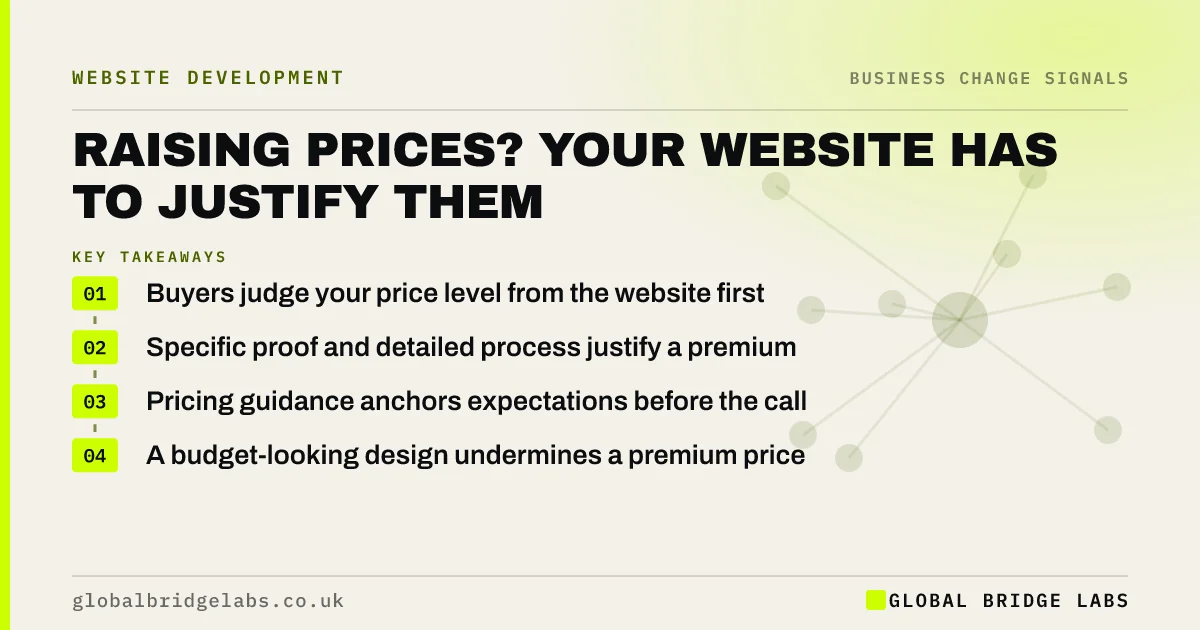
- Buyers judge your price level from the website first.
- Specific proof and detailed process justify a premium.
- Pricing guidance anchors expectations before the call.
- A budget-looking design undermines a premium price.
Raising prices? We will tell you on WhatsApp whether your site supports them.
Chat on WhatsApp →How does your website affect what buyers will pay?
A website sets price expectations before the first conversation. Buyers read its quality, detail and proof as signals of what you charge and whether you are worth it. A site that looks rushed or generic primes buyers to expect low prices, so higher quotes meet more resistance.
Which signals justify higher prices?
Specific evidence of quality, not claims of it.
- Case studies with the problem, approach and result.
- A detailed description of your process and what is included.
- Credentials, accreditations and insurance buyers recognise.
- Real, high-quality photography of your work and team.
- Reviews that mention quality, care and outcomes.
Want to know which premium signals your site lacks? Ask us on WhatsApp.
Chat on WhatsApp →Should premium businesses show prices?
Usually some guidance helps. 'Projects typically from £X' or a range anchors expectations at your level and filters out buyers who would never pay it. Without guidance, buyers assume market averages and are surprised by your quote.
When does raising prices mean a redesign?
When the design itself signals a budget provider: template layouts shared with many competitors, stock images, cramped mobile pages, and a structure built around discounts and offers. Adding case studies to that site helps, but the overall impression still contradicts the price.
What should you remove?
Anything that competes on price: permanent discount banners, 'cheapest in town' claims, and pages for low-value services you no longer want. Keep offers for specific campaigns, not as a permanent feature of the site.
How do you know it is working?
Track the share of enquiries that accept your quote and how often buyers object to price. After changes, fewer but better-fitting enquiries and fewer price objections mean the site is setting expectations correctly.
How do you describe your process to justify price?
Show the work buyers do not see. A premium price is easier to accept when buyers understand the steps involved, such as surveys, planning, specialist checks, quality control and aftercare, and how each one protects them from the problems cheaper providers leave behind.
Set it out as a short numbered process with what happens at each step, how long it takes and what the buyer receives. Add a line on what is not included by cheaper providers, stated factually rather than as criticism. Buyers comparing quotes then have a reason for the difference.
- List the steps from first call to aftercare.
- Say what the buyer receives at each step.
- State timescales honestly.
- Explain what the process protects them from.
What does this look like in practice?
A pattern in UK professional services: a firm raises fees but its website still leads with 'affordable' and a discount for new clients. Removing price-led language, adding fee guidance, detailed process and three case studies with outcomes reduces price objections on calls.
Premium pricing checklist
Review your site before a price rise.
- Remove permanent discounts and 'cheap' language.
- Add pricing guidance at your level.
- Add 3 detailed case studies with results.
- Describe your process and what is included.
- Replace stock images with real photography.
- Track price objections and quote acceptance.
Next step
If you are raising prices, we will review your site in 30 minutes and tell you whether it supports the new level or undermines it.
Message us on WhatsApp for a pricing perception review, or book a 30-minute consultation.
Chat on WhatsApp →Sources and further reading
- Unfair commercial practices guidance (CMA207) · Competition and Markets Authority
- Creating helpful, reliable, people-first content · Google Search Central
- Writing to GOV.UK standards: writing guidelines · GOV.UK
Frequently asked questions
Can a website help me charge higher prices?
Yes. Buyers form price expectations from your website. Specific case studies, a detailed process, recognised credentials, real photography and pricing guidance at your level make higher prices easier to accept and reduce objections on calls. Remove discount-led language at the same time.
Should a premium business show prices on its website?
Usually some guidance helps, such as 'projects typically from £X' or a range. It anchors expectations at your level and filters out buyers who would never pay it, so fewer quotes are wasted. Review the guidance whenever your prices change.
What makes a website look premium?
Clarity, space, real high-quality photography, detailed proof of results, a clear process, recognised credentials and fast, polished performance on mobile. Premium is shown through specific evidence rather than claims of quality or decorative effects. Show the thinking behind the work, not only the result.
Do I need a new website to move upmarket?
Not always. Adding proof, process, pricing guidance and real photography may be enough. You need a redesign when the design itself signals a budget provider through templates, stock images and price-led structure. Test how buyers react before investing in a full redesign.
Written by

Global Bridge Labs (GBL) is a UK–Sri Lanka partner for social media, websites and BPO. Everything here comes from client delivery, not theory.