On this page
- 01Key takeaways
- 02What is the difference between boutique and large BPO providers?
- 03How do they compare?
- 04Why do many SMEs prefer boutique providers?
- 05When is a large provider the better choice?
- 06Does size affect cost?
- 07What should you check whatever the size?
- 08What are the risks on each side?
- 09What does this look like in practice?
- 10Checklist: choose provider size
- 11Next step
- 12Sources and further reading
- 13Frequently asked questions
Key takeaways
Boutique vs large BPO provider is a trade-off between attention and scale. Boutique providers usually give SMEs senior attention, flexibility and small minimums. Large providers offer scale, certifications and multi-site resilience, but often have minimum seat numbers and processes built for bigger clients.
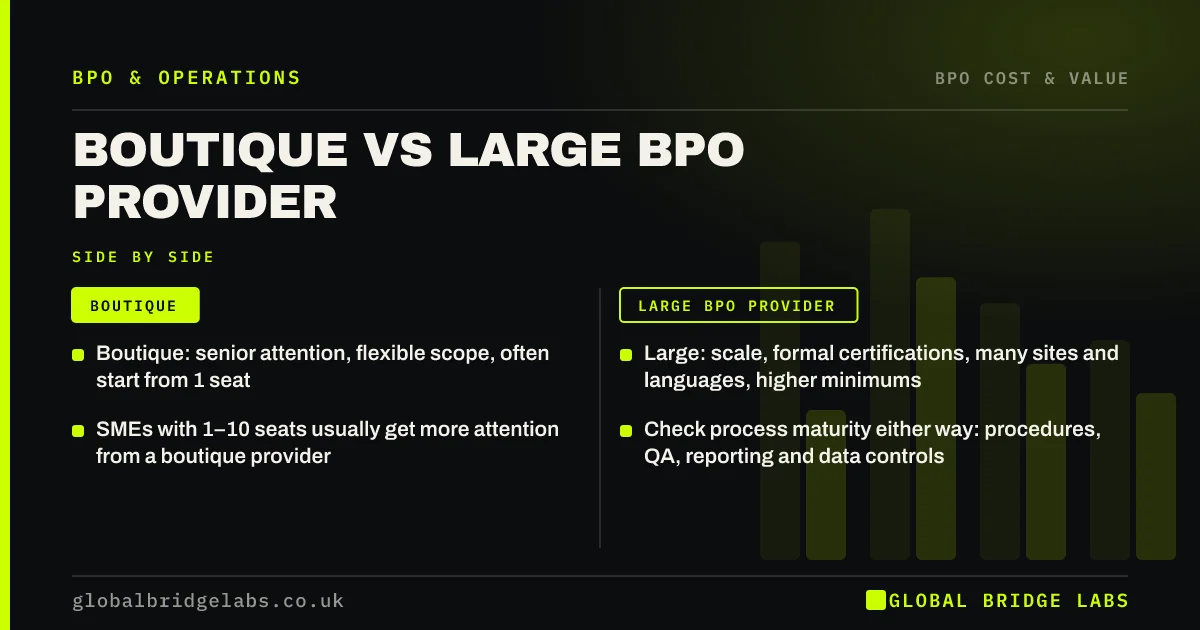
- Boutique: senior attention, flexible scope, often start from 1 seat.
- Large: scale, formal certifications, many sites and languages, higher minimums.
- SMEs with 1–10 seats usually get more attention from a boutique provider.
- Check process maturity either way: procedures, QA, reporting and data controls.
- Check continuity: a boutique must still cover absence and leavers without gaps.
Wondering which size of provider fits your needs? Message us on WhatsApp with how many seats you expect.
Chat on WhatsApp →What is the difference between boutique and large BPO providers?
A boutique BPO provider is a smaller business process outsourcing firm, typically running tens to a few hundred staff, serving a focused set of clients or sectors. A large BPO provider runs thousands of staff across multiple sites and countries, serving enterprise clients alongside smaller ones.
Neither is better in general. The right choice depends on how many seats you need, how much attention you want, and how much scale, formal certification and geographic resilience your work requires.
How do they compare?
The comparison below is typical rather than universal. Individual providers vary.
- Minimum size: boutique often from 1 seat; large often 5–10 seats or more.
- Attention: boutique gives direct access to senior people; large gives an account manager.
- Flexibility: boutique adapts scope and process quickly; large has standard processes.
- Scale: large ramps hundreds of seats and many languages; boutique grows more gradually.
- Certifications: large providers more often hold formal certifications such as ISO 27001.
- Resilience: large has multiple sites; boutique relies on a continuity plan and remote work.
Why do many SMEs prefer boutique providers?
Many SMEs prefer boutique providers because a small account matters to them. A client with three seats can be a meaningful account for a boutique firm and a rounding error for a large one. That usually shows in response times, flexibility and who turns up to the monthly review.
Boutique providers are also more likely to accept a single seat, a mixed front-office and back-office role, and short rolling terms, which suits SMEs testing outsourcing for the first time.
When is a large provider the better choice?
A large provider is the better choice when you need dozens or hundreds of seats quickly, many languages, 24/7 cover across time zones, formal certifications required by your own clients, or multi-site resilience written into the contract. Enterprise procurement teams often require these as standard.
Does size affect cost?
Size affects cost less than location and skill do. As indicative market ranges, managed offshore BPO costs around £9–£18 per hour and onshore UK around £20–£35 for both boutique and large providers. Large providers may offer lower rates at high volume; boutique providers may be cheaper at small volume because they have fewer layers of management and lower minimums.
Compare the total first-year cost including minimum seats, minimum terms and setup, not only the rate.
Want a costed plan at SME scale to compare with other quotes? Send us your scope on WhatsApp and we will discuss your requirements.
Chat on WhatsApp →What should you check whatever the size?
Check process maturity, not size. Ask to see a written procedure, a quality-assurance scorecard and a monthly report. Check how absence and leavers are covered, how data is protected under UK GDPR, and whether the notice period is reasonable.
A boutique provider must prove it can cover a sick team member without a gap. A large provider must prove your small account will get the attention it needs.
What are the risks on each side?
The main risk with a boutique provider is concentration: fewer people, fewer sites and more reliance on a few managers. The main risk with a large provider is dilution: your account handed to junior staff, standard processes that do not fit your business, and slow changes. Both are manageable with the right questions and a good contract.
What does this look like in practice?
Global Bridge Labs (GBL) is deliberately a focused UK–Sri Lanka partner rather than a mass-market call centre. A single support or admin seat can start within two weeks, larger teams are phased so training and quality checks keep up, and the process is written down so quality does not depend on one person.
Checklist: choose provider size
Answer these first.
- How many seats will you need in year one and year three?
- Do you need many languages or 24/7 cover?
- Do your clients require formal certifications?
- How much senior attention do you want?
- What minimum seats and terms can you accept?
- How will absence and leavers be covered?
Next step
Tell us your expected seats and requirements, and we will tell you honestly whether a focused provider like us or a larger one is the better fit. 30 minutes, no pitch.
Message us on WhatsApp to talk it through, or book a 30-minute consultation.
Chat on WhatsApp →Sources and further reading
- Cyber Essentials overview · National Cyber Security Centre
- Contracts and liabilities between controllers and processors · Information Commissioner's Office
- The Sourcing and Consultancy Playbooks · Cabinet Office
Frequently asked questions
Are small BPO companies reliable?
Many are, but check rather than assume. Ask how they cover absence and leavers, how they handle power and connectivity outages, what their quality process is, and whether they sign a processor contract. Reliability comes from process and continuity planning, not headcount.
Do large outsourcing companies work with SMEs?
Some do, but many set minimum seat numbers or contract values that exclude smaller businesses, and SME accounts may get less senior attention. If you choose a large provider, ask who will manage your account day to day and how quickly changes are made.
What is a minimum seat requirement?
A minimum seat requirement is the smallest number of full-time-equivalent team members a provider will contract. Large providers often require five to ten or more; many boutique providers start from one. Minimums affect whether an SME can test outsourcing on a single process.
Is ISO 27001 required for a BPO provider?
It is not a legal requirement, but some clients require it contractually. ISO/IEC 27001 is an information security management standard. Providers without it should still demonstrate equivalent controls: access management, logging, encryption, staff training and incident response. Cyber Essentials is a useful UK baseline.
Written by

Global Bridge Labs (GBL) is a UK–Sri Lanka partner for social media, websites and BPO. Everything here comes from client delivery, not theory.