On this page
- 01Key takeaways
- 02What does a trades customer journey look like?
- 03What do homeowners check before calling a tradesperson?
- 04How should an urgent-job page be designed?
- 05How should a planned-job page be designed?
- 06What happens after the enquiry in trades?
- 07When does the trades journey need less website?
- 08What does this look like in practice?
- 09Trades journey checklist
- 10Next step
- 11Sources and further reading
- 12Frequently asked questions
Key takeaways
Tradespeople usually serve two customer journeys: urgent jobs decided in minutes and planned jobs decided over weeks. Urgent buyers need a phone number, area, availability and reviews on the first screen. Planned buyers need photos of local work, price guidance, a clear process and a simple quote request. Give each journey its own pages rather than one page that serves neither.
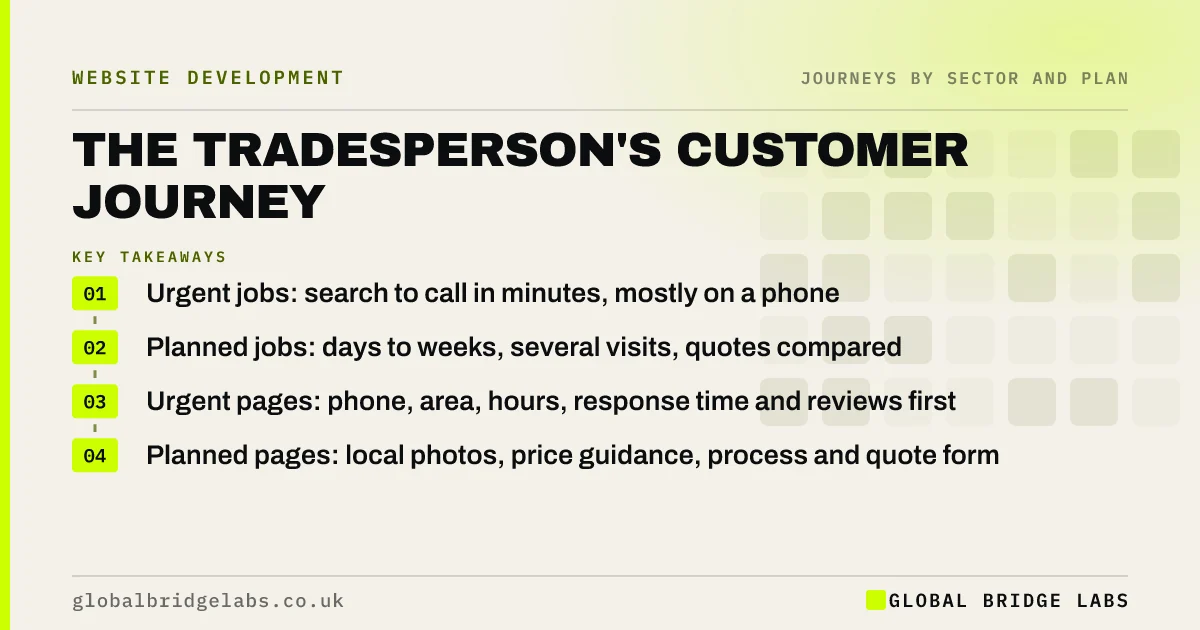
- Urgent jobs: search to call in minutes, mostly on a phone.
- Planned jobs: days to weeks, several visits, quotes compared.
- Urgent pages: phone, area, hours, response time and reviews first.
- Planned pages: local photos, price guidance, process and quote form.
Want your trades website checked for both journeys? Message us on WhatsApp.
Chat on WhatsApp →What does a trades customer journey look like?
A trades customer journey starts with a problem or a project. For an urgent job, such as a leak, the homeowner searches on a phone, checks two or three results for reviews and availability, and calls whoever answers. For a planned job, such as a new bathroom, they browse photos, ask neighbours, read reviews, look for rough prices, request several quotes and choose over weeks.
What do homeowners check before calling a tradesperson?
Homeowners usually check five things before calling: that you do the job, that you cover their area, that you are available soon enough, that other people trust you, and roughly what it will cost. Membership of a recognised trade body or scheme, insurance and guarantees add reassurance. If any of these are missing, they ring the next firm.
- The specific job named in plain words.
- Towns and postcodes covered.
- Availability or typical response time.
- Recent reviews and photos of local work.
- Price guidance or a call-out fee.
- Accreditations, insurance and guarantees.
How should an urgent-job page be designed?
An urgent-job page should put the call first. Show a tappable phone number, the areas covered, hours and typical response time in the first screen on a phone, with a short line of reviews. Keep the page short. A WhatsApp option helps buyers who want to send a photo. Forms are secondary for emergencies.
How should a planned-job page be designed?
A planned-job page should support comparison over several visits. Show photos of similar local jobs, a price guide by job size, a step-by-step process from survey to completion, typical timescales, guarantees and a simple quote request that asks only what you need. Buyers will return to it, so keep the key facts easy to find again.
Want a price guide and process section written for your main job? Message us on WhatsApp.
Chat on WhatsApp →What happens after the enquiry in trades?
After the enquiry, speed and clarity decide many jobs. Buyers often contact several firms, and the first clear reply with a survey date tends to win. Confirm receipt immediately, say when you will call, and follow up quotes within a few days. A missed call with no callback is one of the most common lost jobs in trades.
When does the trades journey need less website?
Some trades win most work through referrals, contractors or letting agents, and the website mainly confirms the recommendation. In that case, focus on a clear homepage, reviews, photos and contact, and invest less in long guides. Ask your recent customers how they found you before deciding.
What does this look like in practice?
A pattern we see on trades sites: one long 'Services' page lists every job, from emergency repairs to full renovations, with a single contact form at the bottom. Emergency callers scroll past paragraphs to find a number, and renovation buyers find no photos or prices.
Splitting it into an emergency page built for the call and project pages built for comparison serves both journeys. Across our client work we have seen a 2.4x enquiry rate from conversion changes of this kind. Global Bridge Labs (GBL) designs trades sites around the two journeys.
Trades journey checklist
- Separate pages for urgent and planned work.
- Phone, area, hours and reviews in the first screen.
- Local job photos on every planned-work page.
- Price guidance and a step-by-step process.
- A short quote form and a WhatsApp option.
- Same-day callback rule for every enquiry.
Next step
Trades websites win or lose jobs in the first screen and the first reply. We will check yours against both journeys and show what to fix first.
Message us on WhatsApp for a trades customer journey review, or book a 30-minute consultation.
Chat on WhatsApp →Sources and further reading
- Google Business Profile Help · Google
- Publishing consumer reviews and complying with consumer protection law · Competition and Markets Authority
- How long do users stay on web pages? · Nielsen Norman Group
Frequently asked questions
How do customers choose a tradesperson online?
For urgent jobs, they search on a phone, check reviews and availability on two or three results and call the first that looks trustworthy and answers. For planned jobs, they browse photos, read reviews, look for rough prices, request several quotes and decide over days or weeks.
What should a tradesperson's website include?
The jobs you do in plain words, areas covered, availability, reviews, photos of local work, price guidance, accreditations and guarantees, and easy contact: a tappable phone number, a short quote form and WhatsApp. Separate urgent and planned work onto their own pages.
Should a trades website show prices?
Price guidance usually helps planned work, as ranges by job size or a call-out fee, with an explanation of what changes the cost. Exact prices are rarely possible without a survey. Guidance helps buyers judge whether you are in range before they call.
Written by

Global Bridge Labs (GBL) is a UK–Sri Lanka partner for social media, websites and BPO. Everything here comes from client delivery, not theory.