On this page
- 01Key takeaways
- 02What makes a trades website different?
- 03Why do many trades websites underperform?
- 04What should a trades website include?
- 05How do trades websites win local search?
- 06Should trades show prices online?
- 07When is a website not the main channel for trades?
- 08What does this look like in practice?
- 09Trades website checklist
- 10Next step
- 11Sources and further reading
- 12Frequently asked questions
Key takeaways
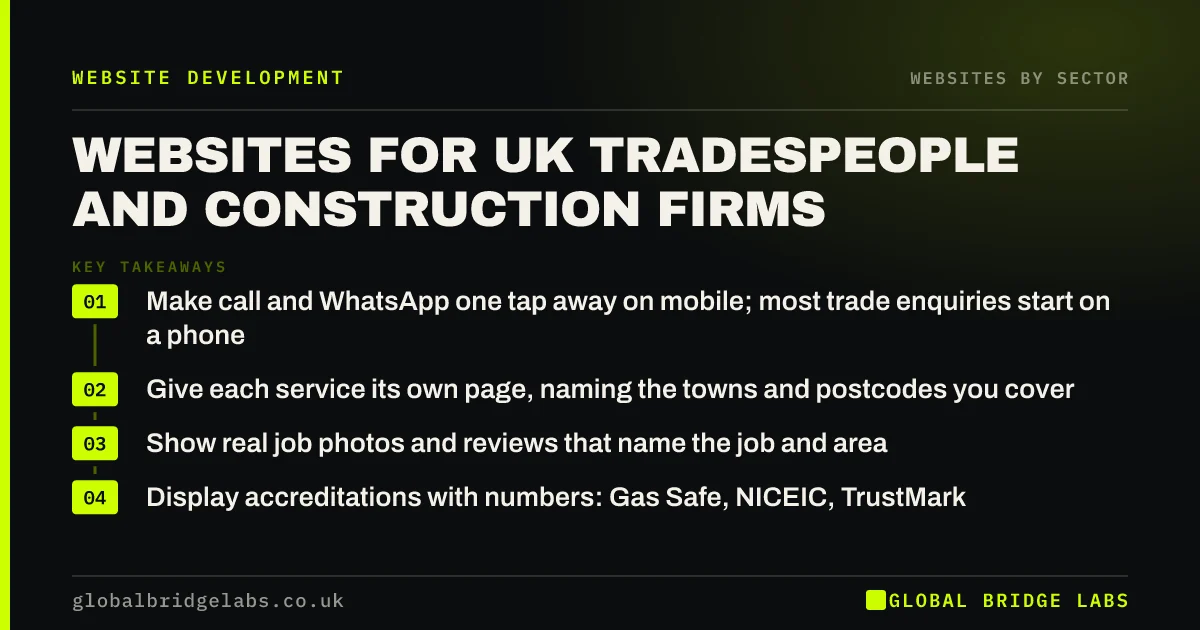
A website for UK tradespeople and construction firms has one job: turn local searches into calls, messages and quote requests. That needs a page per service naming the areas you cover, real photographs of finished jobs, visible accreditations, price guidance, and one-tap call and WhatsApp on mobile, where most trade enquiries start.
- Make call and WhatsApp one tap away on mobile; most trade enquiries start on a phone.
- Give each service its own page, naming the towns and postcodes you cover.
- Show real job photos and reviews that name the job and area.
- Display accreditations with numbers: Gas Safe, NICEIC, TrustMark, trade bodies.
- Give price ranges or typical job costs to filter out poor-fit enquiries.
Want your trade website checked against these five? Send us the URL on WhatsApp.
Chat on WhatsApp →What makes a trades website different?
A trades website is a website for a business that provides skilled building, installation, repair or maintenance services, such as plumbing, electrical work, roofing or construction, usually within a defined local area.
The buyer is different from most sectors. Many are dealing with an urgent problem, searching on a phone, comparing two or three local firms, and deciding within minutes whether to call. Others are planning a larger project and want evidence of quality before inviting a quote. The site has to serve both quickly.
Why do many trades websites underperform?
Many trades websites were built once and left, with a generic headline, a single services page, stock images and a phone number that cannot be tapped. Meanwhile competitors with strong Google Business Profiles and clearer sites take the calls.
The fixes are rarely about design. They are about clarity, proof and making contact effortless for someone on a phone.
- No individual service pages, so the site ranks for nothing specific.
- Stock images instead of real jobs.
- Accreditations missing or buried in the footer.
- No price guidance, so time is spent on unaffordable quote requests.
- Contact only through a long form.
What should a trades website include?
Build the site around these elements, in roughly this order of importance.
- Header with tap-to-call, WhatsApp and a Get a quote button.
- Headline naming the trade, area and a response promise.
- One page per service with process, price guidance and photographs.
- Area pages only where you have real local jobs to show.
- Gallery or project pages with before and after photographs.
- Reviews with names, towns and job types.
- Accreditations, insurance and guarantees with registration numbers.
- A short quote form that accepts photographs.
How do trades websites win local search?
Local search is where most trade work is found. Google ranks local results on relevance, distance and prominence. The website supports relevance through clear service pages naming your areas, and prominence through reviews, local links and consistent business details that match your Google Business Profile.
Keep your name, address and phone identical everywhere, add LocalBusiness structured data using the most specific type, such as Plumber or Electrician, and post finished jobs to your Business Profile regularly.
Want to know why a competitor appears above you in local search? Message us on WhatsApp with both names.
Chat on WhatsApp →Should trades show prices online?
Yes, as ranges or typical job costs. Price is one of the first questions homeowners ask, and a range such as most combi boiler replacements cost £2,200 to £3,500 fitted helps them self-qualify before calling. Include VAT for domestic customers and list what changes the price.
For larger construction projects, publish typical ranges per square metre or per project type, and explain what drives cost. It reduces time spent quoting jobs that were never affordable.
When is a website not the main channel for trades?
Firms that win most work through main contractors, frameworks or long-standing commercial clients may get few enquiries through the website. For them the site is a credibility check: capability statements, accreditations, health and safety credentials and project case studies matter more than quote forms.
The trade-off is focus. Build the site for the buyer who actually hires you, whether that is a homeowner on a phone or a procurement manager checking your credentials.
What does this look like in practice?
A pattern in UK trades: a firm with strong Google reviews and a website that lists eight services on one page, uses stock photographs, and shows the phone number as an image.
Building pages for the three most profitable services, adding real job photographs and reviews, making the number tappable and adding WhatsApp gives the site the same credibility the reviews already have. Across our client work, we have seen a 2.4x enquiry rate after a website rebuild, and trades sites are where clarity and tap-to-contact changes are most visible.
Trades website checklist
Check these on a phone.
- Make tap-to-call and WhatsApp visible at the top.
- Name the trade, area and response time in the headline.
- Build one page per core service.
- Show real job photographs.
- Display accreditations with numbers.
- Publish price ranges including VAT.
- Accept photographs in the quote form.
- Match details to your Google Business Profile.
Next step
If your reviews are better than your website, we will show you how to close the gap in 30 minutes, with the three changes most likely to bring more calls.
Message us on WhatsApp for a trades website review, or book a 30-minute consultation.
Chat on WhatsApp →Sources and further reading
- Tips to improve your local ranking on Google · Google Business Profile Help
- LocalBusiness type · Schema.org
- Publishing consumer reviews and complying with consumer protection law · Competition and Markets Authority
Frequently asked questions
What should a tradesperson's website include?
Tap-to-call and WhatsApp at the top, a headline naming the trade and area, a page for each core service, real job photographs, reviews naming towns and jobs, accreditations with registration numbers, price ranges, and a short quote form that accepts photographs of the job.
Do tradespeople need a website if they have a Google Business Profile?
Yes, for most. The profile wins the map pack, but a website supports its relevance, ranks for specific services and areas, shows detailed proof and pricing, and converts visitors who want to know more. The two work best together, with matching business details on both.
How much does a trades website cost in the UK?
Typical UK ranges are around £1,500 to £5,000 from a freelancer and £5,000 to £15,000 from an agency for a custom site with service and area pages. Add hosting and maintenance of roughly £50 to £200 a month. Judge the cost by the enquiries it produces.
Should my trade website have area pages?
Only where you can show real local work, such as jobs completed, reviews from that area or local knowledge. Pages that swap the town name into identical text are treated as doorway pages by Google. Start with the three to five areas that produce your most profitable work.
Written by

Global Bridge Labs (GBL) is a UK–Sri Lanka partner for social media, websites and BPO. Everything here comes from client delivery, not theory.