On this page
- 01Key takeaways
- 02How do referred visitors use a website?
- 03What do referred visitors need to see?
- 04How can a website lose a referred buyer?
- 05Should you have a page for referrals?
- 06How do you measure referral journeys?
- 07When is referral design not a priority?
- 08What does this look like in practice?
- 09Referral journey checklist
- 10Next step
- 11Sources and further reading
- 12Frequently asked questions
Key takeaways
Referred visitors arrive already inclined to choose you, because someone they trust recommended you. They use the website to confirm the recommendation: that you are real, that you do what they need, that you cover their area and that getting in touch is easy. Design for that check. A site that contradicts or complicates a referral can lose a buyer who was almost won.
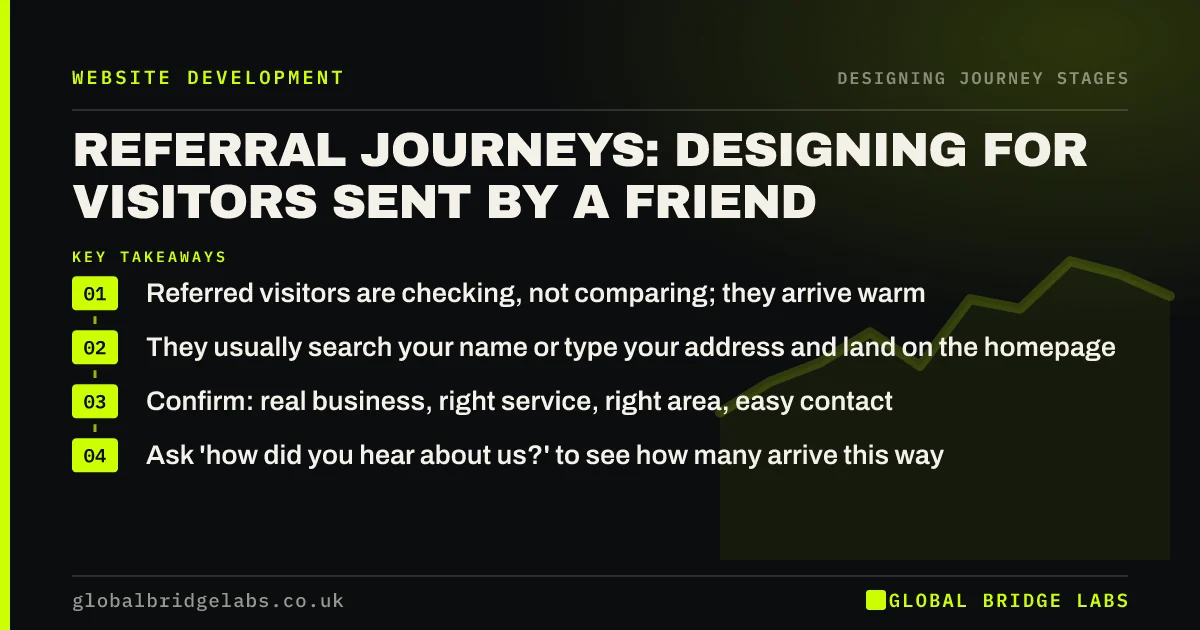
- Referred visitors are checking, not comparing; they arrive warm.
- They usually search your name or type your address and land on the homepage.
- Confirm: real business, right service, right area, easy contact.
- Ask 'how did you hear about us?' to see how many arrive this way.
Want to know how many of your buyers arrive by referral? Ask us on WhatsApp.
Chat on WhatsApp →How do referred visitors use a website?
Referred visitors usually search your business name or type your web address, landing on the homepage or a branded search result. They spend less time comparing and more time confirming: checking you do the specific job, cover their area, look professional and are easy to contact. Many go straight to the phone number or form once those boxes are ticked.
What do referred visitors need to see?
Referred visitors need quick confirmation of four things: that the business is real and current, that it offers what their friend described, that it serves their area or situation, and how to get in touch. They also look for signs the friend's experience is typical, such as reviews and examples.
- Your name and logo matching what the friend called you.
- Clear service list in plain words.
- Areas covered and who you work with.
- Recent reviews and examples of work.
- Phone, form and WhatsApp visible on the homepage.
How can a website lose a referred buyer?
A website loses referred buyers by contradicting the recommendation or adding effort. An out-of-date site suggests the business has closed. A name that differs from what the friend said causes doubt. A homepage that does not mention the service the friend used sends them searching. A contact page with only a long form slows a buyer who was ready to call.
Should you have a page for referrals?
A referral page helps if you run a referral scheme or work through partners, such as letting agents referring tenants to a trades firm. It can explain the scheme, thank referrers and give referred buyers a direct route. For most businesses, making the homepage and service pages confirm quickly matters more than a dedicated page.
How do you measure referral journeys?
Measure referrals by asking. Add 'How did you hear about us?' to forms and phone scripts, with 'Recommended by someone' as an option. In GA4, direct and branded search traffic gives a rough signal but mixes referrals with returning visitors. The question is more reliable than the analytics.
Want a better 'how did you hear about us?' question on your form? Message us on WhatsApp.
Chat on WhatsApp →When is referral design not a priority?
Referral design is not a priority if almost no buyers arrive by recommendation, for example a new e-commerce shop selling to strangers. It is a high priority for trades, professional services and local businesses, where recommendations often drive a large share of new work.
What does this look like in practice?
A pattern we see with trades businesses: recommendations drive most of the work, but the homepage is a slider of stock images and a slogan. Referred buyers have to hunt for the service and the phone number, and a few give up and ask the friend for another name.
Putting services, areas, reviews and the phone number in the first screen serves the check referred buyers came to make. Across our client work we have seen a 2.4x enquiry rate from conversion changes of this kind. Global Bridge Labs (GBL) designs the homepage for people who already know the name.
Referral journey checklist
- Search your business name and check what appears.
- Check the homepage confirms services, areas and contact in one screen.
- Make sure the site looks current.
- Show recent reviews and examples.
- Add 'How did you hear about us?' to forms.
- Track the share of enquiries from referrals.
Next step
If referrals drive your business, your website's job is to confirm them quickly. We will check how your site looks to someone who has just been recommended you.
Message us on WhatsApp for a referral journey check, or book a 30-minute consultation.
Chat on WhatsApp →Sources and further reading
- Get started with attribution · Google Analytics Help
- How long do users stay on web pages? · Nielsen Norman Group
- Google Business Profile Help · Google
Frequently asked questions
How do referred customers use a business website?
They usually search the business name or type the address, land on the homepage, and check that the business is real, offers the service their friend described, covers their area and is easy to contact. They spend less time comparing than other visitors.
Can a website lose a referral?
Yes. An out-of-date look, a name that differs from what the friend said, missing services or areas, and hard-to-find contact details can all turn a warm referral into doubt. Make the homepage confirm the key facts in one screen.
How do I track referrals from my website?
Ask. Add 'How did you hear about us?' to your forms and phone scripts with a 'recommended by someone' option. Analytics shows direct and branded search traffic, but that mixes referrals with returning visitors, so the question is more reliable.
Written by

Global Bridge Labs (GBL) is a UK–Sri Lanka partner for social media, websites and BPO. Everything here comes from client delivery, not theory.