On this page
- 01Key takeaways
- 02What does an urgent call-out journey look like?
- 03What does a considered local service journey look like?
- 04What does a professional appointment journey look like?
- 05What does an online purchase journey look like?
- 06What does a long B2B decision journey look like?
- 07Can one website serve more than one journey?
- 08When do examples mislead?
- 09What does this look like in practice?
- 10Journey pattern checklist
- 11Next step
- 12Sources and further reading
- 13Frequently asked questions
Key takeaways
Good customer journey websites look different because their buyers' journeys are different. Five patterns cover most UK small businesses: the urgent call-out, the considered local service, the professional appointment, the online purchase and the long B2B decision. Identify which pattern your buyers follow, then copy the structure, not the design, of sites that serve it well.
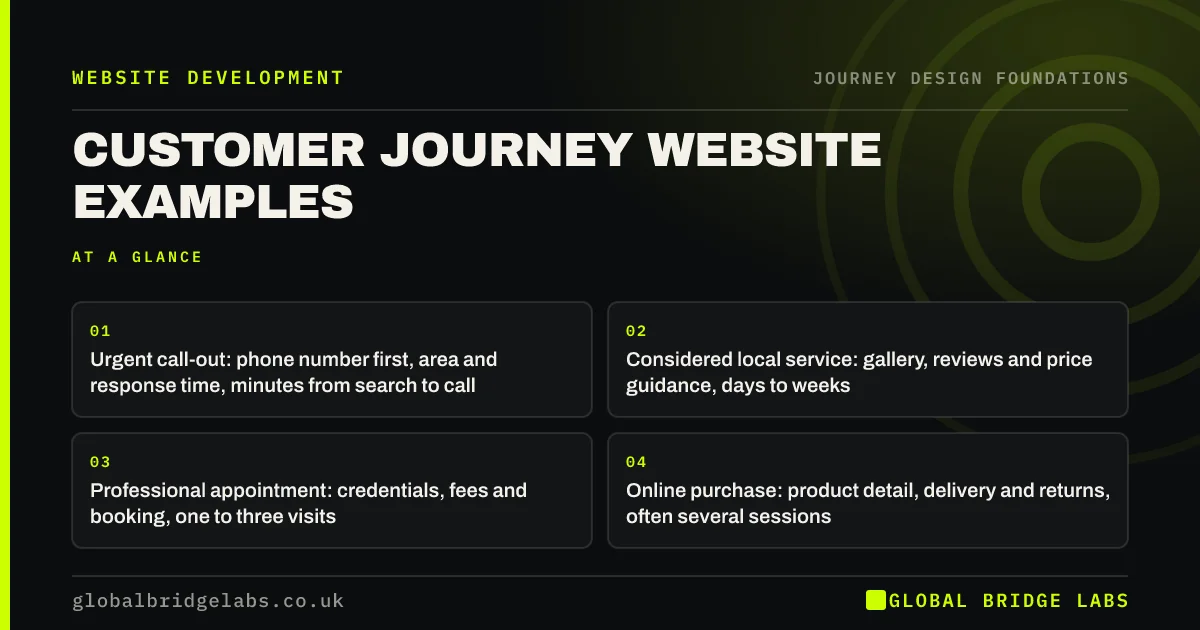
- Urgent call-out: phone number first, area and response time, minutes from search to call.
- Considered local service: gallery, reviews and price guidance, days to weeks.
- Professional appointment: credentials, fees and booking, one to three visits.
- Online purchase: product detail, delivery and returns, often several sessions.
- Long B2B decision: proof, process and documents for a buying group, months.
Not sure which journey pattern your buyers follow? Ask us on WhatsApp.
Chat on WhatsApp →What does an urgent call-out journey look like?
An urgent call-out journey takes minutes. A buyer with a burst pipe or a broken lock searches on a phone, opens two or three results and rings the first business that looks trustworthy and available. The website's job is to make calling easy: a tappable phone number at the top, the areas covered, the hours, typical response time, a call-out price guide and a few reviews.
Long pages, galleries and forms slow this journey down. Keep the first screen focused on the call.
What does a considered local service journey look like?
A considered local service, such as a kitchen fitter, landscaper or builder, has a journey of days or weeks. Buyers browse photos of finished work, read reviews, look for a rough price, compare two or three firms and ask for quotes. The site needs a gallery of local projects, price guidance by job size, a clear process from survey to completion and a simple quote request.
What does a professional appointment journey look like?
A professional appointment journey, for an accountant, solicitor, physiotherapist or clinic, usually spans one to three visits. Buyers check whether you handle their specific situation, look for credentials and fees, and want reassurance about the first meeting. The site needs pages for specific needs, visible qualifications and regulation, fee guidance, and an easy way to book or request a call.
What does an online purchase journey look like?
An online purchase journey often runs over several sessions. Shoppers browse, save items, compare prices elsewhere, return to check delivery costs and returns, then buy. The site needs fast category browsing, detailed product pages, clear delivery and returns information before checkout, and an easy way back to a saved basket. Baymard Institute puts average documented cart abandonment at about 70%, so the journey to payment matters.
What does a long B2B decision journey look like?
A long B2B decision, such as choosing a logistics partner, software supplier or outsourcing provider, can take months and involve several people. Buyers research alone, share links internally and need material for colleagues who never visit your site. The site needs proof by sector, a clear process, answers on risk and compliance, and documents or summaries a champion can forward.
Can one website serve more than one journey?
Yes, if each journey has its own entry points and routes. A plumber may serve urgent call-outs and planned bathroom installations; an accountant may serve sole traders and limited companies. Give each journey its own service pages and next steps rather than one compromise page. The navigation can stay simple if each page knows which buyer it serves.
When do examples mislead?
Examples mislead when you copy the look rather than the journey. A competitor's site may be beautiful and still lose buyers, and a large brand's site is built for a different journey and budget. Use examples to see which answers and routes a journey needs, then check them against your own customers.
What does this look like in practice?
A pattern we see in mixed businesses: an electrician who does emergency call-outs and planned rewires has one service page for both. Emergency buyers scroll past paragraphs about consumer units looking for a number; planned buyers find no prices or examples.
Splitting the page into an emergency page built for the call and a rewire page built for comparison lets each journey work. Across our client work we have seen a 2.4x enquiry rate from conversion changes of this kind. Global Bridge Labs (GBL) identifies the journey pattern before designing a page.
Journey pattern checklist
- Decide which of the five patterns your main buyers follow.
- Note how long their journey usually takes.
- List the answers that pattern needs on the site.
- Check your main service pages provide them.
- Give separate journeys separate pages.
- Review two competitors against the same list.
Next step
Knowing your journey pattern tells you which pages to build first. We will identify yours and show where your site departs from it.
Message us on WhatsApp to identify your customer journey pattern, or book a 30-minute consultation.
Chat on WhatsApp →Sources and further reading
- Journey mapping 101 · Nielsen Norman Group
- Cart abandonment rate statistics · Baymard Institute
- How long do users stay on web pages? · Nielsen Norman Group
Frequently asked questions
What is a good example of a customer journey on a website?
A good example is an emergency plumber whose site shows a tappable phone number, areas covered, hours, response time and reviews in the first screen, because buyers decide in minutes. A good example depends on the journey: a kitchen fitter needs a gallery, prices and process instead.
How do I find out which customer journey my buyers follow?
Ask five recent customers how they found and chose you, check how long enquiries take from first visit in GA4, and look at which pages they landed on. Most small businesses match one of five patterns: urgent call-out, considered local service, professional appointment, online purchase or long B2B decision.
Should I copy a competitor's website journey?
Copy the answers and routes that suit your buyers, not the design. A competitor's site may also lose buyers, and its journey may serve a different customer. Check every idea against your own customer research and analytics before adopting it.
Written by

Global Bridge Labs (GBL) is a UK–Sri Lanka partner for social media, websites and BPO. Everything here comes from client delivery, not theory.