On this page
- 01Key takeaways
- 02What does it mean when a team is at full capacity?
- 03How do you measure team capacity?
- 04When should you wait rather than add capacity?
- 05When should you hire?
- 06When should you outsource?
- 07How do the three options compare?
- 08What are the risks of staying at full capacity?
- 09How do you keep service steady while adding capacity?
- 10What does this look like in practice?
- 11Full capacity checklist
- 12Next step
- 13Sources and further reading
- 14Frequently asked questions
Key takeaways
A team at full capacity has three options: wait, hire or outsource. Wait if the peak is short and predictable. Hire if the extra work needs judgement and will last. Outsource if the extra work is repeatable, needs cover, or may swing up and down. Measure utilisation for 8 to 12 weeks before choosing.
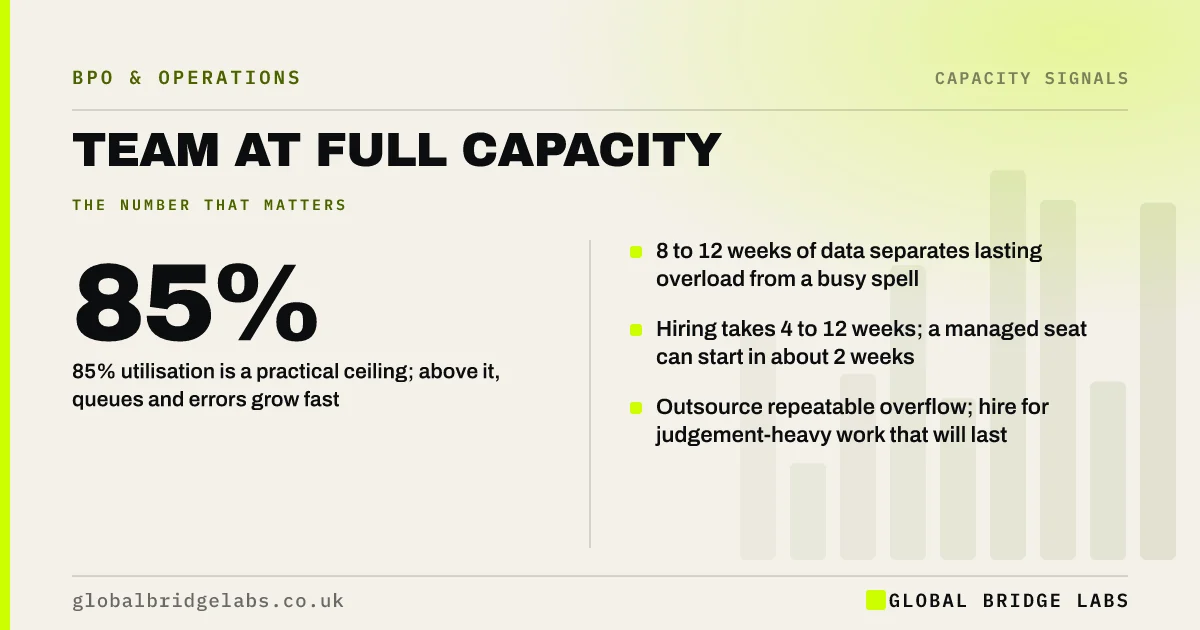
- 85% utilisation is a practical ceiling; above it, queues and errors grow fast.
- 8 to 12 weeks of data separates lasting overload from a busy spell.
- Hiring takes 4 to 12 weeks; a managed seat can start in about 2 weeks.
- Outsource repeatable overflow; hire for judgement-heavy work that will last.
Team maxed out? Message us on WhatsApp with what is overflowing.
Chat on WhatsApp →What does it mean when a team is at full capacity?
A team at full capacity has no spare time to absorb extra work without something slipping. Queues lengthen, replies slow, overtime becomes routine and small errors increase. Full capacity is not 100% busy: most teams hit it at around 85% utilisation, because the rest goes on interruptions, handovers and variation in the work.
How do you measure team capacity?
Measure hours available against hours of work arriving. Record for each person the hours they work, the time spent on planned work, and the work carried over each week. If carried-over work rises for several weeks in a row, the team is above capacity even if nobody is complaining yet.
When should you wait rather than add capacity?
Wait when the overload is short, predictable and followed by a quiet period, such as a two-week product launch. Plan it: pause non-urgent work, agree temporary overtime and tell customers about reply times. Waiting is wrong if the same peak comes back every month; that is a pattern, not a spike.
When should you hire?
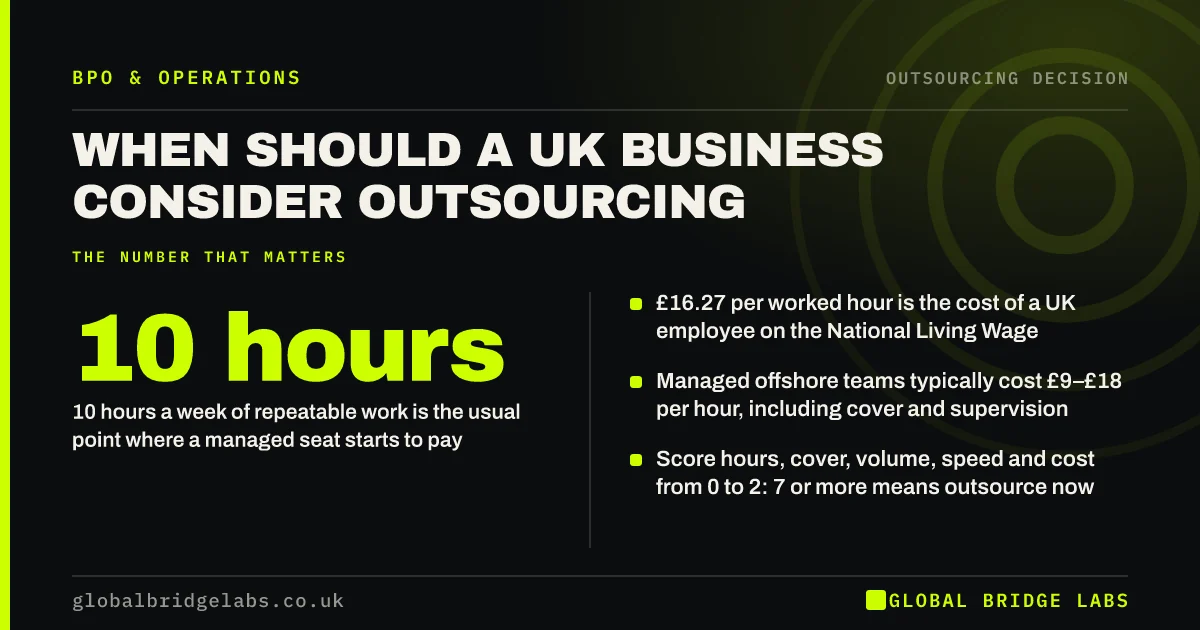
Hire when the extra work needs judgement, relationships or physical presence, and when you expect it to last at least a year. A hire builds capability inside the business. It takes 4 to 12 weeks to recruit and costs at least £16.27 per worked hour at the National Living Wage before overheads.
When should you outsource?
Outsource when the extra work is repeatable and documented, needs cover beyond one person's hours, or may swing up and down. It adds capacity in weeks, not months, and can scale back without redundancy. As an indicative range, managed offshore teams cost £9–£18 per hour including cover and supervision.
Often the best move is to outsource the repeatable part of the team's work so the existing people spend their time on the judgement-heavy part. That adds capacity where it is needed without changing the team.
Want the three options costed for your team? Ask us on WhatsApp and we will discuss your requirements.
Chat on WhatsApp →How do the three options compare?
The comparison below assumes the overflow is repeatable support or admin work. For specialist work, hiring moves ahead.
- Wait: no cost, but risks errors, overtime and staff leaving if it lasts.
- Hire: 4 to 12 weeks to start, fixed cost, builds in-house capability.
- Outsource: about 2 weeks to start, variable cost, includes cover.
- Hybrid: keep a senior lead in-house, outsource the volume around them.
What are the risks of staying at full capacity?
Teams at full capacity for months make more mistakes, stop improving how they work, and lose people. The Health and Safety Executive lists workload as one of the main causes of work-related stress, and employers have a legal duty to assess and manage that risk. The cost shows up later as turnover and recruitment.
How do you keep service steady while adding capacity?
Add capacity in stages and protect the customer-facing work first. Move the most repeatable slice of the overflow to the new capacity, keep the existing team on exceptions and key customers, and review reply times weekly. Adding capacity all at once, or moving the hardest work first, is how service dips during the change.
Tell the team what is changing and why. People at full capacity usually welcome help, but they need to know their roles are safe and what the new team will and will not do.
- Week 1 to 2: hand over the simplest, highest-volume work.
- Week 3 to 6: add the next category once accuracy is proven.
- Weekly: compare reply times and backlog with the baseline.
- Month 3: decide whether the in-house team needs to grow at all.
What does this look like in practice?
A pattern we see in UK logistics SMEs: a four-person customer service team at full capacity after a new contract. Hiring two more takes three months. Outsourcing delivery status queries, the most repeatable 40% of contacts, adds capacity within weeks and leaves the in-house team handling exceptions and key accounts.
Full capacity checklist
Work through these before you decide.
- Measure hours available against work arriving for 8 to 12 weeks.
- Check whether carried-over work is rising.
- Split the overflow into repeatable and judgement-heavy work.
- Decide whether the extra volume will last.
- Cost waiting, hiring and outsourcing over 12 months.
- Choose one, or a hybrid, and set a review date.
Next step
Tell us what your team is overflowing with. We will say whether we would wait, hire or outsource, and why, in a 30-minute call.
Message us on WhatsApp about your team's capacity, or book a 30-minute consultation.
Chat on WhatsApp →Sources and further reading
- Work-related stress and how to manage it · Health and Safety Executive
- National Minimum Wage and National Living Wage rates · GOV.UK
- Rates and thresholds for employers 2026 to 2027 · HM Revenue & Customs
Frequently asked questions
What do you do when your team is at full capacity?
Measure the overload for 8 to 12 weeks, split it into repeatable and judgement-heavy work, and choose: wait for short predictable peaks, hire for lasting judgement-heavy work, and outsource repeatable work that needs cover or swings in volume. A hybrid often works best.
What is a healthy utilisation rate for a team?
Around 75% to 85% for most support and admin teams. Above that, small increases in work create long queues because there is no slack for interruptions and variation. Teams running at 95% for long periods usually show rising errors, overtime and turnover.
Is outsourcing faster than hiring?
Usually. A managed seat on a documented process can start in about two weeks, while recruiting typically takes 4 to 12 weeks including notice periods. Outsourcing also includes holiday and sickness cover, which a single hire does not.
Written by

Global Bridge Labs (GBL) is a UK–Sri Lanka partner for social media, websites and BPO. Everything here comes from client delivery, not theory.