On this page
- 01Key takeaways
- 02Why does the website matter in a business sale?
- 03What will buyers check?
- 04What should you fix first?
- 05How do you show the website's value?
- 06Should you redesign before selling?
- 07What about compliance risk?
- 08What documentation should you prepare?
- 09What does this look like in practice?
- 10Pre-sale website checklist
- 11Next step
- 12Sources and further reading
- 13Frequently asked questions
Key takeaways
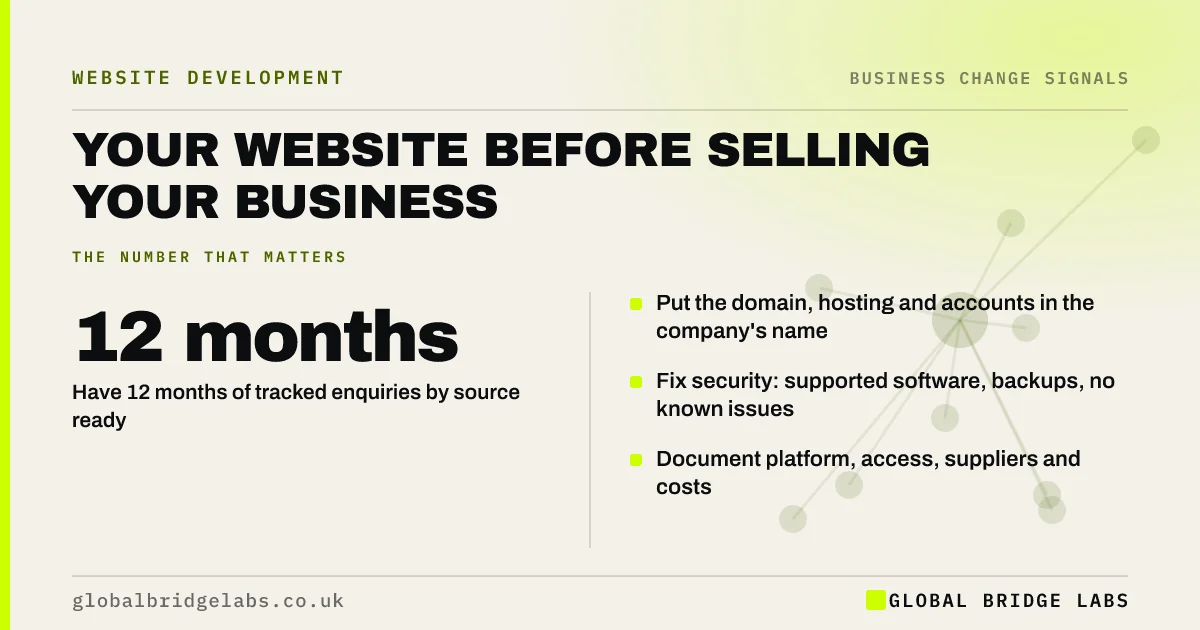
Before selling a business, make the website a clean asset: owned by the company, secure, documented, with reliable enquiry and traffic data. Buyers' due diligence will ask who owns the domain, where enquiries come from and whether the site is a risk. A redesign is rarely needed; ownership, tracking and security fixes usually are.
- Put the domain, hosting and accounts in the company's name.
- Have 12 months of tracked enquiries by source ready.
- Fix security: supported software, backups, no known issues.
- Document platform, access, suppliers and costs.
Preparing to sell? We will review your website as a buyer would, on WhatsApp.
Chat on WhatsApp →Why does the website matter in a business sale?
In a business sale, the website is both an asset and a risk. As an asset, it holds rankings, enquiry flow and brand reputation. As a risk, it may be owned by a former supplier, run on unsupported software or have no reliable data. Buyers and their advisers check both.
What will buyers check?
Due diligence on a website usually covers ownership, performance, risk and cost.
- Who owns the domain, hosting, site files and content.
- Traffic and enquiry data by source for at least 12 months.
- Search visibility for core services.
- Platform support status and security history.
- Compliance: privacy notice, cookies, accessibility.
- Ongoing costs and supplier contracts.
Want a due diligence check of your website before buyers see it? Ask us on WhatsApp.
Chat on WhatsApp →What should you fix first?
Ownership. A domain registered to a former employee or agency is a problem a buyer will price in. Move the domain, hosting and all accounts into the company's name, record access in a secure document, and make sure more than one person can reach them.
How do you show the website's value?
With data. Twelve months of enquiries by source, Search Console performance for core service terms and the share of new business that starts on the website turn it from a cost into an asset with measurable returns.
Should you redesign before selling?
Usually not. A redesign shortly before sale adds cost, can disrupt rankings, and leaves no track record for the new site. Fix ownership, security, data and obvious content problems instead. Consider a redesign only if the site is a clear liability, such as an unsupported platform that buyers will flag.
What about compliance risk?
Buyers inherit compliance problems. Check the privacy notice matches how data is actually handled, the cookie banner meets PECR, and the site follows basic accessibility practice. The Data (Use and Access) Act 2025 raised potential PECR penalties, which makes cookie compliance a larger due diligence point than before.
What documentation should you prepare?
A short website pack that a buyer's adviser can read in ten minutes. It should list every account and who holds it, the platform and versions, hosting and renewal dates, suppliers and costs, and a summary of traffic and enquiries with the reports attached.
Add any known issues and what is planned to fix them. Buyers are more comfortable with disclosed, understood problems than with surprises found during due diligence, and a clear pack signals that the business is well run in other areas too.
- Account list: domain, hosting, CMS, analytics, profiles.
- Platform, versions and support status.
- Suppliers, contracts, costs and renewal dates.
- 12-month traffic and enquiry summary.
- Known issues and planned fixes.
What does this look like in practice?
A pattern in UK owner-managed businesses: the owner prepares for sale and discovers the domain is registered in the name of a web designer who has since retired. Recovering it takes weeks. Starting the website clean-up six to twelve months before sale avoids that delay landing in the middle of due diligence.
Pre-sale website checklist
Start 6 to 12 months before a sale.
- Transfer domain, hosting and accounts to the company.
- Document access, platform, suppliers and costs.
- Collect 12 months of enquiry and traffic data.
- Update software and confirm backups work.
- Check privacy notice, cookies and accessibility.
- Fix outdated content and broken pages.
Next step
If you are preparing to sell, we will review your website as a buyer's adviser would in 30 minutes, and list what to fix before due diligence.
Message us on WhatsApp for a pre-sale website review, or book a 30-minute consultation.
Chat on WhatsApp →Sources and further reading
- Data (Use and Access) Act 2025 · legislation.gov.uk
- Cookies and similar technologies under PECR · Information Commissioner's Office
- Google Search Console · Google
Frequently asked questions
Does a website add value when selling a business?
It can, if it is owned by the company, secure and backed by data showing the enquiries and customers it brings in. A site with strong rankings and measurable enquiry flow is an asset; one with unclear ownership or unsupported software is a risk buyers price in.
What website checks happen in due diligence?
Buyers typically check domain and account ownership, traffic and enquiry data, search visibility, platform and security status, compliance with privacy, cookie and accessibility requirements, and ongoing supplier costs and contracts. Prepare this information before buyers ask for it. Keep it current until completion.
Should I redesign my website before selling my business?
Usually not. A redesign shortly before sale adds cost, risks ranking disruption and leaves no track record. Focus on ownership, security, data and content fixes. Redesign only if the site is a clear liability, such as an unsupported platform. A clean, documented site is easier to value.
How do I prove my website generates business?
Track enquiries by source for at least 12 months, connect them to jobs won where possible, and show Search Console performance for core service terms. A simple report of enquiries, conversions and revenue from the website is persuasive in due diligence.
Written by

Global Bridge Labs (GBL) is a UK–Sri Lanka partner for social media, websites and BPO. Everything here comes from client delivery, not theory.