On this page
- 01Short answer
- 02Testimonial or case study: what is the difference?
- 03Why do most testimonials not persuade anyone?
- 04How do you collect testimonials that are specific?
- 05How should a case study be structured?
- 06What are the UK rules on reviews and testimonials?
- 07When should you anonymise proof?
- 08What does this look like in practice?
- 09Proof checklist
- 10Next step
- 11Sources and further reading
- 12Frequently asked questions
Short answer
Testimonials and case studies work on your website when they are specific, attributable and placed next to the decision they support. A review that names the job, place and result, beside the call to action on the relevant service page, does far more than a page of anonymous five-star quotes.
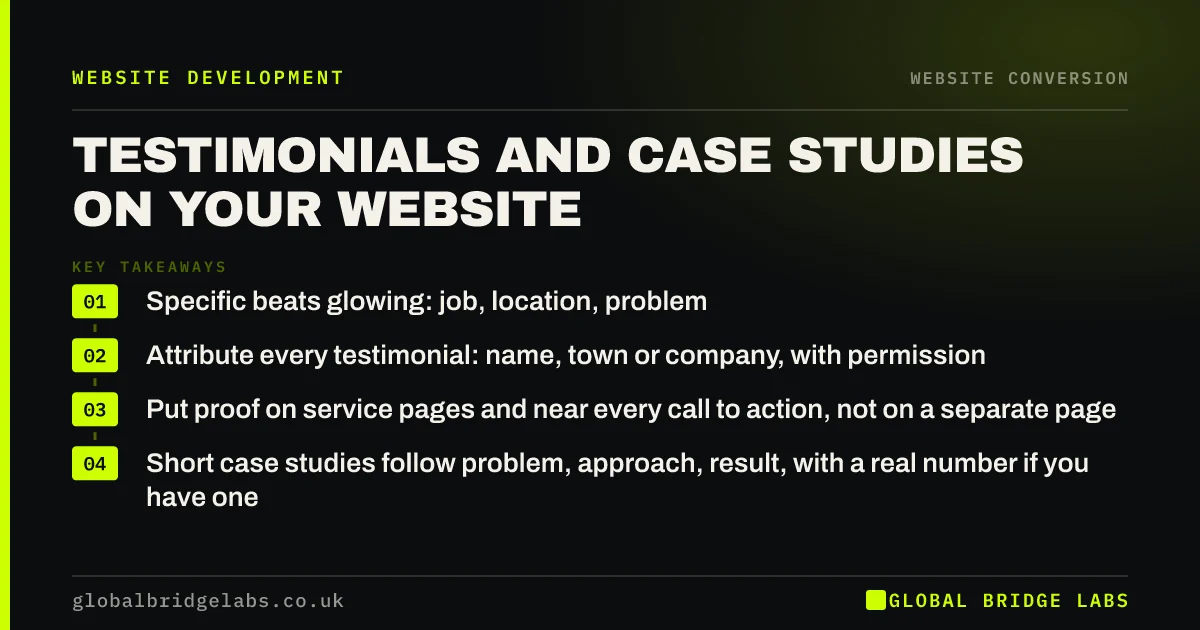
- Specific beats glowing: job, location, problem and result in the customer's words.
- Attribute every testimonial: name, town or company, with permission.
- Put proof on service pages and near every call to action, not on a separate page.
- Short case studies follow problem, approach, result, with a real number if you have one.
- Publish genuine reviews only; UK law bans fake and concealed incentivised reviews.
Want help turning your best reviews into on-page proof? Message us on WhatsApp.
Chat on WhatsApp →Testimonial or case study: what is the difference?
A testimonial is a short statement from a customer about their experience with a business. A case study is a structured account of a specific piece of work, describing the customer's problem, what the business did and the result, usually with more detail and evidence.
Testimonials build general trust quickly. Case studies prove capability for a particular kind of work and suit larger or more complex purchases where buyers want to see how you think.
Why do most testimonials not persuade anyone?
Most testimonials fail because they are vague. "Great service, would recommend" could have been written about anyone, and visitors know it. They also fail when they are unattributed, or when they sit on a testimonials page most visitors never open.
Persuasive proof answers the specific doubt a buyer has at that moment: will they turn up, will it cost what they said, will the result last, will they deal with problems properly.
How do you collect testimonials that are specific?
Ask better questions at the right time, usually straight after a successful job. Instead of asking for a review, ask two or three questions and use the answers, with permission.
- What were you worried about before choosing us?
- What happened during the job that stood out?
- What is different now the work is done?
- Can we use your name, town and a photograph of the work?
How should a case study be structured?
Keep case studies short and scannable, between 300 and 700 words for most SMEs, and follow a predictable structure so buyers can compare them.
- Headline with the result: Kitchen refit completed in nine days, on the fixed price.
- Client context: sector, size, location, with permission to name or anonymised.
- The problem in their words.
- What you did, in three to five steps.
- The result, with a real figure and time period if you have one.
- A quote from the client and photographs of the work.
Want a case study template for your sector? Message us on WhatsApp.
Chat on WhatsApp →What are the UK rules on reviews and testimonials?
The Digital Markets, Competition and Consumers Act 2024 bans fake reviews, commissioning fake reviews, and publishing reviews in a misleading way, including concealing incentivised reviews. The CMA has published guidance for businesses that publish consumer reviews and can fine businesses directly.
In practice: use genuine reviews only, get permission to use names and photographs, disclose any incentive, and do not selectively hide negative reviews in a way that gives a misleading overall picture. The ASA's advertising code also requires that testimonials are genuine and supported by evidence.
When should you anonymise proof?
Anonymise when clients are bound by confidentiality, work in sensitive sectors such as healthcare or finance, or simply prefer not to be named. An anonymised case study that gives sector, size and region, such as a logistics firm with 40 staff in the Midlands, still carries weight.
The trade-off is credibility. Named proof is more persuasive, so ask every satisfied client, and use anonymised examples to fill gaps rather than as the default.
What does this look like in practice?
A pattern in hospitality and trades: dozens of strong Google reviews, none of them on the website, and a testimonials page with five undated quotes signed with initials.
Pulling the most specific recent reviews onto each relevant service page, with names and towns where customers agree, and linking to the full review profile, puts proof where decisions happen. It uses what the business already has and costs almost nothing.
Proof checklist
Review this every quarter.
- Ask for specific testimonials after every successful job.
- Get permission to use names, towns and photographs.
- Place a relevant review beside every call to action.
- Write short case studies for your main services.
- Link to your independent review profiles.
- Remove undated or unattributed quotes.
- Check the CMA review guidance before publishing.
Next step
If your best proof is sitting in Google reviews and email threads, we will pick the strongest pieces with you in 30 minutes and show you where each belongs on the site.
Message us on WhatsApp for a proof placement plan, or book a 30-minute consultation.
Chat on WhatsApp →Sources and further reading
- Publishing consumer reviews and complying with consumer protection law · Competition and Markets Authority
- Unfair commercial practices guidance (CMA207) · Competition and Markets Authority
- Recognising ads: brand-owned and paid social media · ASA / CAP
Frequently asked questions
Where should testimonials go on a website?
Next to the decision they support: a review summary under the homepage headline, a relevant testimonial on each service page beside the call to action, and proof near forms and pricing. A separate testimonials page can exist, but few visitors go looking for it.
How do I get better testimonials from customers?
Ask specific questions straight after a successful job: what they were worried about beforehand, what stood out during the work, and what is different now. Their answers produce specific, credible testimonials. Always ask permission to use their name, town and any photographs.
Can I use Google reviews as testimonials on my website?
Yes, if the reviews are genuine and you present them accurately, ideally with a link to the source or through an official widget. Do not edit them misleadingly or hide negative reviews in a way that distorts the picture, which UK consumer law and CMA guidance prohibit.
How long should a case study be?
For most small businesses, 300 to 700 words is enough. Cover the client context, the problem, what you did in a few steps, the result with a real figure if possible, and a quote. Keep it scannable with headings and photographs so buyers can compare several quickly.
Written by

Global Bridge Labs (GBL) is a UK–Sri Lanka partner for social media, websites and BPO. Everything here comes from client delivery, not theory.