
On this page
Key takeaways
Skills-based routing sends calls to the people best able to handle them, such as billing calls to staff trained in billing. It can cut transfers and handling time. In small teams, though, too many skill groups split capacity and create long waits. Keep it simple: a few skills, everyone covering the general queue and a clear back-up rule.
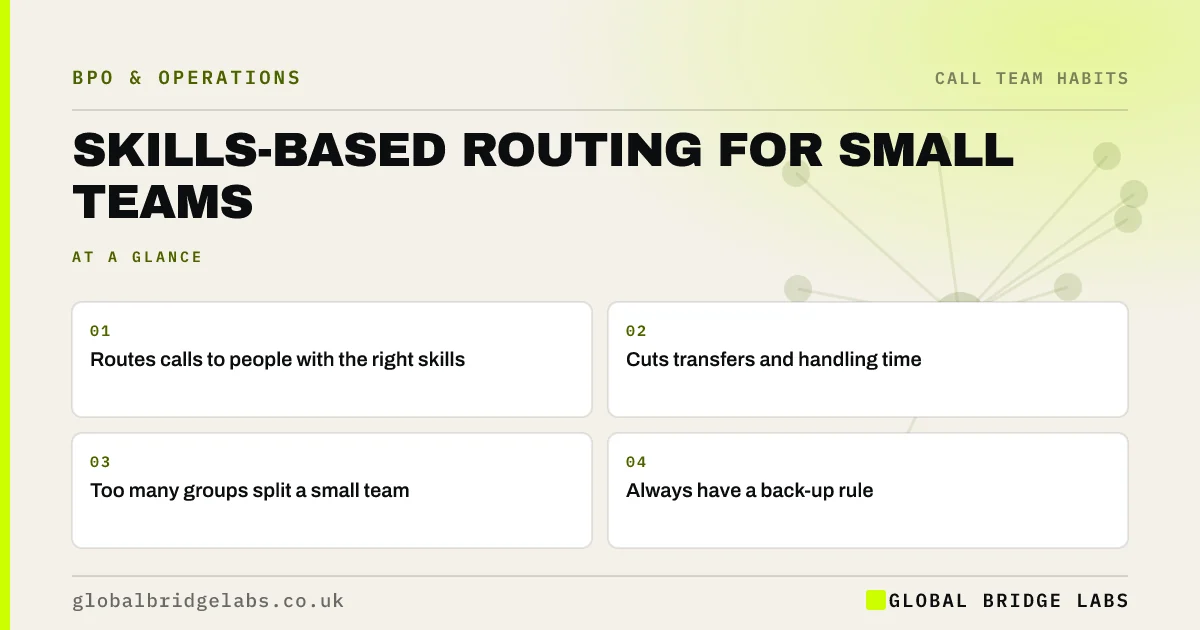
- Routes calls to people with the right skills.
- Cuts transfers and handling time.
- Too many groups split a small team.
- Always have a back-up rule.
Thinking about skills-based routing? Message us on WhatsApp.
Chat on WhatsApp →How does it work?
Calls are tagged by menu choice, number dialled or customer type. Each person is tagged with the skills they have. The phone system offers each call to someone with the matching skill, often preferring the most skilled, and can fall back to others after a set time.
When does it help?
When some calls need specific knowledge, system access or authority, and the volume of those calls is high enough to keep a few people busy. It also helps when language skills matter. It reduces transfers because the first person reached can usually help.
When does it hurt?
In small teams, each extra skill group means fewer people per queue. Erlang maths shows that several small queues need more people overall than one shared queue for the same service level. Billing callers may wait while general staff are free.
- Small groups need more people per call.
- Callers wait while others are free.
- Rotas get harder to plan.
Want your routing reviewed? Send us your current setup on WhatsApp.
Chat on WhatsApp →What works for small teams?
Two or three skills at most, with most people covering the general queue. Set a fall-back so any call waiting beyond a set time goes to anyone free. Cross-train to widen the pool for each skill over time.
What does this look like in practice?
A pattern we see: a team of six has five skill groups, and billing callers wait while others are idle. Merging to two groups with a 30-second fall-back cuts waits for billing callers and improves overall service level.
Two more people are then trained in billing, so the specialist group is no longer stretched when one person is on leave.
Skills-based routing checklist
- Limit skill groups to two or three.
- Keep most people on the general queue.
- Set a time-based fall-back.
- Cross-train to widen each skill pool.
- Report service level by queue.
Next step
List your current skill groups and how many people cover each, merge any with only one or two people and add a fall-back rule.
Message us on WhatsApp to simplify your call routing, or book a 30-minute consultation.
Chat on WhatsApp →Sources and further reading
- Stop trying to delight your customers (Dixon, Freeman and Toman, 2010) · Harvard Business Review
- Measuring success · GOV.UK Service Manual
Frequently asked questions
Is skills-based routing worth it for a small business?
Sometimes, for a few distinct call types that need specific skills. But many small queues usually hurt service level. Keep the number of skills small, make sure most people cover general calls and use a fall-back so no caller waits while someone is free.
What is a fall-back in call routing?
A fall-back is a rule that widens the pool of people who can take a call after it has waited a set time. For example, a billing call might go to billing staff first, then to anyone after 30 seconds. It stops callers waiting while others are free.
Why do many small queues need more staff?
Because random clusters of calls are harder to absorb when each queue has few people. One shared queue lets anyone free take the next call. Splitting into small groups loses that flexibility, so you need more people overall to reach the same service level.
Written by

Global Bridge Labs (GBL) is a UK–Sri Lanka partner for social media, websites and BPO. Everything here comes from client delivery, not theory.


