On this page
Key takeaways
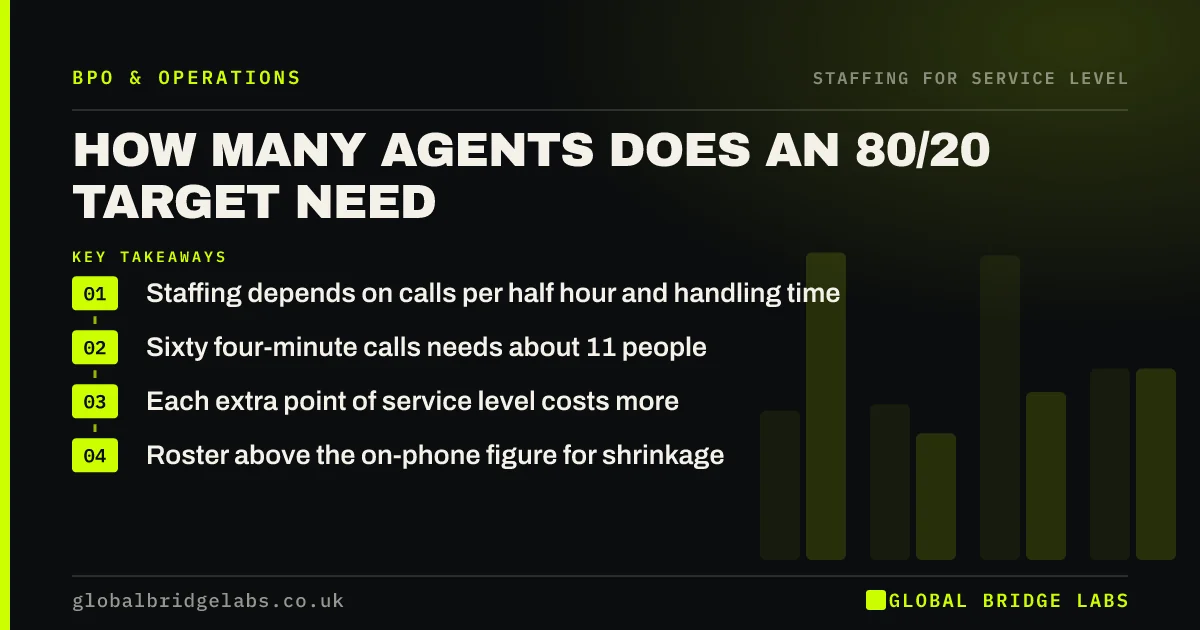
The number of people an 80/20 target needs depends on calls per half hour and how long each call takes, including wrap-up. As an illustrative example, 60 calls in a half hour at four minutes each needs about 11 people on the phones to get close to 80/20. Rostered numbers must be higher again to cover breaks, training and absence.
- Staffing depends on calls per half hour and handling time.
- Sixty four-minute calls needs about 11 people.
- Each extra point of service level costs more.
- Roster above the on-phone figure for shrinkage.
Want your 80/20 staffing worked out? Message us on WhatsApp.
Chat on WhatsApp →What do you need to know first?
Three numbers: calls offered per half hour, average handling time including after-call work, and your target. Use four weeks of half-hourly data and plan the busiest typical half hours, not the daily average.
How do you work it out?
Start with workload. Sixty calls at four minutes each is 240 minutes of work arriving in 30 minutes, enough to keep eight people busy non-stop. With exactly eight, any cluster of calls builds a queue that never clears. The Erlang C formula adds people until enough calls are answered within the threshold. In this illustrative example, ten people answer about 65% within 20 seconds, 11 about 81% and 12 about 90%.
Why can't people be busy all the time?
Calls arrive randomly, so there must be some spare capacity to catch clusters. At 11 people in the example, each is busy about 73% of the time. Push that much higher and waits grow quickly. Some idle time between calls is the price of a fast answer.
Want to see the staffing curve for your busiest half hour? Send us your call data on WhatsApp.
Chat on WhatsApp →How many should you roster?
The figure above is people actually on the phones. Breaks, training, one-to-ones, sickness and holidays all take people away. If a quarter to a third of paid time goes on these, you need to roster noticeably more people than the on-phone figure to have that many available.
What does this look like in practice?
A pattern we see: an owner plans staff from the daily call total and wonders why mornings are always behind. Planning the 9am to 11am half hours separately shows two extra people are needed then, and far fewer in the afternoon.
80/20 staffing checklist
- Export calls by half hour for four weeks.
- Measure handling time including wrap-up.
- Work out the on-phone figure per half hour.
- Add cover for breaks, training and absence.
- Check results against the interval report.
Next step
Pick your three busiest half hours, work out the on-phone figure for each, and compare it with how many people are actually available then.
Message us on WhatsApp to plan staffing for 80/20, or book a 30-minute consultation.
Chat on WhatsApp →Sources and further reading
Frequently asked questions
Can I just divide call hours by staff hours?
Not for a service level target. Simple division assumes calls arrive evenly, so it gives the minimum people needed to handle the work with everyone always busy. Real calls cluster, so you need extra capacity to answer most of them quickly. Erlang C or a calculator based on it accounts for this.
Why does a small change in calls need another person?
Because service level is sensitive near the edge. When people are already busy most of the time, a few extra calls create queues that build on each other. Adding one person at that point often lifts service level by ten or more points in a busy half hour.
Are online Erlang calculators accurate enough?
For planning, usually yes, as long as your inputs are accurate. They assume callers wait indefinitely and calls arrive randomly, which is not quite true. Check their output against your real interval reports, and adjust for abandonment and the way your team actually works.
Written by

Global Bridge Labs (GBL) is a UK–Sri Lanka partner for social media, websites and BPO. Everything here comes from client delivery, not theory.