On this page
Key takeaways
Erlang C estimates how many people you need to answer a given share of calls within a threshold. It uses calls per interval, average handling time and the target. This worked example takes 20 calls in a half hour, each four minutes, and shows the service level at each staffing level. Figures are illustrative and the method works for any small team.
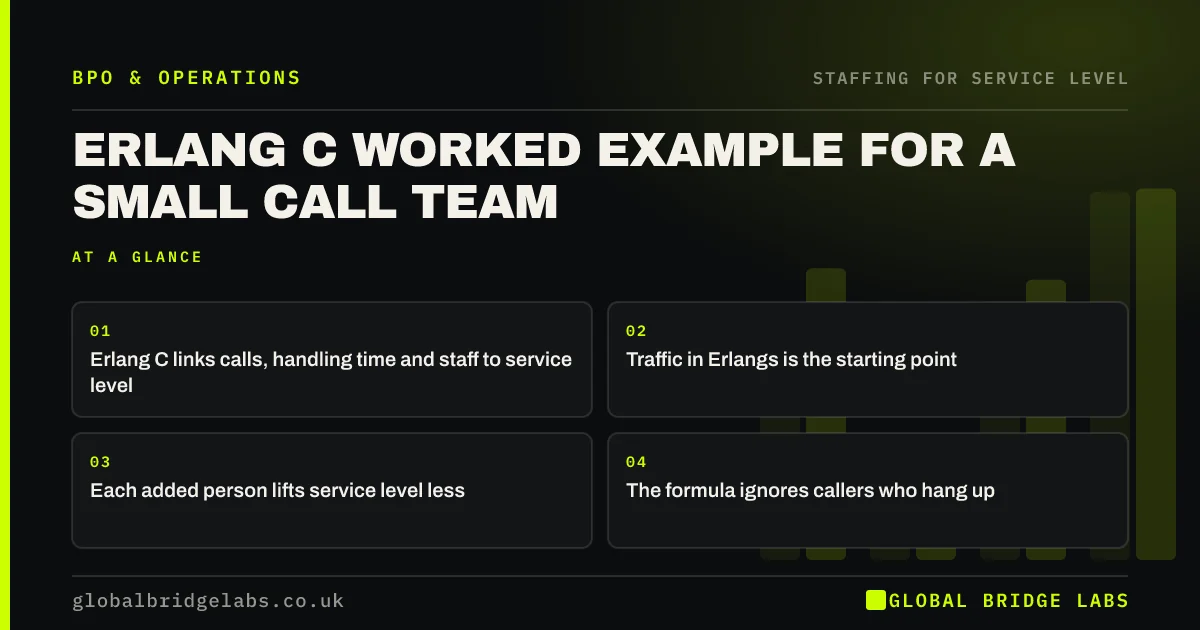
- Erlang C links calls, handling time and staff to service level.
- Traffic in Erlangs is the starting point.
- Each added person lifts service level less.
- The formula ignores callers who hang up.
Want Erlang C run on your own numbers? Message us on WhatsApp.
Chat on WhatsApp →What are the inputs?
Calls offered in the interval, average handling time and the interval length. In this example: 20 calls, 240 seconds each, in a 1,800-second half hour. Traffic is calls times handling time divided by interval length: 20 times 240 divided by 1,800, which is about 2.7 Erlangs, meaning about 2.7 people's worth of work.
What does the formula do?
For a chosen number of people, Erlang C works out the chance that a caller has to wait at all. It then works out how many of those waiting callers are still answered within the threshold. The two together give the service level. You repeat this for three, four, five people and so on.
What are the results?
Three people is barely above the workload, so queues build, while five clears 80/20 comfortably. With these illustrative inputs and a 20-second threshold, the results are roughly as follows.
- Three people: about 22% within 20 seconds.
- Four people: about 66%.
- Five people: about 87%.
- Six people: about 95%.
Want the same table for your busiest half hours? Send us your call data on WhatsApp.
Chat on WhatsApp →What are the limits?
Erlang C assumes callers never hang up and that calls arrive randomly and independently. In reality some callers give up, which makes real service level slightly better than predicted for those who stay but leaves lost calls. It also ignores breaks and shrinkage, so the result is people on the phones, not people rostered.
What does this look like in practice?
A pattern we see: a team uses a simple calls-times-minutes sum and rosters three people for a half hour like this example. The interval report shows service level around 20%. Erlang C explains why, and a fifth person at that time fixes it.
Erlang C checklist
- Collect calls per half hour.
- Measure handling time including wrap-up.
- Work out traffic in Erlangs.
- Test several staffing levels.
- Add shrinkage before rostering.
Next step
Take one busy half hour, work out its traffic in Erlangs, and use a calculator to see the service level at each staffing level.
Message us on WhatsApp to run Erlang C on your calls, or book a 30-minute consultation.
Chat on WhatsApp →Sources and further reading
- Measuring success · GOV.UK Service Manual
- Maximum weekly working hours · GOV.UK
Frequently asked questions
What is Erlang C used for?
It is used to estimate how many people are needed to meet a service level target for incoming calls. It is the standard starting point for call centre staffing. It takes calls per interval, handling time and the target, and returns the expected service level for each number of people.
What is the difference between Erlang B and Erlang C?
Erlang B estimates how many calls are blocked when there is no queue, so it is used for sizing phone lines. Erlang C assumes callers queue until answered, so it is used for staffing a team. For service level planning, Erlang C is the one you need.
Does Erlang C work for very small teams?
It gives useful guidance, but small teams should treat results as approximate. With few calls per half hour, randomness matters more and real results swing. Use it to set a starting rota, then check against four weeks of interval reports and adjust.
Written by

Global Bridge Labs (GBL) is a UK–Sri Lanka partner for social media, websites and BPO. Everything here comes from client delivery, not theory.