On this page
Key takeaways
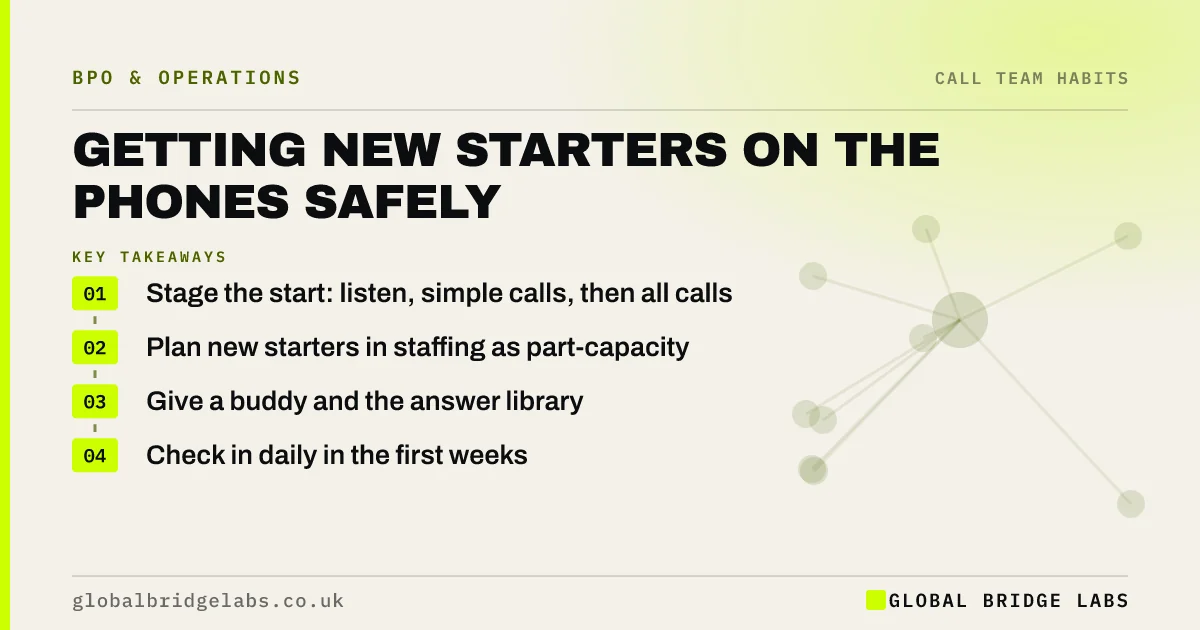
New starters need time to learn before they handle every type of call alone. A staged approach works best: listening to calls, then handling simple call types with support, then building up to the full range. Plan their time in your staffing figures, give them the answer library and a named buddy, and check in often.
- Stage the start: listen, simple calls, then all calls.
- Plan new starters in staffing as part-capacity.
- Give a buddy and the answer library.
- Check in daily in the first weeks.
Want an induction plan for phone staff? Message us on WhatsApp.
Chat on WhatsApp →Why stage the start?
Throwing new starters onto every call type at once leads to long calls, holds, mistakes and stress. Staging lets them build confidence on simple calls while learning the harder ones. Callers get better service, and new starters are less likely to leave early.
What does a staged plan look like?
A typical plan moves through three or four stages over the first few weeks. Move on when the person is ready, not on a fixed date.
- Listening to calls with a colleague.
- Taking simple call types with support nearby.
- Adding more call types as confidence grows.
- Handling the full range with regular coaching.
How should staffing account for new starters?
Count new starters as part of a person in your staffing plan for the first weeks, because their calls take longer and they need support. Their buddy's capacity also drops. Avoid starting new people just before a peak if you can.
Want help planning cover while new starters learn? Send us your rota on WhatsApp.
Chat on WhatsApp →What support do they need?
A named buddy, the answer library, clear escalation routes and short daily check-ins. Encourage questions. Listen to a few of their calls each week and give specific, positive feedback.
What does this look like in practice?
A pattern we see: new starters take every call type from day two and several leave within a month. A staged plan with listening first and simple calls next keeps more of them, and their calls reach normal length sooner.
Callers notice the difference too, because they are less likely to be put on hold while a nervous new starter searches for an answer.
New starter checklist
- Plan a staged start.
- Count new starters as part-capacity.
- Assign a named buddy.
- Share the answer library on day one.
- Check in daily for the first weeks.
Next step
Write a simple staged plan for your next new starter, listing which call types they will handle in each week and who will support them.
Message us on WhatsApp to plan phone training for new starters, or book a 30-minute consultation.
Chat on WhatsApp →Sources and further reading
- Employing staff for the first time · GOV.UK
- Work-related stress and how to manage it · Health and Safety Executive
Frequently asked questions
How long does it take new phone staff to be fully productive?
It depends on how complex your calls and systems are. Simple lines may take a couple of weeks; complex ones several months. Track how call length and quality change over time for each new starter, and plan their capacity in your staffing figures accordingly.
Should new starters listen to calls before taking them?
Yes, usually. Listening to experienced colleagues shows how real calls go, the questions customers ask and how systems are used. A few days of listening, followed by simple calls with support, builds confidence and reduces mistakes on live calls. Pair them with different colleagues to hear different styles.
Which calls should new starters take first?
Simple, common call types with clear answers, such as booking changes or order updates. Leave complaints, complex account issues and vulnerable callers until they have more experience. Use your call reason codes to route simple calls to new starters where your system allows.
Written by

Global Bridge Labs (GBL) is a UK–Sri Lanka partner for social media, websites and BPO. Everything here comes from client delivery, not theory.