On this page
Key takeaways
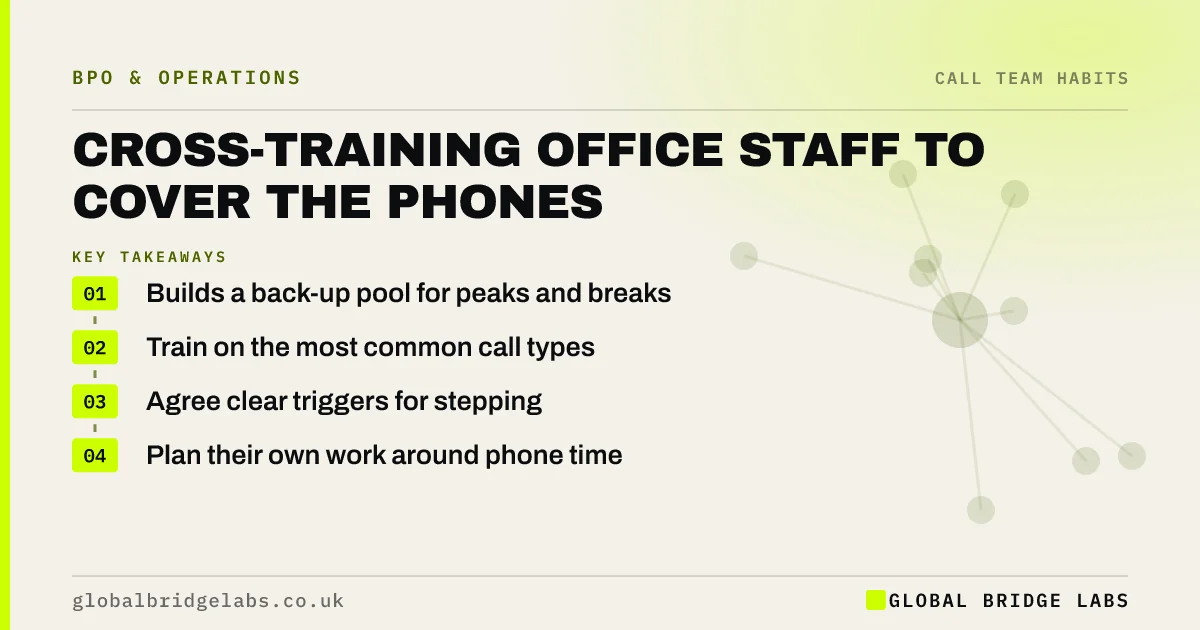
Cross-training gives you a pool of colleagues, from admin, sales or operations, who can answer calls when the main team is busy, on breaks or absent. It is a flexible, low-cost way to protect service level. It works when people are properly trained on common calls, know when to step in and their own work is planned around it.
- Builds a back-up pool for peaks and breaks.
- Train on the most common call types.
- Agree clear triggers for stepping in.
- Plan their own work around phone time.
Want a cross-training plan for your office? Message us on WhatsApp.
Chat on WhatsApp →Who should be cross-trained?
People whose work can pause briefly and who know your customers and products, such as admin, operations or sales staff. Choose volunteers where possible, because people who dislike phone work give callers a worse experience.
What should they learn?
The opening and closing, the top five or ten call types, how to use the answer library, how to take a good message and when to escalate. They do not need to handle everything; they need to handle the common calls well and pass on the rest cleanly.
- Opening and closing.
- Top call types.
- The answer library.
- Messages and escalation.
When should they step in?
Agree triggers, such as callers waiting longer than a minute, a lunchtime slot each day or when someone is off sick. Rotate the cover so it does not always fall on the same person.
Want help setting triggers for back-up cover? Send us your rota on WhatsApp.
Chat on WhatsApp →How do you protect their own work?
Plan phone time into their week, not on top of it. Agree with their manager how much time they will spend on calls and adjust their other targets. Track how often they are called on; if it is daily, you need more core phone capacity.
What does this look like in practice?
A pattern we see: a business struggles to cover lunchtimes. Training three admin colleagues on the top eight call types, with a rota for one each day, lifts lunchtime service level without new hires.
The admin team also gains a better sense of what customers ask about, and suggests two process changes that remove some of those calls entirely.
Cross-training checklist
- Choose willing colleagues.
- Train them on top call types.
- Agree triggers for stepping in.
- Plan phone time into their week.
- Track how often cover is used.
Next step
Pick two willing colleagues, train them on your top five call types and give each a regular lunchtime slot on the phones.
Message us on WhatsApp to plan cross-trained phone cover, or book a 30-minute consultation.
Chat on WhatsApp →Sources and further reading
- Flexible working · Acas
- Work-related stress and how to manage it · Health and Safety Executive
Frequently asked questions
Should all office staff answer the phones?
Not necessarily. Choose people whose work can pause and who are comfortable on the phone. Callers notice when someone is reluctant or unsure. A small, willing, trained back-up pool usually works better than asking everyone to pick up when the phone rings.
How much training does phone back-up need?
Enough to handle the most common call types, take good messages and escalate the rest. For many businesses that is a few hours of training plus listening to some calls, then supported practice. Refresh it regularly so back-up staff stay confident.
Will cross-training slow down other work?
It can if phone time is added on top of a full workload. Plan it into their week and adjust their other targets. Track how often back-up is used, and if it is constant, increase core phone capacity rather than stretching other teams.
Written by

Global Bridge Labs (GBL) is a UK–Sri Lanka partner for social media, websites and BPO. Everything here comes from client delivery, not theory.