On this page
Key takeaways
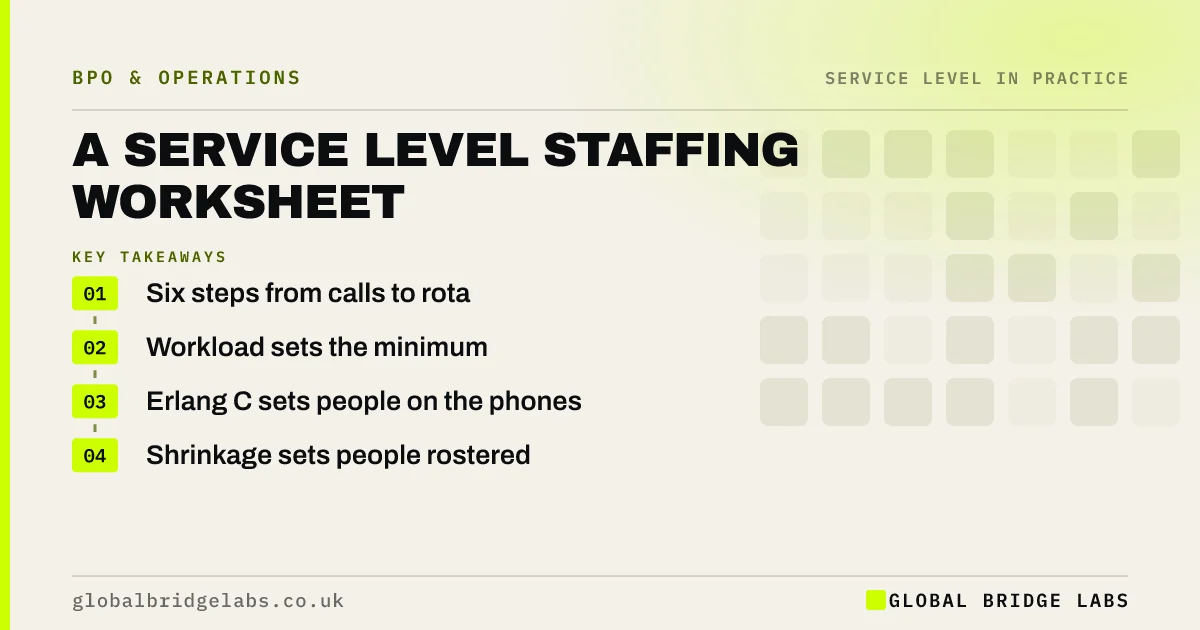
This worksheet turns your call data into a staffing plan in six steps: calls per half hour, handling time, workload, people on the phones for your target, shrinkage and people rostered. It uses a simple worked example with illustrative figures. Repeat it for each busy half hour and compare the result with your current rota.
- Six steps from calls to rota.
- Workload sets the minimum.
- Erlang C sets people on the phones.
- Shrinkage sets people rostered.
Want this worksheet filled in for your team? Message us on WhatsApp.
Chat on WhatsApp →Steps 1 and 2: calls and handling time
Write down the forecast calls for one half hour and the average handling time including after-call work. In our illustrative example: 40 calls in a half hour, four minutes each.
Step 3: workload
Multiply calls by handling time and divide by the interval length. Forty calls at four minutes is 160 minutes of work in 30 minutes, enough to keep about 5.3 people busy non-stop. This is the absolute minimum, at which queues would never clear.
Step 4: people on the phones
Use an Erlang C calculator with your target. In the example, with a 20-second threshold, seven people give about 64%, eight about 82% and nine about 92%. For 80/20, plan eight on the phones in that half hour.
- Seven: about 64%.
- Eight: about 82%.
- Nine: about 92%.
Want the numbers run for your busiest half hours? Send us your data on WhatsApp.
Chat on WhatsApp →Steps 5 and 6: shrinkage and rostered staff
Divide people on the phones by one minus your shrinkage. With 30% shrinkage, eight divided by 0.7 is about 11.4, so plan for 12 people across the rota to have eight available in that half hour. Compare with your current rota and note the gap.
What does this look like in practice?
A pattern we see: an owner fills in the worksheet for the three busiest half hours and finds the rota is short by two people in one of them, and over by one in another. Moving one start time fixes most of the gap at no extra cost.
The worksheet is then kept as a living sheet, updated each month as forecasts and shrinkage change.
Staffing worksheet checklist
- Forecast calls for the half hour.
- Measure handling time with wrap-up.
- Work out the workload.
- Find people needed for your target.
- Add shrinkage and compare with the rota.
Next step
Fill in the six steps for your busiest half hour and compare the result with the number of people actually available then.
Message us on WhatsApp to plan staffing for your service level, or book a 30-minute consultation.
Chat on WhatsApp →Sources and further reading
- Holiday entitlement · GOV.UK
- Maximum weekly working hours · GOV.UK
Frequently asked questions
Where do I find an Erlang C calculator?
Many free online calculators and spreadsheet templates exist, and some phone systems and workforce tools include one. Check that it asks for calls per interval, handling time, interval length and target. Use it as a guide and compare its results with your real interval reports.
Why is rostered staff higher than people on the phones?
Because people are not available all the time they are paid. Breaks, holidays, sickness, training and meetings take them off the phones. Shrinkage covers this gap. Planning without it means you will regularly have fewer people available than the plan assumes.
How often should I update the worksheet?
Monthly for most small teams, and whenever call volumes, handling time or shrinkage change noticeably. Update it before known peaks, such as seasonal rushes, so your rota is ready before calls arrive rather than adjusted after the queue builds. Keep old versions to compare.
Written by

Global Bridge Labs (GBL) is a UK–Sri Lanka partner for social media, websites and BPO. Everything here comes from client delivery, not theory.