On this page
Key takeaways
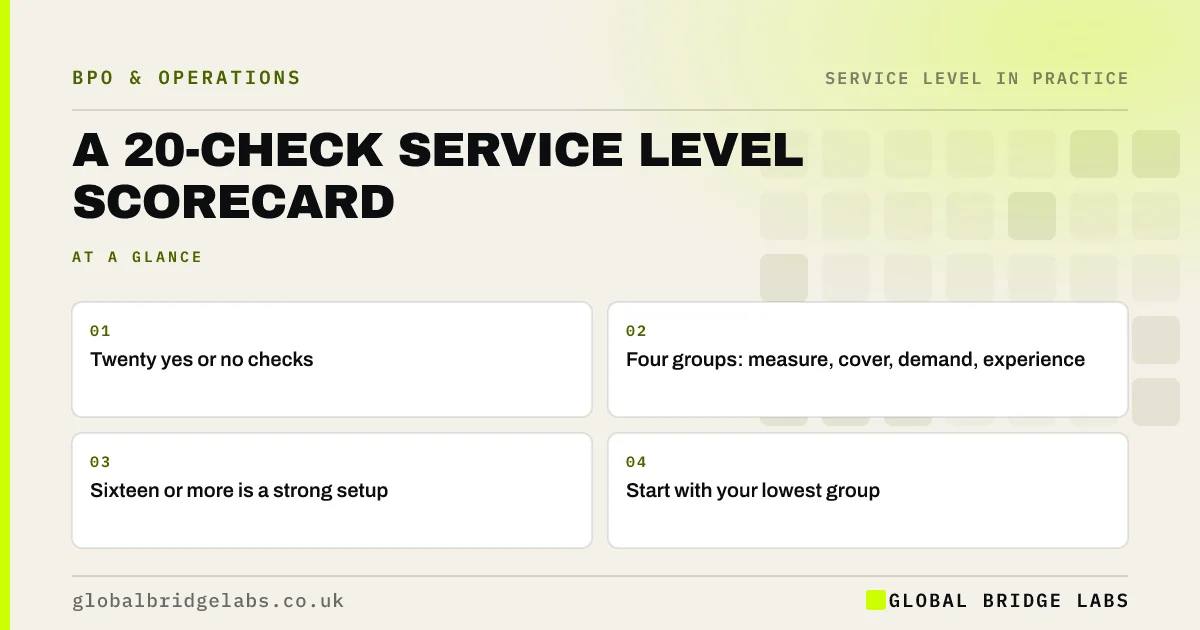
This scorecard has 20 yes or no checks in four groups of five: measure, cover, demand and experience. Score one point for each yes. Sixteen or more suggests a strong setup, 12 to 15 means work on the gaps, and under 12 means start with measurement. The lowest-scoring group shows where to focus first.
- Twenty yes or no checks.
- Four groups: measure, cover, demand, experience.
- Sixteen or more is a strong setup.
- Start with your lowest group.
Want help scoring your call service? Message us on WhatsApp.
Chat on WhatsApp →Measure
Score one point for each check you can answer yes to today, without planning to do it later.
- Service level formula written down.
- Service level reported by half hour.
- Abandonment reported alongside.
- Longest wait tracked daily.
- Every call coded with a reason.
Cover
These checks show whether people are on the phones when callers need them.
- Forecast made by half hour.
- Shrinkage included in rotas.
- Breaks staggered around peaks.
- Overflow or back-up rules agreed.
- Callback offered before callers give up.
Demand
These checks show whether you are reducing the calls that did not need to happen.
- Pareto chart of reasons reviewed monthly.
- Top reason has an owner and a fix.
- Proactive updates for status questions.
- Customer messages checked for clarity.
- Repeat callers reviewed.
Want your scores benchmarked against your own last quarter? Send them to us on WhatsApp.
Chat on WhatsApp →Experience
These checks show whether callers are helped well once they get through.
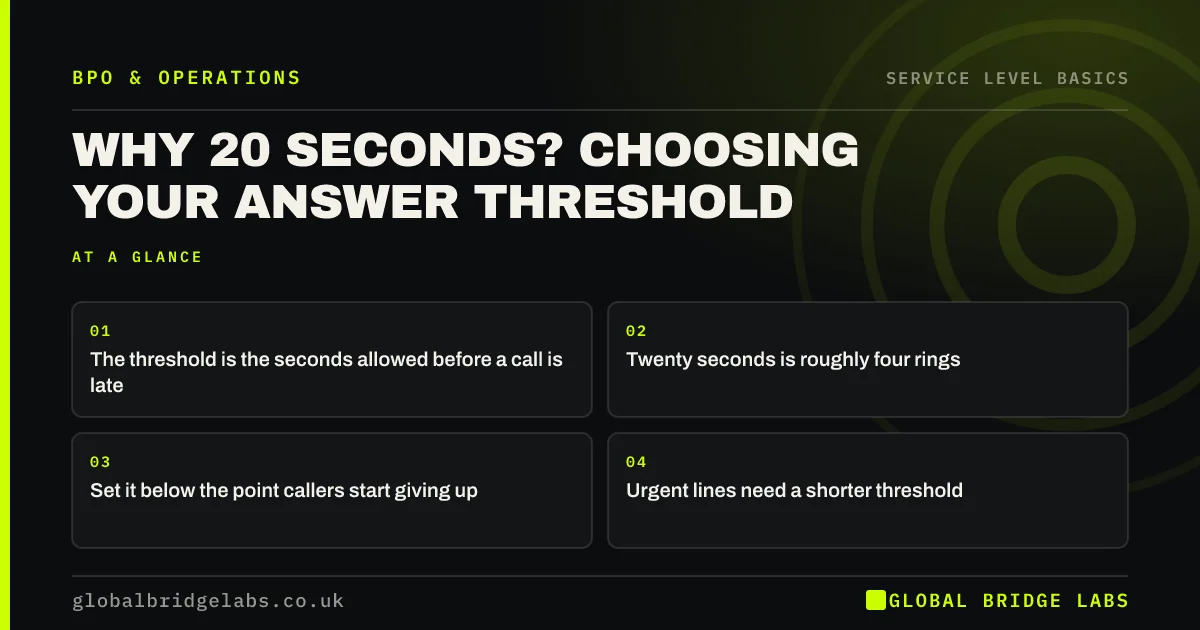
- Queue message under 20 seconds.
- Menu with four or fewer options.
- Resolution measured with speed.
- Calls sampled and coached.
- Call handling standards shared with all teams.
How do you use the score?
Add up each group. Fix the lowest group first, because gaps there usually limit the others. Rescore each quarter and track the total over time.
What does this look like in practice?
A pattern we see: a team scores 11, with only one point in demand. It starts coding call reasons and building a monthly review. A quarter later it scores 15, and service level has improved without new staff.
The team keeps the scorecard on its monthly review agenda, so the score becomes a regular check rather than a one-off exercise.
Scorecard checklist
- Score all 20 checks honestly.
- Add up each group.
- Fix the lowest group first.
- Rescore each quarter.
- Share the score with the team.
Next step
Score your business on all 20 checks today, note your lowest group and pick one check in it to turn into a yes this month.
Message us on WhatsApp to score your call service, or book a 30-minute consultation.
Chat on WhatsApp →Sources and further reading
- Measuring success · GOV.UK Service Manual
- Stop trying to delight your customers (Dixon, Freeman and Toman, 2010) · Harvard Business Review
Frequently asked questions
What score should I aim for?
Sixteen or more suggests a strong setup. Twelve to 15 means good foundations with gaps to fix. Under 12 usually means measurement is the place to start, because without reliable data it is hard to improve cover, demand or experience with confidence.
Which group should I fix first?
Usually your lowest-scoring group. If several are low, start with measure, because the other groups depend on accurate data. Fixing one or two checks at a time and rescoring each quarter is more effective than trying to change everything at once.
Can I use the scorecard with an outsourced provider?
Yes. Score the whole service, including what the provider does. Ask the provider to help answer checks about their reporting, rotas and standards. Gaps in the provider's area become points for your next review meeting with them. Share the scorecard with them in advance.
Written by

Global Bridge Labs (GBL) is a UK–Sri Lanka partner for social media, websites and BPO. Everything here comes from client delivery, not theory.