On this page
Key takeaways
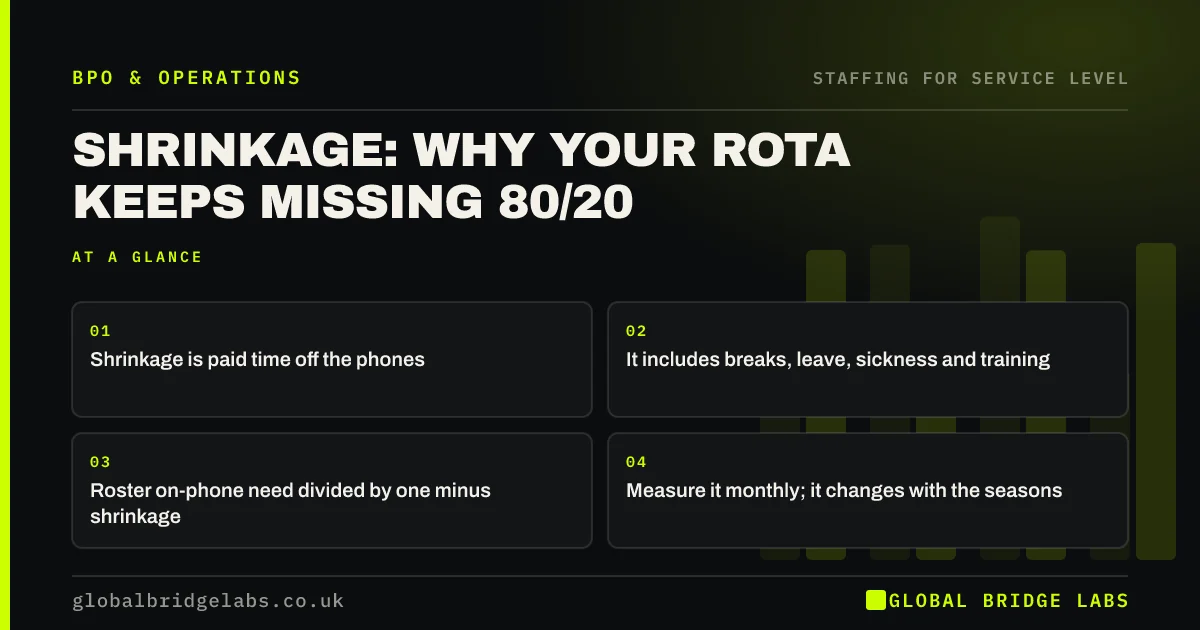
Shrinkage is the share of paid time when people are not available to take calls: breaks, holidays, sickness, training, meetings and one-to-ones. If your staffing plan says 11 people are needed on the phones and shrinkage is 30%, you need to roster about 16. Ignoring shrinkage is one of the most common reasons a rota misses its target.
- Shrinkage is paid time off the phones.
- It includes breaks, leave, sickness and training.
- Roster on-phone need divided by one minus shrinkage.
- Measure it monthly; it changes with the seasons.
Want your shrinkage measured? Message us on WhatsApp.
Chat on WhatsApp →What counts as shrinkage?
Planned shrinkage includes holidays, breaks, training, team meetings and coaching. Unplanned shrinkage includes sickness, lateness and unexpected tasks. Some teams also count time spent on non-call work, such as emails, if the same people handle both.
How do you calculate it?
Divide the hours staff were paid but not available for calls by total paid hours, and multiply by 100. Track planned and unplanned separately. As a check, paid holiday alone is 5.6 weeks a year for full-time workers under the statutory minimum, which is around 11% of a working year before breaks or sickness.
How does shrinkage change staffing?
Divide the on-phone figure by one minus shrinkage. If 11 people are needed on the phones and shrinkage is 30%, you need 11 divided by 0.7, about 16 people rostered for that half hour across your team plan. Planning for 11 means you will regularly have seven or eight available.
- On-phone need divided by one minus shrinkage.
- Plan by half hour, not by day.
- Use separate figures for busy seasons.
Want help adding shrinkage to your rota? Send us your rota on WhatsApp.
Chat on WhatsApp →How do you reduce shrinkage fairly?
You should not cut breaks or holidays. Instead, schedule training and meetings in quiet half hours, keep one-to-ones short and regular, and look at what drives sickness, such as stress from constant queues. Lower unplanned shrinkage usually comes from better working conditions, not tighter control.
What does this look like in practice?
A pattern we see: a team rosters exactly the on-phone figure and misses 80/20 most mornings. Measuring shrinkage shows it is about 28%, mostly training and meetings booked at 10am. Moving them to mid-afternoon fixes most of the gap.
Shrinkage checklist
- Record paid hours off the phones.
- Split planned and unplanned shrinkage.
- Divide on-phone need by one minus shrinkage.
- Move training and meetings to quiet times.
- Review shrinkage monthly.
Next step
Total last month's paid hours off the phones by type, work out your shrinkage percentage and add it to next month's rota plan.
Message us on WhatsApp to plan for shrinkage, or book a 30-minute consultation.
Chat on WhatsApp →Sources and further reading
- Holiday entitlement · GOV.UK
- Sickness absence in the UK labour market · Office for National Statistics
Frequently asked questions
What is a typical shrinkage percentage?
It varies widely by team, season and how it is measured. Many teams find it sits somewhere around a quarter to a third of paid time once holidays, breaks, sickness, training and meetings are included. Measure your own rather than relying on a general figure, and review it each season.
Is shrinkage the same as absence?
No. Absence is one part of shrinkage. Shrinkage also includes planned time off the phones, such as breaks, holidays, training and meetings. A team with low sickness can still have high shrinkage if training and meetings take a lot of time in busy hours.
Should shrinkage be planned by half hour?
Yes, where possible. Breaks, meetings and training happen at particular times, so shrinkage is uneven through the day. Planning it by half hour shows whether too many people are off the phones in your busiest intervals, which is where service level is usually lost.
Written by

Global Bridge Labs (GBL) is a UK–Sri Lanka partner for social media, websites and BPO. Everything here comes from client delivery, not theory.