On this page
Key takeaways
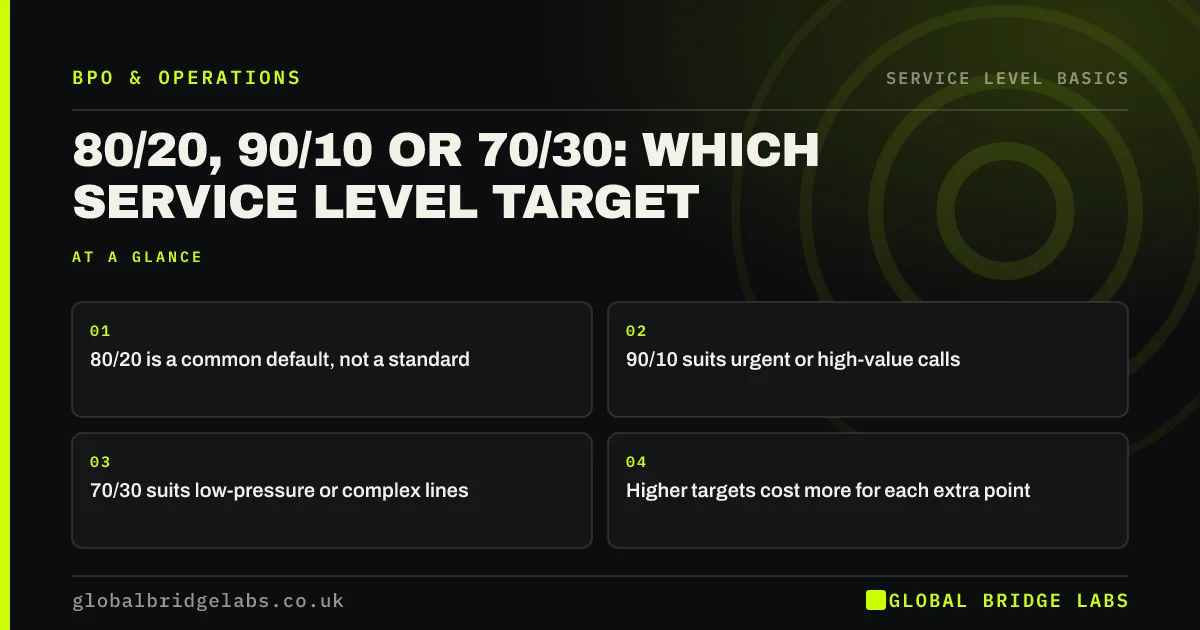
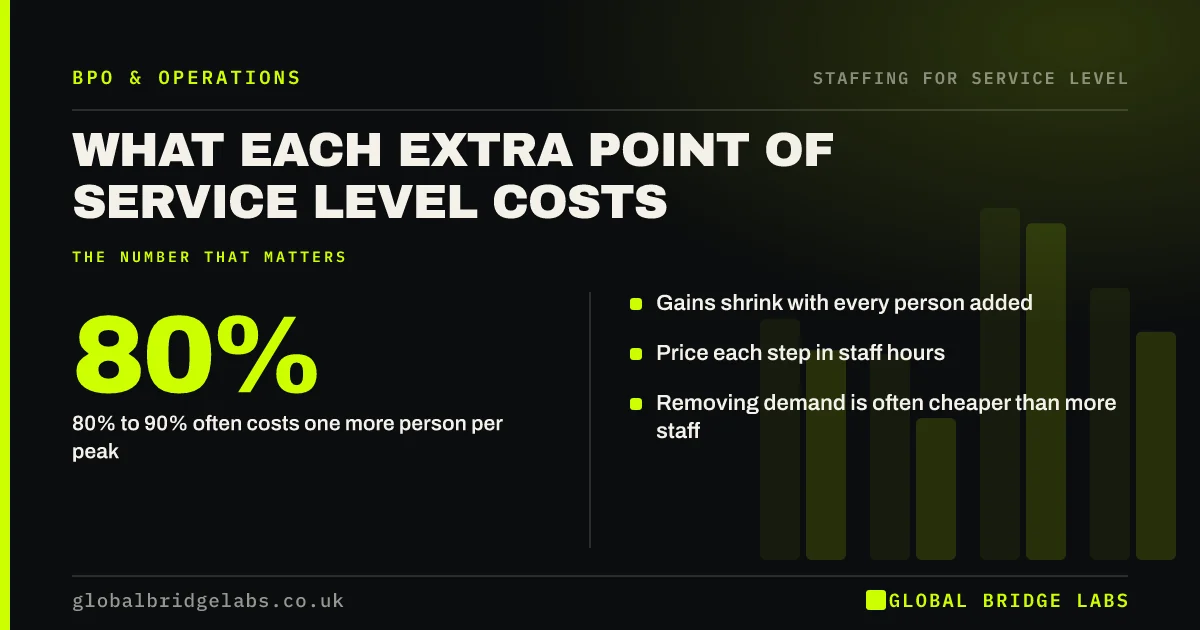
Each extra point of service level costs more than the one before. In a busy half hour, 65% to 80% may need one more person, and 80% to 90% another. Beyond that, gains are small. Price each step in staff hours, compare it with the value of the calls you would save, and stop where the gain no longer pays.
- Gains shrink with every person added.
- 80% to 90% often costs one more person per peak.
- Price each step in staff hours.
- Removing demand is often cheaper than more staff.
Want each service level step priced for your team? Message us on WhatsApp.
Chat on WhatsApp →Why do the gains shrink?
Once there is enough spare capacity to absorb most clusters of calls, each extra person is mostly idle. In an illustrative half hour with 60 four-minute calls, ten people give about 65% within 20 seconds, 11 about 81%, 12 about 90% and 13 about 95%. The first step adds 16 points; the third adds five.
How do you price each step?
Multiply the extra people by the half hours they are needed and by the full hourly cost, including employer costs. One extra person for four busy half hours each weekday is ten hours a week. At an illustrative full cost of £18 an hour, that is £180 a week. Example only.
What is the extra service worth?
Estimate how many callers hang up at the lower level and what a lost call is worth. For a sales line, a lost call may be a lost job. For a service line, it may be a repeat call or a complaint. If the value of saved calls is higher than the cost, the step pays.
- Count abandoned calls at each level.
- Estimate the value of a lost call.
- Compare with the cost of the step.
- Call abandonment rate: what it is and how to lower it
- What missed calls really cost a trades business
Want the business case for a higher target? Send us your numbers on WhatsApp.
Chat on WhatsApp →What are the cheaper alternatives?
Before paying for another person, check whether you can remove demand, shorten after-call work or move breaks. Overflow cover for the peak half hours can also be cheaper than a full extra shift, because you pay only when calls exceed your team.
What does this look like in practice?
A pattern we see: an owner wants 90/20 and gets a quote for two extra staff. Pricing each step shows the first person is worth it for the morning peak, but the second adds little. Overflow covers the rest of the gap.
Service level cost checklist
- Work out service level at each staffing level.
- Price each step in staff hours.
- Estimate the value of saved calls.
- Check demand and break fixes first.
- Compare with overflow cover.
Next step
For your busiest half hour, list the service level at each staffing level, price each step and decide where the gain stops paying.
Message us on WhatsApp to price your service level target, or book a 30-minute consultation.
Chat on WhatsApp →Sources and further reading
- National Minimum Wage and National Living Wage rates · GOV.UK
- Rates and thresholds for employers 2026 to 2027 · HM Revenue & Customs
Frequently asked questions
Why does going from 80% to 90% cost so much?
Because the last few points need spare capacity for the rare moments when many calls arrive together. Each added person spends more time waiting for calls. In busy half hours one person may cover the step, but across a whole day the cost adds up quickly.
Is it ever worth aiming for 95%?
For urgent or high-value lines, sometimes. Emergency call-outs, safety lines or premium sales lines may justify it in their busiest hours. For most general lines, the extra cost is better spent on resolving calls first time or removing avoidable calls.
Can overflow replace a higher in-house target?
Often it can cover the gap. Your team handles the steady volume and overflow takes calls beyond it during peaks. You pay for overflow only when it is used, which can be cheaper than rostering extra people for every busy half hour.
Written by

Global Bridge Labs (GBL) is a UK–Sri Lanka partner for social media, websites and BPO. Everything here comes from client delivery, not theory.