
On this page
Key takeaways
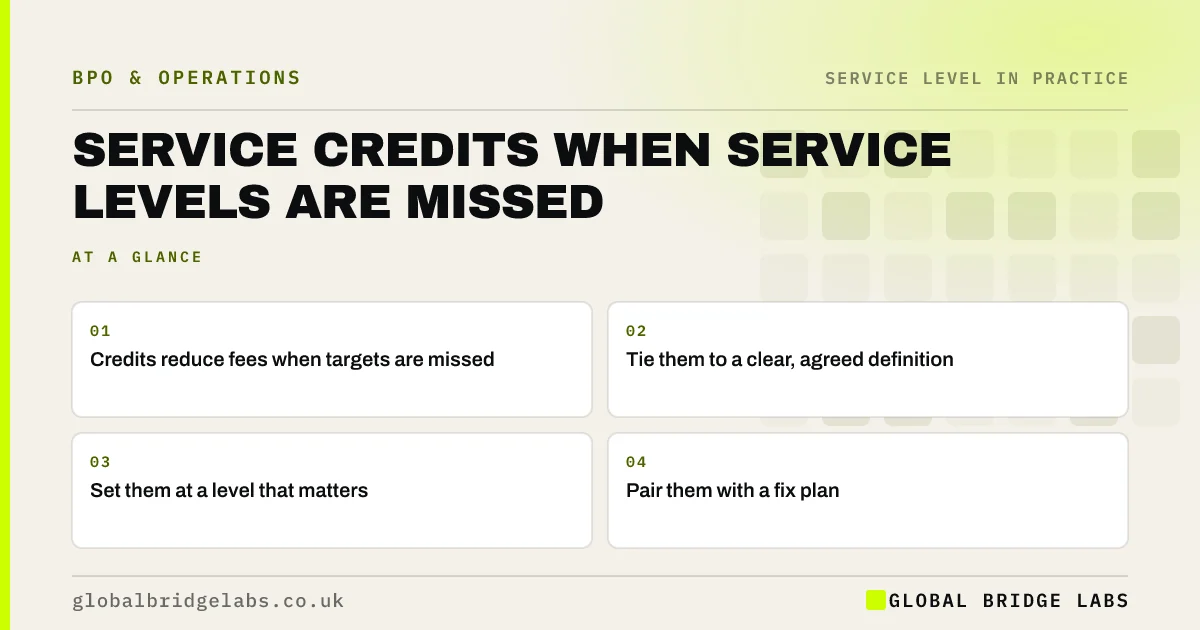
Service credits are reductions in a provider's fees when agreed service levels are missed. They give the provider a financial reason to meet targets and give you some recompense. They work best when tied to a clear definition, set at a level that matters, capped sensibly and paired with a plan to fix the cause.
- Credits reduce fees when targets are missed.
- Tie them to a clear, agreed definition.
- Set them at a level that matters.
- Pair them with a fix plan.
Want help setting service credits? Message us on WhatsApp.
Chat on WhatsApp →How do service credits work?
The contract lists measures, such as service level and abandonment, with targets. If a target is missed in a period, a set percentage of that period's fee is credited. Credits are often tiered, rising with the size of the miss, and capped at a share of the fee.
Which measures should carry credits?
A small number that matter most to your callers, such as service level by half hour or day, abandonment and callback completion. Too many credited measures make contracts complex and encourage arguments about minor misses.
- Service level.
- Abandonment.
- Callback completion.
How much should credits be?
Enough that the provider takes misses seriously, but not so high that the provider prices in a large risk premium. Many contracts cap total credits at a modest share of the monthly fee. The UK government's Sourcing Playbook discusses balanced risk in service contracts.
Want your SLA and credits reviewed? Send them to us on WhatsApp.
Chat on WhatsApp →Why should credits drive fixes?
Credits compensate, but they do not fix the service. Require a short improvement plan after any credited miss, reviewed at the next meeting. Repeated misses should allow escalation or termination, not just more credits.
What does this look like in practice?
A pattern we see: a contract has credits for monthly service level only, and the provider meets it while lunchtimes suffer. Adding a daily measure and an improvement plan requirement leads to lunchtime cover and fewer complaints.
The credits themselves are rarely triggered after that, which is the outcome both sides wanted.
Both sides also agree to review the measures each year, so the contract keeps pace with changes in call volumes and the lines covered.
Service credit checklist
- Define each measure precisely.
- Credit only key measures.
- Set tiered, capped credits.
- Require an improvement plan.
- Allow escalation for repeated misses.
Next step
List the measures in your current contract, check each has a precise definition and add an improvement plan requirement for any credited miss.
Message us on WhatsApp to set fair service credits, or book a 30-minute consultation.
Chat on WhatsApp →Sources and further reading
- Contracts and liabilities between controllers and processors · Information Commissioner's Office
- The Sourcing and Consultancy Playbooks · Cabinet Office
Frequently asked questions
What is a service credit?
A service credit is a reduction in a provider's fee when an agreed service level is missed. It is set out in the contract, usually as a percentage of the fee for the period. It gives the provider an incentive to meet targets and gives the customer some recompense.
Are service credits the only remedy for poor service?
No. Credits compensate for misses, but contracts should also require improvement plans, regular reviews and, for repeated or serious failures, escalation or termination rights. Relying only on credits can leave you with a provider that pays small credits rather than fixing the service.
How should service levels be defined for credits?
Precisely: the formula, threshold, clock start, abandon cut-off, period measured and how transfers and callbacks count. Vague definitions lead to disputes. Use the same definition in reports and the contract, and require access to raw data so figures can be checked.
Written by

Global Bridge Labs (GBL) is a UK–Sri Lanka partner for social media, websites and BPO. Everything here comes from client delivery, not theory.


