
On this page
Key takeaways
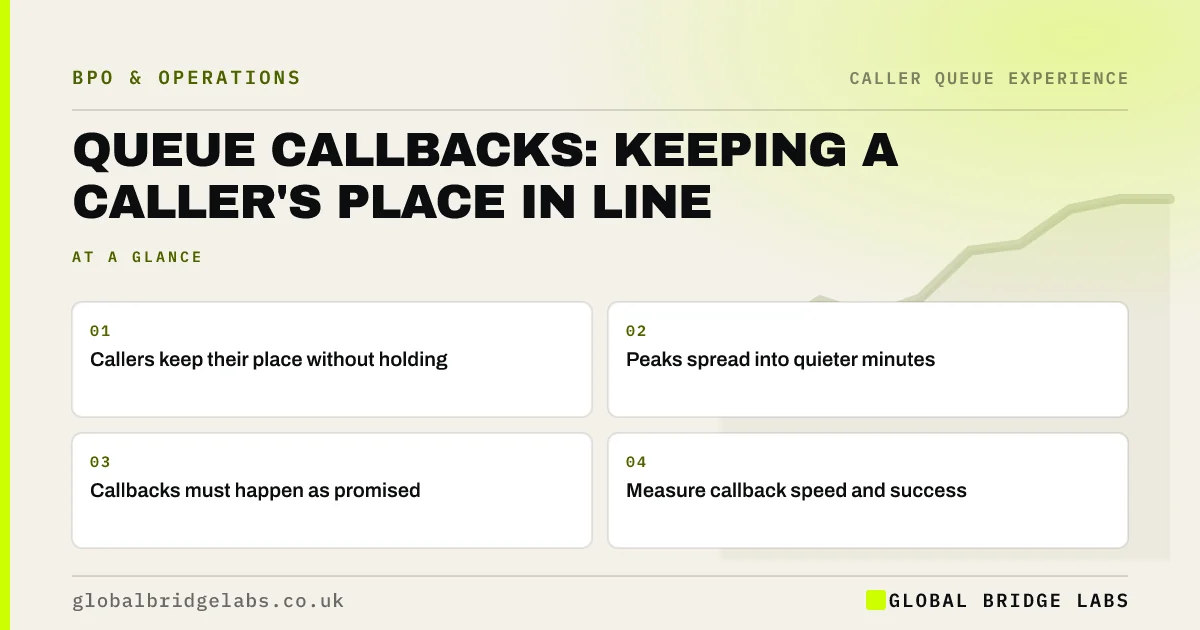
A queue callback lets a caller hang up and keep their place, then receive a call when they reach the front. It removes the worst part of a wait, the time on hold, and spreads busy peaks into quieter minutes. It only works if callbacks really happen on time, so measure them as carefully as live calls.
- Callers keep their place without holding.
- Peaks spread into quieter minutes.
- Callbacks must happen as promised.
- Measure callback speed and success.
Want to add a queue callback? Message us on WhatsApp.
Chat on WhatsApp →How does a queue callback work?
When the wait passes a set point, the caller hears an offer to be called back. They confirm their number and hang up. The system holds their place and calls them back when a person is free, often connecting the caller before the agent to avoid waiting at the other end.
When should you offer it?
Offer it when the expected wait is longer than callers are happy to hold, often around one to two minutes. Offering it too early adds steps for short waits; offering it too late means many callers have already hung up.
How does it affect service level?
Decide how callbacks count. Some teams count them as answered when the callback connects, others report them separately. Either way, report callback time and success rate, so a good service level is not hiding callbacks made hours later.
- Report callbacks separately.
- Track time to callback.
- Track successful connections.
Want callback rules set for your peaks? Send us your call data on WhatsApp.
Chat on WhatsApp →What makes callbacks fail?
Callbacks fail when they are made too late, from a withheld number callers ignore, or when nobody is free to make them in a long peak. Use a recognisable number, set a limit on how many callbacks can queue, and make a second attempt if the first is missed.
What does this look like in practice?
A pattern we see: Monday morning abandonment is high. Offering a callback at 90 seconds means many callers choose it, and callbacks are completed by mid-morning. Abandonment falls and the Monday service level for remaining calls improves.
The team also learns that callbacks made from a recognisable number connect far more often than those from a withheld one, so the outgoing number is changed in the first week.
Queue callback checklist
- Offer callbacks when waits pass your limit.
- Use a recognisable outgoing number.
- Cap the number of queued callbacks.
- Retry missed callbacks once.
- Report callback speed and success.
Next step
Check whether your phone system supports queue callbacks, set an offer point near your callers' patience limit and track the first month closely.
Message us on WhatsApp to set up queue callbacks, or book a 30-minute consultation.
Chat on WhatsApp →Sources and further reading
- Stop trying to delight your customers (Dixon, Freeman and Toman, 2010) · Harvard Business Review
- UK Customer Satisfaction Index · Institute of Customer Service
Frequently asked questions
Do customers like callback options?
Many do, because they avoid holding and can carry on with their day. Satisfaction depends on the callback arriving when promised. A callback that comes hours later, or from an unknown number, can be worse than waiting, so measure callback performance as closely as live calls.
What if the customer misses the callback?
Most systems retry after a few minutes. If the second attempt fails, leave a short voicemail or send a text explaining how to reach you. Record missed callbacks so you can see whether the number used, the timing or the delay is causing them.
Does a callback count as an answered call?
That depends on your agreed definition. Some teams count the callback as answered when it connects; others report callbacks separately from live calls. Separate reporting is clearer. Whatever you choose, write it down and make sure any provider reports the same way.
Written by

Global Bridge Labs (GBL) is a UK–Sri Lanka partner for social media, websites and BPO. Everything here comes from client delivery, not theory.


