
On this page
Key takeaways
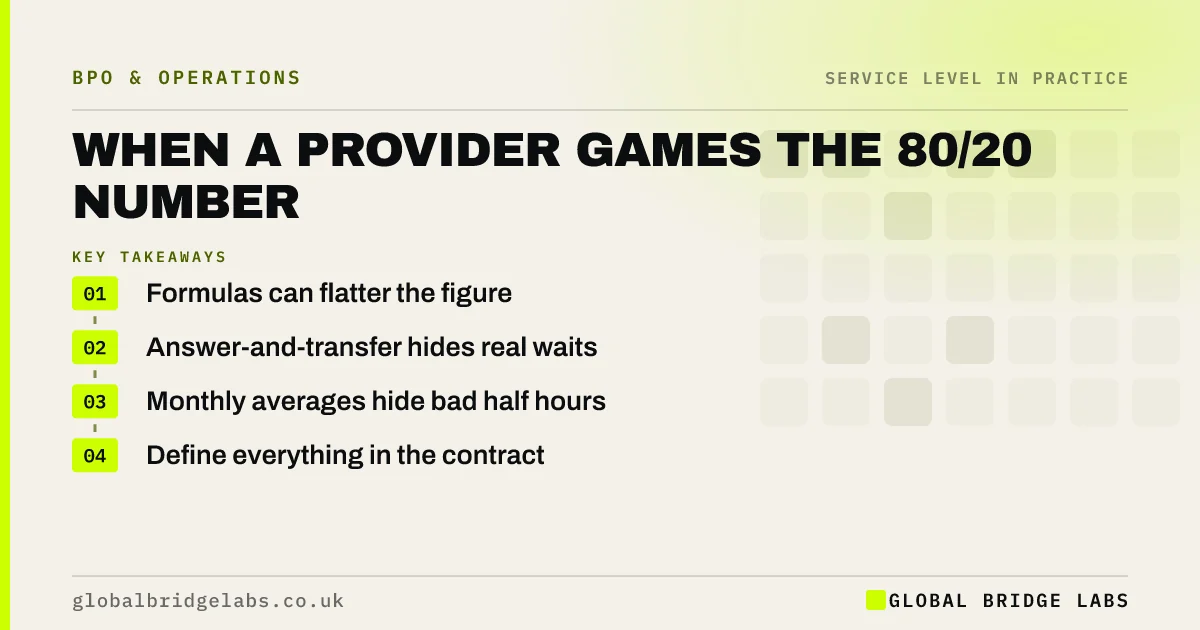
A service level figure can look good without callers being served well. Common tricks include leaving abandoned calls out, starting the clock late, answering and transferring, and reporting only monthly averages. You protect yourself by defining the formula in the contract, asking for raw data and half-hourly reports, and checking outcomes as well as speed.
- Formulas can flatter the figure.
- Answer-and-transfer hides real waits.
- Monthly averages hide bad half hours.
- Define everything in the contract.
Concerned your provider's figures look too good? Message us on WhatsApp.
Chat on WhatsApp →How can service level be gamed?
Usually through definitions rather than outright misreporting, which is why the small print of the formula matters so much.
- Counting only answered calls.
- Starting the clock after a long menu.
- Excluding calls that abandon within a long cut-off.
- Answering quickly and transferring to a second queue.
- Reporting monthly averages only.
How do you spot it?
Compare service level with abandonment and the longest wait. If service level is high but abandonment is high too, check the formula. Look at transfer rates and second-queue waits. Ask for raw call records and recalculate a sample yourself.
What should the contract say?
Define the formula, the threshold, where the clock starts, the short-abandon cut-off and how transfers and callbacks count. Require half-hourly reports and access to raw call data. Link service credits to the agreed definition.
- Formula and threshold.
- Clock start and abandon cut-off.
- Half-hourly reports and raw data.
Want your provider's report checked? Send it to us on WhatsApp.
Chat on WhatsApp →How do you keep it honest?
Review reports monthly with the provider, recalculate a sample each quarter and pair speed with outcome measures, such as resolution and sampled call quality. A provider confident in its service will welcome the scrutiny.
What does this look like in practice?
A pattern we see: a provider reports 90/20, but recalculating from raw data with abandoned calls included gives 74/20. The contract is updated with a clear definition, and the provider adds lunchtime cover to meet the honest target.
Monthly reviews now start with the recalculated figure, which both sides accept, so discussions focus on improving service rather than arguing about numbers.
Gaming check checklist
- Define the formula in the contract.
- Ask for raw call data.
- Compare service level with abandonment.
- Check transfers and second queues.
- Recalculate a sample quarterly.
Next step
Ask your provider for one month of raw call records, recalculate service level using your preferred formula and compare it with their report.
Message us on WhatsApp to check your provider's figures, or book a 30-minute consultation.
Chat on WhatsApp →Sources and further reading
- Contracts and liabilities between controllers and processors · Information Commissioner's Office
- Measuring success · GOV.UK Service Manual
Frequently asked questions
Is gaming service level the same as fraud?
Usually not. Most gaming comes from definitions that favour the provider, such as excluding abandoned calls, rather than false data. That is why the contract should define the formula precisely. Deliberately false reporting would be a much more serious breach and should be handled as such.
How do I check a provider's service level?
Ask for raw call records, recalculate a sample using your agreed formula and compare with their report. Check abandonment, longest waits and transfers alongside. Listen to some calls. If the figures do not match, discuss the definition first before assuming anything worse.
What is answer-and-transfer?
It is when a call is answered quickly, counting towards service level, and then transferred to another queue where the caller waits again. The first figure looks good, but the caller's total wait is long. Track transfers and second-queue waits to see the full picture.
Written by

Global Bridge Labs (GBL) is a UK–Sri Lanka partner for social media, websites and BPO. Everything here comes from client delivery, not theory.


