
On this page
Key takeaways
AI voice agents can answer every call instantly, so a traditional service level target is easy to hit. The real questions are whether the caller's need was met and how quickly they reach a person when it was not. Measure resolution, hand-off speed and caller outcomes, not just answer speed, and keep a clear route to a person.
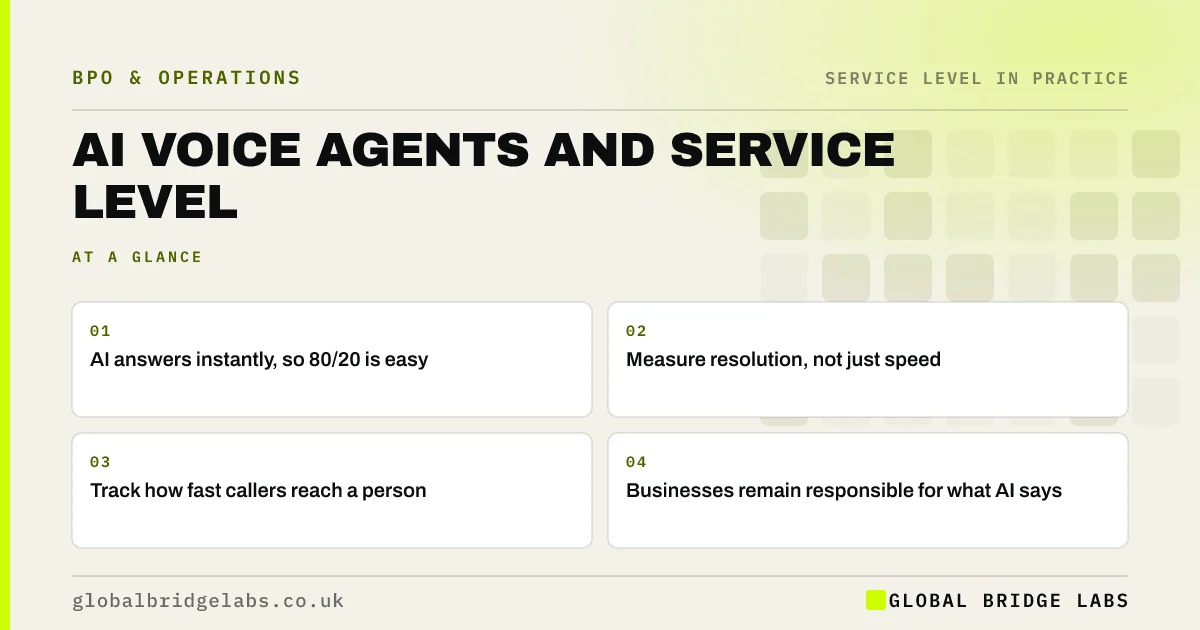
- AI answers instantly, so 80/20 is easy.
- Measure resolution, not just speed.
- Track how fast callers reach a person.
- Businesses remain responsible for what AI says.
Considering an AI voice agent for your phones? Message us on WhatsApp.
Chat on WhatsApp →Where can AI voice agents help?
For simple, repetitive requests: opening hours, booking or changing appointments, order status and taking messages. They can handle these at any hour and absorb spikes. They work best when the task is clear and the data they need is reliable.
Where do they struggle?
With complex, emotional or unusual calls, unclear speech, strong accents for some systems and anything requiring judgement. A caller stuck in a loop with an AI agent has a worse experience than one who waited for a person.
How should service level be measured?
Measure how quickly callers reach a person when they need one, the share of calls fully resolved by the AI, and caller feedback. Count calls the AI could not handle and how long those callers waited for a person.
- Time to reach a person.
- Share resolved by the AI.
- Caller feedback.
- First contact resolution: what it is and how to improve it
- A two-question post-call survey that works
Want help setting measures for AI call handling? Ask us on WhatsApp.
Chat on WhatsApp →What are the risks?
A business can be held responsible for what its automated agent tells customers, as a Canadian tribunal found in a case involving an airline chatbot. Check accuracy regularly, limit what the agent can promise and follow ICO guidance on AI and personal data.
What does this look like in practice?
A pattern we see: an AI agent answers all calls instantly, but many callers ask for a person and wait longer than before. Limiting the AI to bookings and order status, with an immediate route to a person for everything else, improves feedback.
Reviewing a sample of AI calls each week also catches two answers that were out of date, which are corrected before they cause complaints.
AI voice agent checklist
- Limit AI to simple tasks.
- Keep a quick route to a person.
- Measure time to reach a person.
- Sample AI calls for accuracy.
- Check data protection rules.
Next step
List the call reasons an AI agent could fully resolve, and decide how quickly callers with other reasons must reach a person.
Message us on WhatsApp to plan AI and human call handling, or book a 30-minute consultation.
Chat on WhatsApp →Sources and further reading
- Artificial intelligence · Information Commissioner's Office
- Moffatt v. Air Canada, 2024 BCCRT 149 · Civil Resolution Tribunal of British Columbia
Frequently asked questions
Do AI voice agents improve service level?
They answer instantly, so a traditional 80/20 figure improves. Whether service improves depends on how many calls the AI fully resolves and how quickly others reach a person. Measure resolution, time to reach a person and caller feedback to see the real effect.
Can AI voice agents replace call handlers?
For some simple, repetitive calls, they can handle much of the work. For complex, emotional or unusual calls, people remain important. Most businesses get the best results from a mix, with AI for simple tasks and a quick route to a person for everything else.
Is my business responsible for what an AI agent says?
Generally, you should assume so. A Canadian tribunal held an airline responsible for incorrect information its chatbot gave a customer. Check accuracy regularly, limit what the agent can promise and make sure customers can reach a person to correct mistakes.
Written by

Global Bridge Labs (GBL) is a UK–Sri Lanka partner for social media, websites and BPO. Everything here comes from client delivery, not theory.


