On this page
- 01Key takeaways
- 02Why do scaling efforts fail?
- 03Which hiring mistakes are most common?
- 04Which process mistakes are most common?
- 05Which outsourcing mistakes are most common?
- 06What is the leadership mistake?
- 07What are the early warning signs?
- 08What does this look like in practice?
- 09Mistake-prevention checklist
- 10Next step
- 11Sources and further reading
- 12Frequently asked questions
Key takeaways
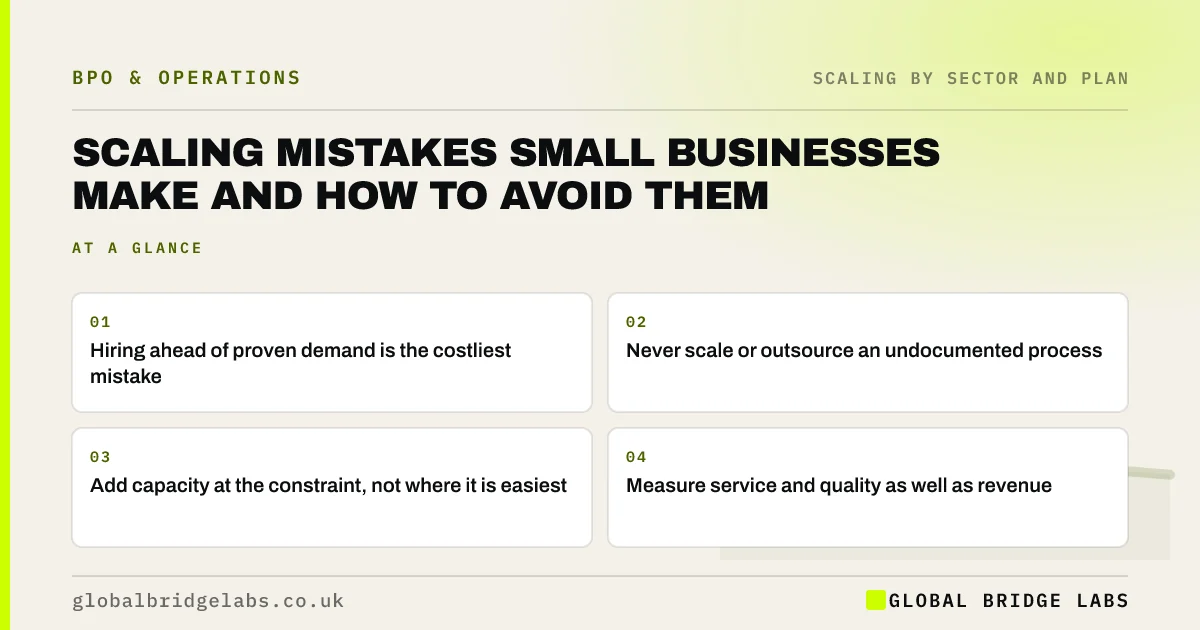
The commonest mistakes when scaling a business are adding fixed cost before demand is proven, scaling a process nobody has written down, and leaving the owner as the approval point for everything. Each has an early warning sign. Catching it costs a few hours. Missing it can cost a year's profit.
- Hiring ahead of proven demand is the costliest mistake.
- Never scale or outsource an undocumented process.
- Add capacity at the constraint, not where it is easiest.
- Measure service and quality as well as revenue.
Recognise one of these in your business? Message us on WhatsApp and we will talk it through.
Chat on WhatsApp →Why do scaling efforts fail?
Scaling efforts fail because growth exposes weaknesses that a small business could live with. Informal handovers, unwritten rules and an owner who decides everything work at five people and break at fifteen. The mistakes below are the usual ways firms respond to that pressure, and each makes it worse.
Which hiring mistakes are most common?
Three hiring mistakes come up repeatedly. Recruiting several people at once on the strength of one good quarter. Turning a part-time need into a full-time job because that is how jobs are advertised. And hiring support roles before the revenue-earning roles they are meant to support.
- Mistake 1: hiring ahead of proven demand.
- Mistake 2: a full-time role for a part-time need.
- Mistake 3: support hires before revenue hires.
Which process mistakes are most common?
The process mistakes are scaling work that is not written down and adding capacity in the wrong place. An undocumented process cannot be taught quickly, to an employee or a provider. And extra hands anywhere but the constraint raise cost without raising output.
- Mistake 4: scaling an undocumented process.
- Mistake 5: adding capacity away from the bottleneck.
Which outsourcing mistakes are most common?
The outsourcing mistakes are handing over a broken process in the hope the provider will fix it, and choosing on hourly rate alone. A provider can run and improve a working process. It cannot rescue one the client does not understand. The cheapest rate often carries the highest rework.
- Mistake 6: outsourcing a process that does not work.
- Mistake 7: choosing on price, with no owner or scorecard.
- Outsourcing decision mistakes UK SMEs make
- Who should own the outsourcing relationship in a small firm?
Want to discuss your requirements before choosing a provider? Message us on WhatsApp.
Chat on WhatsApp →What is the leadership mistake?
The leadership mistake is the owner remaining the approval point for quotes, hires, payments and complaints as volume doubles. Staff cannot normally be required to work more than an average of 48 hours a week, and owners who exempt themselves from that limit become the slowest step in the business.
- Mistake 8: the owner approving everything.
What are the early warning signs?
Each mistake shows an early sign. Watch for staff with idle time after a hiring round, the same question asked by every new starter, queues that do not shrink when people are added, rework rising after a handover, and decisions waiting days for the owner.
What does this look like in practice?
A pattern we see in UK firms after a difficult growth year: three of the eight mistakes happened together. The business hired quickly, into unwritten processes, with the owner approving everything. Unpicking it starts with the same step each time, which is writing down how the main processes work.
Mistake-prevention checklist
Review this before any commitment to add capacity.
- Demand has been steady for two quarters.
- The need is sized in hours, not job titles.
- The process is written down.
- Capacity is going to the constraint.
- An owner and a scorecard are in place.
- Decisions the team can make alone are defined.
- Service and quality are measured weekly.
- A review date is set for 90 days.
Next step
Tell us what you are planning and what worries you about it. We will say plainly which of these mistakes the plan risks and how to avoid it.
Message us on WhatsApp for a plan review, or book a 30-minute consultation.
Chat on WhatsApp →Sources and further reading
- Maximum weekly working hours · GOV.UK
- Redundancy: your rights · GOV.UK
- The Sourcing and Consultancy Playbooks · Cabinet Office
Frequently asked questions
What are common mistakes when scaling a business?
Common mistakes are hiring ahead of proven demand, scaling processes that are not documented, adding capacity in the wrong place, outsourcing a process that does not work, choosing suppliers on price alone, and keeping the owner as the approval point for every decision.
Why do businesses fail when they scale?
Businesses fail when scaling because costs and complexity grow faster than revenue and control. Fixed costs are added early, quality drops as untrained people join undocumented processes, cash is stretched and the owner becomes a bottleneck. The underlying business may be sound while the scaling is not.
How can I scale without losing quality?
Scale without losing quality by documenting processes first, adding capacity in small steps, training from written guides, sampling work weekly and tracking error rates alongside volume. Slow down if quality measures worsen. Speed gained at the expense of quality is usually lost again in rework.
What should I fix before trying to scale?
Fix three things first: make sure each sale is profitable, write down how your main processes work, and name who owns operations. With those in place, adding capacity is straightforward. Without them, more volume makes existing problems larger.
Written by

Global Bridge Labs (GBL) is a UK–Sri Lanka partner for social media, websites and BPO. Everything here comes from client delivery, not theory.