On this page
- 01Key takeaways
- 02Why do admin staff keep leaving?
- 03What does turnover cost?
- 04How do you break the turnover cycle?
- 05Where does outsourcing help?
- 06Does outsourcing have its own turnover?
- 07When is turnover a management problem instead?
- 08What should you ask in exit conversations?
- 09What does this look like in practice?
- 10Turnover checklist
- 11Next step
- 12Sources and further reading
- 13Frequently asked questions
Key takeaways
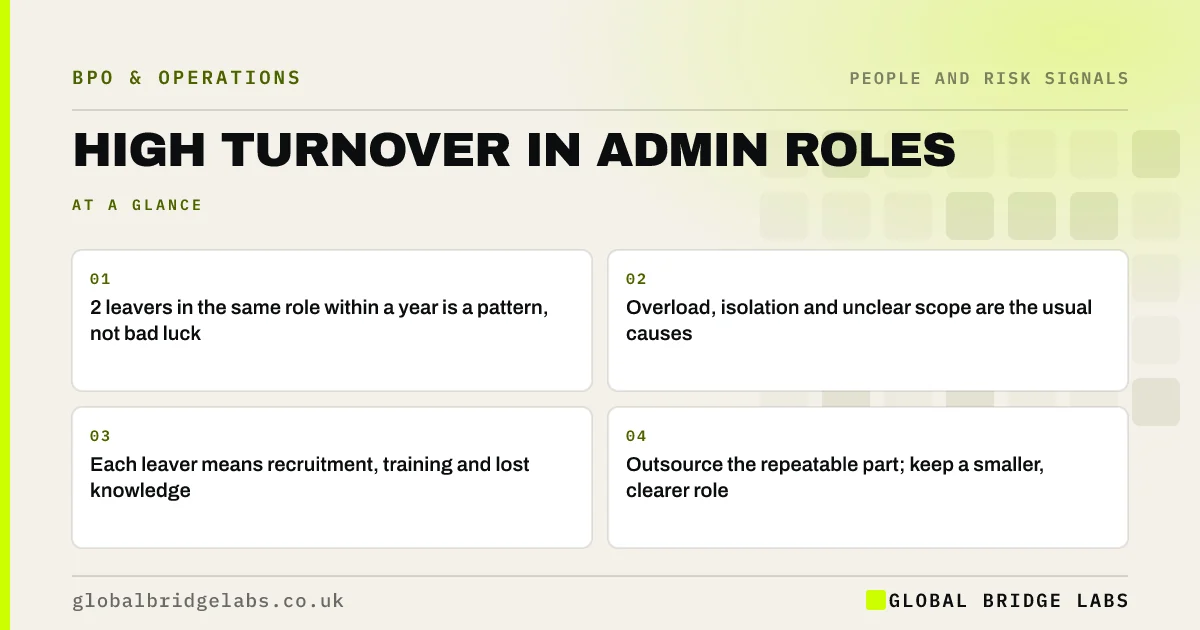
High staff turnover in admin roles usually means the role is overloaded, isolated or badly defined, not that you keep hiring the wrong people. Each leaver costs recruitment, training and weeks of work falling back on others. If two or more people have left the same role in a year, redesign it, and consider outsourcing the repeatable part.
- 2 leavers in the same role within a year is a pattern, not bad luck.
- Overload, isolation and unclear scope are the usual causes.
- Each leaver means recruitment, training and lost knowledge.
- Outsource the repeatable part; keep a smaller, clearer role.
Same admin role keeps emptying? Message us on WhatsApp and tell us what it involves.
Chat on WhatsApp →Why do admin staff keep leaving?
Admin roles in small businesses often become the place where every unassigned task lands. The job grows without anyone deciding it should, the person has no cover and no peers, and interruptions make the day stressful. People leave for roles that are clearer, better supported or more flexible, even at similar pay.
- The role has grown to cover several jobs.
- No cover for holidays or busy periods.
- Constant interruptions from phones and colleagues.
- No progression or peers to learn from.
What does turnover cost?
Each leaver costs advertising or agency fees, interview time, notice-period gaps, training, and weeks of lower productivity while the new person learns. During the gap the work falls on the owner or colleagues. Knowledge that lived only in the leaver's head is lost, so mistakes rise for a while after each change.
Want to estimate what turnover in one role is costing you? Ask us on WhatsApp.
Chat on WhatsApp →How do you break the turnover cycle?
Redesign the role before hiring again. List everything the last person did, remove what does not need doing, and split the rest into work that needs presence and judgement and work that is repeatable. A smaller, clearer role with support behind it is easier to fill and more likely to keep its holder.
Where does outsourcing help?
Outsourcing takes the repeatable, high-interruption part of the role, such as phones, inbox, data entry and invoicing, and gives the in-house person support and cover. The remaining role becomes more focused and less stressful. If turnover continues, the outsourced part keeps running during the next gap, and the process is already written down.
Does outsourcing have its own turnover?
Yes, providers have staff turnover too, which is why you are buying a managed process rather than a person. A good provider handles leavers with cover, documented procedures and handover, so your service continues. Ask how they manage turnover and continuity before you sign.
When is turnover a management problem instead?
When exit conversations point to how people are treated, pay well below the local market, or conflict with a particular person. Outsourcing will not fix those, and they will affect other roles too. Look at exit reasons honestly before deciding that the role itself is the problem.
What should you ask in exit conversations?
Ask what the job was really like, not only why they are leaving. Leavers are often candid about workload, interruptions, cover and support. Keep the questions the same for every leaver so patterns show up across several departures.
- Which parts of the role took most of your time?
- What made the role harder than it needed to be?
- Did you get cover for holidays and busy periods?
- What would have made you stay?
What does this look like in practice?
A pattern we see in UK construction and property firms: the office administrator role has had four holders in two years, each leaving after being overloaded by phones, quotes and invoicing at once. Outsourcing phones and invoicing leaves a focused coordinator role that the next hire has now held for over a year.
Turnover checklist
Use this before hiring for the same role again.
- Count leavers from the role in the last two years.
- Review exit reasons honestly.
- List everything the role now covers.
- Remove tasks nobody needs.
- Outsource the repeatable, high-interruption part.
- Hire for a smaller, clearer role with cover behind it.
Next step
Tell us what the role that keeps emptying involves. We will suggest how to split it and what could be outsourced.
Message us on WhatsApp about the role, or book a 30-minute consultation.
Chat on WhatsApp →Sources and further reading
- Work-related stress and how to manage it · Health and Safety Executive
- Holiday entitlement · GOV.UK
- Vacancies and jobs in the UK (latest bulletin) · Office for National Statistics
Frequently asked questions
Why do my admin staff keep leaving?
Usually because the role is overloaded, isolated or unclear: it has grown to cover several jobs, has no cover, and is full of interruptions. Review exit reasons and the tasks the role covers before hiring again, and redesign it so it is smaller and supported.
How much does staff turnover cost a small business?
Each leaver costs recruitment fees or advertising, interview time, gaps during notice periods, training, and weeks of lower productivity. The work also falls on others, often the owner, and knowledge is lost. Across a year, repeated turnover in one role can cost more than the salary suggests.
Can outsourcing reduce staff turnover?
It can reduce turnover in the in-house role by taking away the repeatable, high-interruption work and giving cover. The outsourced process also keeps running when people leave, because it is documented and managed by the provider rather than held by one person.
Written by

Global Bridge Labs (GBL) is a UK–Sri Lanka partner for social media, websites and BPO. Everything here comes from client delivery, not theory.