
On this page
Key takeaways
There is no single answer to how long callers will wait. Patience depends on why they are calling, whether they have other options, what time it is and what the queue tells them. Measure your own callers' patience from the wait times of abandoned calls, then set your answer threshold, callback offer and messages around it.
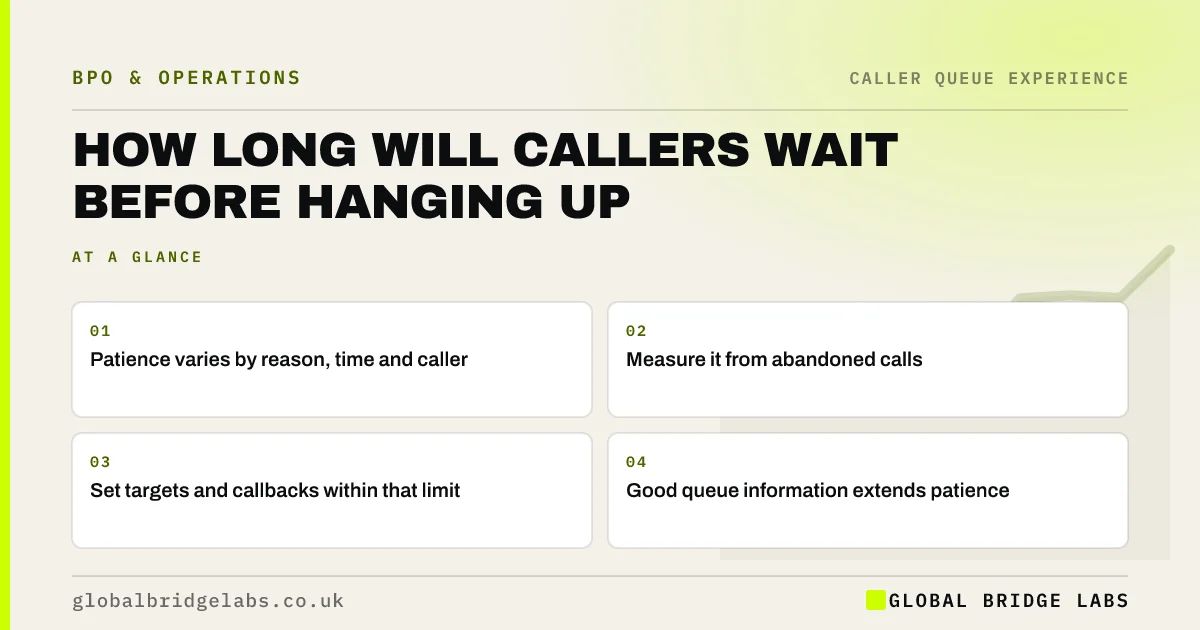
- Patience varies by reason, time and caller.
- Measure it from abandoned calls.
- Set targets and callbacks within that limit.
- Good queue information extends patience.
Want to know how long your callers will wait? Message us on WhatsApp.
Chat on WhatsApp →Why does patience vary so much?
A caller with an urgent problem and no alternative will wait longer than someone with a quick question who can email instead. Callers on a lunch break have little time. Callers paying for the call, or calling from a mobile with poor signal, may give up sooner.
How do you measure your callers' patience?
Export abandoned calls with the time each waited before hanging up. Plot how many hung up in each 15-second band. Most queues show a clear point where hang-ups rise. That is your callers' patience limit, and it may differ by time of day and line.
How does queue information change it?
Callers who know how long they will wait, or that a callback is available, tend to wait more calmly or choose the callback. Callers in silence or listening to repeated messages give up sooner. Better queue information can move the patience point later.
- Honest wait estimates.
- A callback offer.
- Calm hold sound.
Want your abandonment data turned into a patience curve? Send it to us on WhatsApp.
Chat on WhatsApp →How should you use the result?
Set your answer threshold well inside the patience limit, offer callbacks just before it and staff peak half hours so few callers reach it. Recheck after any change to the queue message or menu.
What does this look like in practice?
A pattern we see: abandoned calls jump sharply after about 90 seconds on the sales line, but much later on the accounts line. Offering a callback at 60 seconds on sales only reduces lost enquiries without changing the accounts queue.
Rechecking the curve a month later shows the sales hang-up point has moved later, because callers now hear an honest wait estimate and know a callback is available.
Caller patience checklist
- Export abandoned call wait times.
- Plot hang-ups in 15-second bands.
- Find the point where hang-ups rise.
- Compare by line and time of day.
- Set callbacks before that point.
Next step
Export a month of abandoned calls, plot when callers hang up and set your callback offer just before the point where hang-ups rise.
Message us on WhatsApp to measure caller patience, or book a 30-minute consultation.
Chat on WhatsApp →Sources and further reading
- Stop trying to delight your customers (Dixon, Freeman and Toman, 2010) · Harvard Business Review
- UK Customer Satisfaction Index · Institute of Customer Service
Frequently asked questions
How long do customers wait on hold before hanging up?
It varies by business, reason and time of day, so measure your own. Your abandoned call data shows when callers start giving up. Many businesses find a clear rise in hang-ups at a certain point, and that point is a better guide than any general figure.
Do mobile callers hang up sooner?
They can, especially if they are on the move, have poor signal or are paying for the call. Check whether your phone system can split abandonment by caller type. Callback options and text alternatives help mobile callers who cannot hold for long.
Does a callback offer stop hang-ups?
It reduces them, because callers who would have given up can choose a callback instead. Offer it just before the point where hang-ups usually rise. Make sure callbacks are completed quickly, or callers will stop trusting the offer. Track uptake each week.
Written by

Global Bridge Labs (GBL) is a UK–Sri Lanka partner for social media, websites and BPO. Everything here comes from client delivery, not theory.


