
On this page
Key takeaways
Intraday management means watching calls and staffing during the day and adjusting when reality differs from the plan. In a small team it can be as simple as one person checking the queue every half hour, moving breaks, pausing non-urgent work or switching on overflow. Agree the triggers and actions in advance so nobody has to improvise.
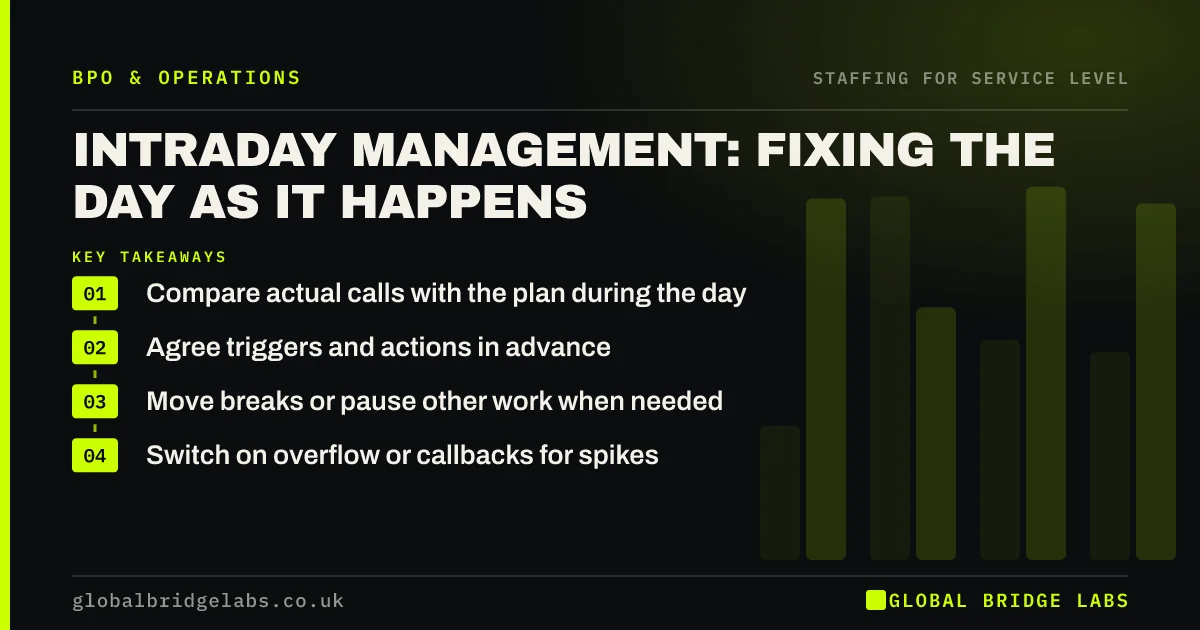
- Compare actual calls with the plan during the day.
- Agree triggers and actions in advance.
- Move breaks or pause other work when needed.
- Switch on overflow or callbacks for spikes.
Want simple intraday rules for your team? Message us on WhatsApp.
Chat on WhatsApp →What does intraday management involve?
Checking calls waiting, longest wait and people available against the plan, usually every 15 to 30 minutes. When calls run ahead of forecast or people are missing, you act quickly to protect the next few half hours rather than waiting for the end-of-day report.
What triggers should you set?
Simple, visible triggers work best, such as more than three callers waiting, a wait over two minutes, or two people unexpectedly away. Each trigger should have one agreed action and one person who takes it.
What actions can you take?
Most actions are small and quick. Agree them with the team and write them down.
- Delay a short break by 15 minutes.
- Pause emails or admin and log back in to calls.
- Bring a cross-trained colleague onto the phones.
- Switch on a queue callback or overflow.
- Post a short service update message.
Want an intraday action list drafted for your team? Send us your setup on WhatsApp.
Chat on WhatsApp →How do you avoid burning people out?
Intraday changes should be occasional, not constant. If the same trigger fires every day, the plan is wrong, so fix the rota or demand instead. Always give back delayed breaks, and avoid using colleagues from other teams so often that their own work suffers.
What does this look like in practice?
A pattern we see: an unexpected outage triggers a surge of calls. Because the team has an agreed action list, a queue message goes up within minutes, admin work pauses and callbacks switch on. Service level dips briefly instead of collapsing for the morning.
Intraday management checklist
- Name one person to watch the queue.
- Set two or three simple triggers.
- Agree one action per trigger.
- Give back any delayed breaks.
- Review triggers that fire daily.
Next step
Write down three triggers and the action for each, share them with the team and review how often each one fired after a month.
Message us on WhatsApp to set up intraday management, or book a 30-minute consultation.
Chat on WhatsApp →Sources and further reading
- Measuring success · GOV.UK Service Manual
- Work-related stress and how to manage it · Health and Safety Executive
Frequently asked questions
Who should do intraday management in a small team?
Usually a team leader or a senior team member, alongside their own calls. It does not need to be a full-time role. The key is that one named person checks the queue regularly and is allowed to take the agreed actions without waiting for approval.
How often should I check the queue?
Every 15 to 30 minutes in busy periods, and less often in quiet ones. A wallboard or phone system alert can do the watching for you by flagging when a trigger is reached. The goal is to act early, before a short spike turns into a long queue.
What if intraday changes happen every day?
Then the plan needs fixing, not the day. Look at the interval report to see which half hours keep triggering actions, and adjust the rota, breaks or demand for those times. Intraday management should handle genuine surprises, not routine peaks.
Written by

Global Bridge Labs (GBL) is a UK–Sri Lanka partner for social media, websites and BPO. Everything here comes from client delivery, not theory.


