On this page
Key takeaways
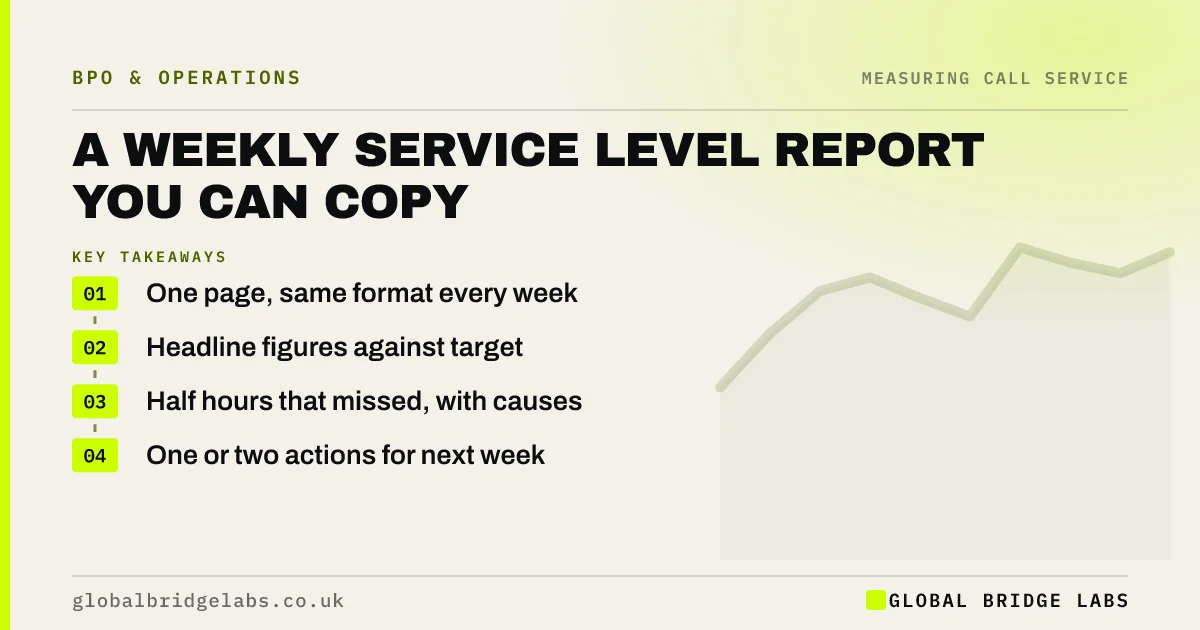
A weekly service level report should fit on one page and lead to a decision. It needs the headline figures against target, the half hours that missed, the main reasons for calls, what changed and what will be done next week. Use the same template every week so trends are easy to see.
- One page, same format every week.
- Headline figures against target.
- Half hours that missed, with causes.
- One or two actions for next week.
Want this template adapted for your business? Message us on WhatsApp.
Chat on WhatsApp →What sections should it have?
Five short sections are enough. Each one answers a question the owner of the target needs answered every week.
- Headlines: calls, service level, abandonment, longest wait.
- Misses: half hours below target and why.
- Reasons: top five call reasons and changes.
- Quality: sample score and comments.
- Actions: what changes next week, and who owns each.
How should figures be presented?
Show this week, last week and target side by side, so movement is obvious. State the formula once at the top, including how abandoned calls are treated. Use numbers and short sentences rather than many charts.
What should the commentary say?
Explain the main misses in plain words, such as "Monday 9am to 10am missed because two people were on training." Avoid long narratives. The commentary should help someone who was not there understand the week in a minute.
Want your current report turned into this format? Send it to us on WhatsApp.
Chat on WhatsApp →Who should receive it?
The person who owns the target, the team leader and, if a provider handles calls, the provider's account manager. Share a short version with the team too, so people see the effect of their work and the reasons behind changes.
What does this look like in practice?
A pattern we see: weekly reports are long and differ each week, so trends are missed. A one-page template with fixed sections makes a slipping lunchtime service level visible within two weeks, and the fix is in place before customers start complaining.
Reports also become quicker to write, because the person preparing them fills in the same sections each time rather than deciding what to include.
Weekly report checklist
- Use one page and fixed sections.
- State the formula at the top.
- Show this week, last week and target.
- Explain misses in one sentence each.
- End with owned actions.
Next step
Copy the five sections into a document, fill it in for last week and share it with whoever owns your service level target.
Message us on WhatsApp to set up weekly call reporting, or book a 30-minute consultation.
Chat on WhatsApp →Sources and further reading
- Measuring success · GOV.UK Service Manual
- Writing to GOV.UK standards: writing guidelines · GOV.UK
Frequently asked questions
What should a weekly call report include?
Headline figures against target, the half hours that missed and why, the top call reasons, a quality score from sampled calls and the actions planned for next week. Keep it to one page and use the same format every week so trends are easy to spot and compare.
Should a provider use my report template?
It helps. Ask any provider to report against your template and formula, so their figures can be compared with your own team's and with past months. If they use their own format, ask them to include the same core figures and the half-hour detail.
How long should the report take to prepare?
Thirty minutes or less once it is set up. Most figures come straight from your phone system export. If it takes longer, simplify it or automate the data pull. Time spent on the report should be much smaller than time spent acting on it.
Written by

Global Bridge Labs (GBL) is a UK–Sri Lanka partner for social media, websites and BPO. Everything here comes from client delivery, not theory.