On this page
Key takeaways
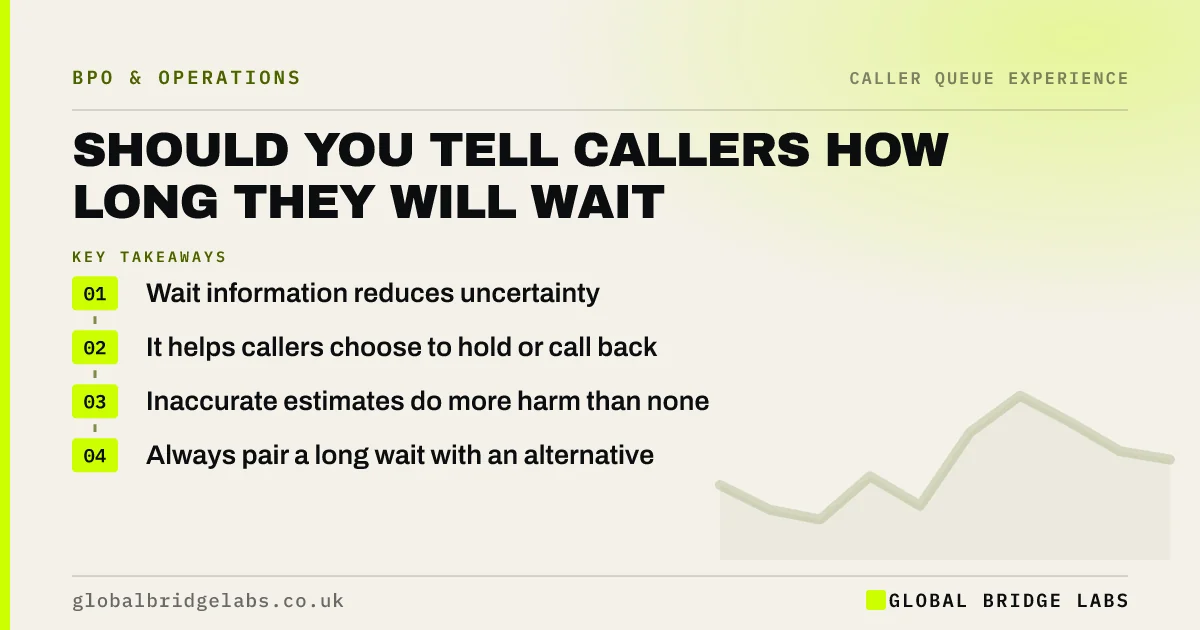
Telling callers how long they will wait, or their place in the queue, helps them decide whether to hold, request a callback or try later. It reduces the uncertainty that makes waiting feel longer. It only helps if it is accurate, so test it before switching it on and avoid announcing very long waits without an alternative.
- Wait information reduces uncertainty.
- It helps callers choose to hold or call back.
- Inaccurate estimates do more harm than none.
- Always pair a long wait with an alternative.
Not sure whether to announce wait times? Message us on WhatsApp.
Chat on WhatsApp →Why does wait information help?
Uncertain waits feel longer than known ones. A caller told the wait is about three minutes can decide to stay, while one left guessing may hang up at 90 seconds. Wait information also gives callers a reason to accept a callback instead of holding.
Wait time or place in queue?
Place in queue is easy to calculate and always accurate, but it means little if callers do not know how fast the queue moves. Estimated wait is more useful but harder to get right in small teams, where one long call changes everything. Many small businesses use place in queue plus a rough time range.
How accurate does it need to be?
Accurate enough that callers are not misled. An estimate of two minutes that turns into eight damages trust more than no estimate. Test the estimate against actual waits for a few weeks before announcing it, and round up rather than down.
- Test against real waits first.
- Round estimates up.
- Update the estimate during the wait.
Want your phone system's wait estimate checked? Send us your call data on WhatsApp.
Chat on WhatsApp →What if the wait is long?
Pair any long wait with a clear alternative: a callback that keeps their place, a web answer for common questions or a better time to call. Announcing a 15-minute wait with no option feels like being told to give up.
What does this look like in practice?
A pattern we see: a team switches on estimated wait announcements, but the estimates are often far too short at lunchtime. Switching to place in queue plus a callback offer above position five improves feedback and reduces abandonment.
Wait announcement checklist
- Decide between wait time and place in queue.
- Test accuracy against real waits.
- Round estimates up.
- Pair long waits with an alternative.
- Review accuracy monthly.
Next step
Compare your phone system's wait estimates with actual waits for two weeks, and switch on announcements only if they are reliably accurate.
Message us on WhatsApp to set up wait announcements, or book a 30-minute consultation.
Chat on WhatsApp →Sources and further reading
- Stop trying to delight your customers (Dixon, Freeman and Toman, 2010) · Harvard Business Review
- UK Customer Satisfaction Index · Institute of Customer Service
Frequently asked questions
Do callers prefer to know their position in the queue?
Many do, because it shows progress and reduces uncertainty. It works best when the queue moves steadily. If one person is ahead of a caller for several minutes, position alone can frustrate, so combine it with a time range or a callback offer.
How do phone systems estimate wait time?
Most use recent average handling time and the number of people available to predict how long the queue will take to clear. Small teams and long calls make these estimates less reliable. Check the method your system uses and test it against real waits before announcing it.
Should I announce waits when the queue is short?
It is often unnecessary when the caller is next or the wait is under a minute. Many systems announce only when the expected wait is above a threshold. This keeps short waits short and saves the information for when it really helps the caller decide.
Written by

Global Bridge Labs (GBL) is a UK–Sri Lanka partner for social media, websites and BPO. Everything here comes from client delivery, not theory.