
On this page
Key takeaways
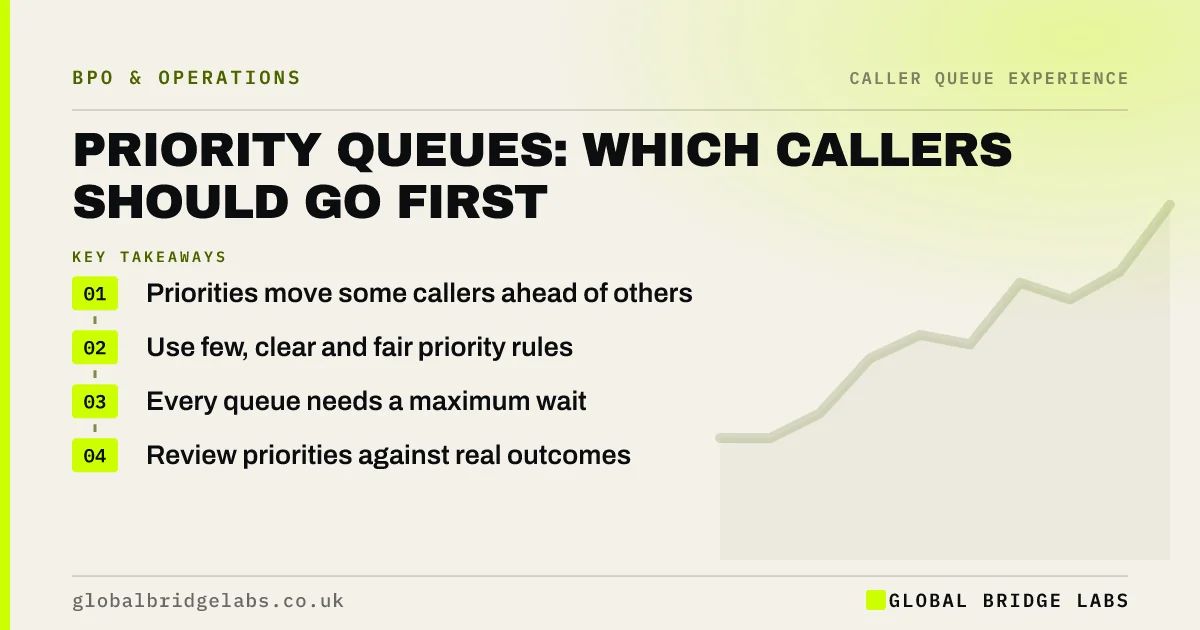
Priority queues let some calls jump ahead, such as urgent faults, vulnerable customers or high-value accounts. They can improve service where it matters most, but they also make other callers wait longer. Use a small number of clear, fair priorities, set a maximum wait for every queue and review whether priorities still match what callers need.
- Priorities move some callers ahead of others.
- Use few, clear and fair priority rules.
- Every queue needs a maximum wait.
- Review priorities against real outcomes.
Want help designing priority rules? Message us on WhatsApp.
Chat on WhatsApp →Who should get priority?
Common priorities are urgent safety or service failures, customers in vulnerable circumstances, calls about to breach a deadline and sometimes key accounts. Base priorities on the impact of waiting, not only on customer value, and explain them internally.
How do priority queues work?
Callers are identified by menu choice, number or account, and placed in a queue with higher priority. When a person becomes free, the system offers them the highest-priority caller first. Lower-priority callers move forward only when no higher-priority call is waiting.
What is the risk?
Lower-priority callers can wait a very long time during busy periods. Set a maximum wait or an ageing rule that raises a call's priority the longer it waits. Report service level for each queue, not just the overall figure.
- Maximum wait for every queue.
- Raise priority as waits grow.
- Report each queue separately.
- The slowest 20%: measuring your longest call waits
- Why a daily service level hides your worst half hours
Want your priority rules reviewed? Send them to us on WhatsApp.
Chat on WhatsApp →How do you keep it fair?
Use priorities that you would be comfortable explaining to any customer, such as safety or vulnerability. Make sure nobody is disadvantaged because of a protected characteristic. Review outcomes regularly to check that lower-priority callers are not routinely failed.
What does this look like in practice?
A pattern we see: a business gives priority to key accounts, and everyday customers wait over ten minutes at peaks. Adding an ageing rule that raises any call over three minutes keeps priority callers fast while capping everyone else's wait.
Reporting each queue separately also shows that the urgent option is chosen by many callers with routine questions, so its wording is tightened and a short confirmation question is added before the call is prioritised.
Priority queue checklist
- List priorities based on impact.
- Keep the list short.
- Set a maximum wait for every queue.
- Add an ageing rule.
- Report each queue separately.
Next step
Write down who currently gets priority and why, set a maximum wait for every queue and check last month's longest waits by queue.
Message us on WhatsApp to set fair priority queues, or book a 30-minute consultation.
Chat on WhatsApp →Sources and further reading
- FG21/1: Guidance for firms on the fair treatment of vulnerable customers · Financial Conduct Authority
- Equality Act 2010 · legislation.gov.uk
Frequently asked questions
Is it fair to prioritise some callers?
It can be, if priorities are based on clear reasons such as urgency, safety or vulnerability, and other callers still receive a reasonable service. Set maximum waits for all queues and review outcomes. Prioritising only by customer value can damage trust if everyday customers routinely wait too long.
How do I identify priority callers?
Common methods include a menu option for urgent issues, recognising numbers linked to flagged accounts and asking a quick question at the start of the call. Be careful with menu options, as many callers will choose urgent if it is quicker. Check how often it is used.
Should vulnerable customers get priority?
Customers in vulnerable circumstances may need faster or more tailored support, and some regulated firms have specific duties. Priority is one tool. Others include longer calls, named contacts and alternative channels. Record needs only with appropriate consent and handle that information carefully.
Written by

Global Bridge Labs (GBL) is a UK–Sri Lanka partner for social media, websites and BPO. Everything here comes from client delivery, not theory.


