On this page
Key takeaways
Call handling standards describe how your business handles every call, in a page everyone can remember. They cover answering, holds, transfers, notes, callbacks, difficult callers and accessibility. Clear standards make service consistent, help new starters and make it easier for overflow or outsourced teams to sound like you.
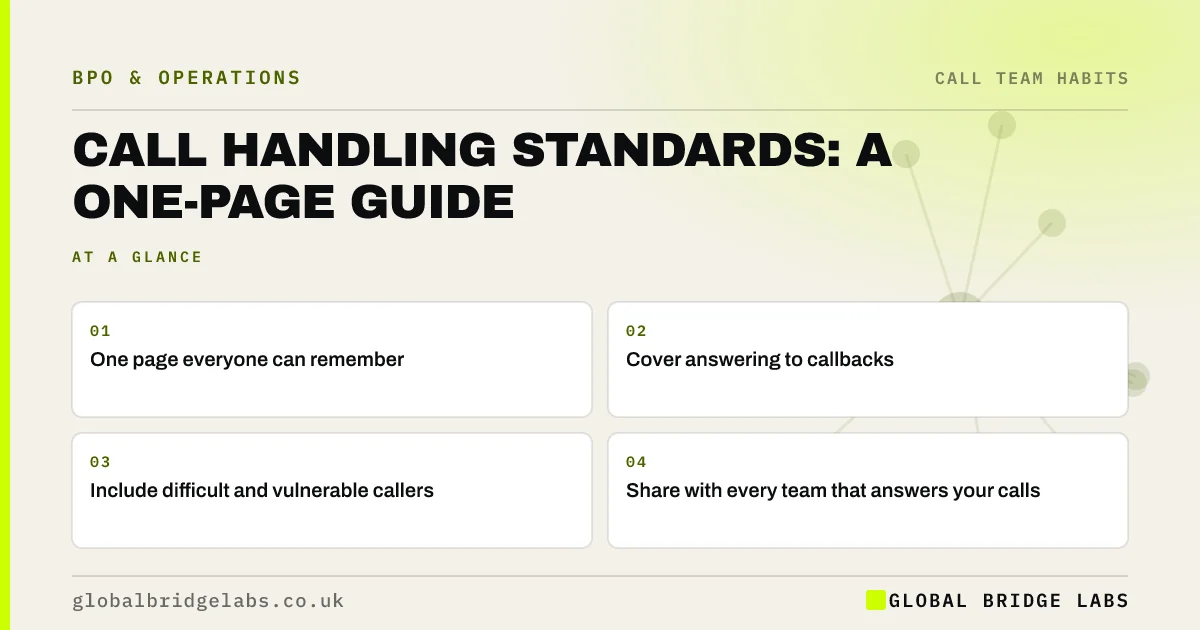
- One page everyone can remember.
- Cover answering to callbacks.
- Include difficult and vulnerable callers.
- Share with every team that answers your calls.
Want call handling standards drafted for you? Message us on WhatsApp.
Chat on WhatsApp →What should the standards cover?
Keep each item to one or two lines, and link to the answer library or policy for detail.
- How to answer and close calls.
- When and how to hold or transfer.
- What to record in notes.
- How quickly callbacks happen.
- How to handle angry or abusive callers.
- How to support vulnerable callers.
How should they be written?
In plain, specific language. "Answer with the business name and your first name" is clearer than "answer professionally". Each standard should be easy to check on a sampled call.
What about accessibility?
Include how to handle calls through text relay services such as Relay UK, which may take longer and involve a relay assistant. Explain how to offer other channels for customers who cannot use the phone easily, and how to record any adjustments they need, with consent.
- Text relay calls.
- Other channels on request.
- Recording adjustments with consent.
- Vulnerable customers: a process an outsourced team can follow
- How many phone menu options before callers give up?
Want your current standards reviewed? Send them to us on WhatsApp.
Chat on WhatsApp →How do you keep standards alive?
Use them in induction, coaching and call sampling. Review them each year or when processes change. Share them with any overflow or outsourced team so callers get the same experience wherever their call is answered.
What does this look like in practice?
A pattern we see: three people handle holds and transfers in three different ways, and callers notice. A one-page standard, discussed in a huddle and used in coaching, makes calls consistent within a few weeks.
The same page is shared with the overflow provider, so evening callers hear the same opening and get the same callback promise as daytime callers.
Call standards checklist
- Write one page of standards.
- Use plain, checkable wording.
- Include accessibility and vulnerability.
- Use them in coaching and sampling.
- Share with overflow teams.
Next step
Draft one line for each of the six standard areas, discuss them with the team and use them in your next round of call sampling.
Message us on WhatsApp to set call handling standards, or book a 30-minute consultation.
Chat on WhatsApp →Sources and further reading
Frequently asked questions
What are call handling standards?
They are a short set of agreed rules for how your business handles calls, covering answering, holds, transfers, notes, callbacks and difficult callers. They make service consistent across people and teams, and give a clear basis for training, coaching and checking calls.
How do I handle a Relay UK call?
Relay UK connects deaf, hard of hearing and speech-impaired people with a relay assistant who passes on text or speech. Speak directly to the caller, not the assistant, allow extra time and do not hang up on the short pause at the start. Include this in your standards.
Should standards be the same for outsourced teams?
Yes. Callers should get the same experience wherever their call is answered. Share your standards, answer library and escalation rules with any provider, include them in the contract or brief and check sampled calls against them in the same way as your own team.
Written by

Global Bridge Labs (GBL) is a UK–Sri Lanka partner for social media, websites and BPO. Everything here comes from client delivery, not theory.