
On this page
Key takeaways
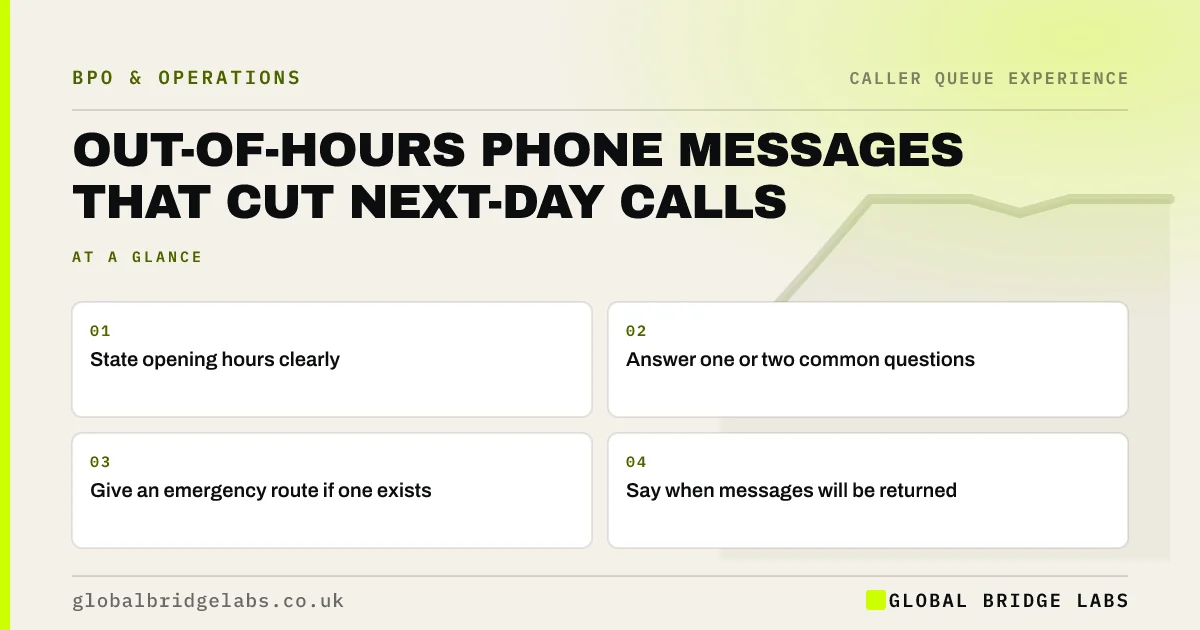
An out-of-hours message is often the first thing callers hear at evenings, weekends and bank holidays. A good one gives your opening hours, answers the most common questions, explains what to do in an emergency and says when you will call back if they leave a message. Done well, it removes calls from the next morning's peak.
- State opening hours clearly.
- Answer one or two common questions.
- Give an emergency route if one exists.
- Say when messages will be returned.
Want your out-of-hours message rewritten? Message us on WhatsApp.
Chat on WhatsApp →What should it say?
Thank the caller, confirm the business, give your hours and when you reopen. Then answer the most common out-of-hours question, such as how to track an order or report a fault, and say what happens to messages. Keep it under 40 seconds.
How do you choose what to answer?
Check your call reasons for the first hour after opening. The top reasons are often things callers tried to ask the night before. If one reason can be answered in a sentence or a web link, put it in the message.
What about urgent calls?
If you offer emergency cover, give the route clearly. If you do not, say so, and give public numbers where relevant, such as 999 where life is at risk. Never imply someone will respond urgently if they will not.
- Clear emergency route if you have one.
- Honest wording if you do not.
- Public numbers where relevant.
- Customers contacting out of hours: when to cover it
- Night calls that are not emergencies: handle them well
Want help deciding between a message and live out-of-hours cover? Ask us on WhatsApp.
Chat on WhatsApp →Should callers leave a message?
Only if you will return messages quickly. If you do take messages, say when you will call back and keep that promise. Returning all messages in the first hour can itself create a morning queue, so plan who returns them.
What does this look like in practice?
A pattern we see: the first hour after opening is swamped by callers repeating questions they tried to ask overnight. Adding a one-sentence answer about order tracking to the out-of-hours message noticeably reduces those calls.
The team also starts returning overnight messages in a set order, urgent first, with one person assigned, so morning callbacks no longer pull everyone off the live queue at opening time.
Out-of-hours message checklist
- Give hours and reopening time.
- Answer the top overnight question.
- Give an honest emergency route.
- Say when messages are returned.
- Update it for bank holidays.
Next step
Check your top call reasons in the first hour after opening, and add the most common one to your out-of-hours message with a short answer.
Message us on WhatsApp to improve your out-of-hours message, or book a 30-minute consultation.
Chat on WhatsApp →Sources and further reading
- UK bank holidays · GOV.UK
- Stop trying to delight your customers (Dixon, Freeman and Toman, 2010) · Harvard Business Review
Frequently asked questions
How long should an out-of-hours message be?
Aim for under 40 seconds. Callers want hours, a quick answer to their likely question and what to do next. Long messages listing every service or promotion make callers hang up before they hear the useful part. Put the most important information first.
Should I change my message for bank holidays?
Yes. Say when you are closed and when you reopen, especially over longer breaks such as Christmas. Mention any reduced hours on the days around the holiday. Set a reminder to change the message back, because outdated holiday messages confuse callers.
Is it better to have live out-of-hours cover?
It depends on what your callers need. If they have urgent problems or you lose sales overnight, live cover may be worth it. If most out-of-hours calls are simple questions, a good message and fast morning callbacks may be enough.
Written by

Global Bridge Labs (GBL) is a UK–Sri Lanka partner for social media, websites and BPO. Everything here comes from client delivery, not theory.


