On this page
- 01Key takeaways
- 02What is time to enquiry?
- 03Why does time to enquiry matter for website design?
- 04How do you estimate time to enquiry?
- 05How does time to enquiry affect advertising?
- 06Should you try to shorten time to enquiry?
- 07When does time to enquiry mislead?
- 08What does this look like in practice?
- 09Time to enquiry checklist
- 10Next step
- 11Sources and further reading
- 12Frequently asked questions
Key takeaways
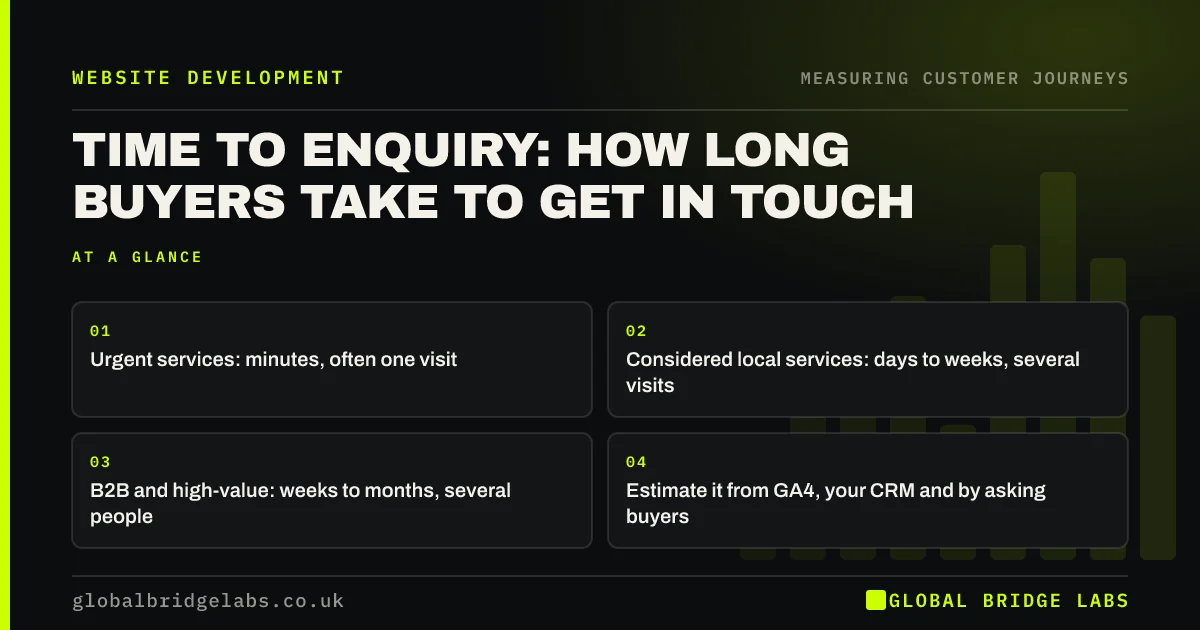
Time to enquiry is how long buyers take between first visiting your website and getting in touch. It ranges from minutes for urgent services to weeks or months for considered and B2B purchases. Knowing yours tells you whether to design for one-visit decisions or for buyers who return several times, and how to judge your pages and adverts fairly.
- Urgent services: minutes, often one visit.
- Considered local services: days to weeks, several visits.
- B2B and high-value: weeks to months, several people.
- Estimate it from GA4, your CRM and by asking buyers.
Want to know your typical time to enquiry? Message us on WhatsApp.
Chat on WhatsApp →What is time to enquiry?
Time to enquiry is the time between a buyer's first visit to your website and their first contact with you, whether by form, phone, chat or email. In analytics it is sometimes called time to conversion or time lag. It measures the length of the website part of the customer journey, which varies widely by sector and purchase size.
Why does time to enquiry matter for website design?
Time to enquiry matters because it decides what the site must do on each visit. If buyers decide in one visit, every landing page must carry them to contact quickly. If they take three weeks and five visits, the site must help them learn, compare and come back: clear titles, saved information, proof and a route back to pricing.
How do you estimate time to enquiry?
Estimate it three ways and compare. In GA4, look at how many sessions users have before a key event, using a user-level exploration or segment of users who enquired. In your CRM or inbox, compare first-visit dates where your form captures them. And ask buyers: 'How long had you been looking before you contacted us?'. The answer is a range, not one number.
- GA4: sessions per user before the key event, for enquirers.
- Forms: capture the landing page and first-visit source where possible.
- Ask: 'How long had you been looking?' on calls and forms.
- Group the answers into ranges by service.
How does time to enquiry affect advertising?
Time to enquiry affects how you judge adverts. If buyers take two weeks, a campaign judged after three days looks like it failed. Attribution windows in ad platforms and GA4 also matter: if they are shorter than your time to enquiry, credit goes elsewhere or disappears. Match your review period to your buyers' pace.
- Marketing attribution for small businesses, kept simple
- Advertising payback period: how long until it pays for itself?
Want your ads judged over the right time window? Ask us on WhatsApp.
Chat on WhatsApp →Should you try to shorten time to enquiry?
Shorten it by removing unnecessary delays, not by pressuring buyers. Missing price guidance, unclear next steps and hard-to-find proof make buyers come back later or not at all. Answering those on the first visit shortens the journey for buyers who were ready. Buyers who need time to decide should be helped, not rushed.
When does time to enquiry mislead?
It misleads when visits cannot be linked, such as buyers switching devices or clearing cookies, which makes journeys look shorter than they are. It also misleads for referral-led businesses, where buyers decided before their first visit. Treat GA4 figures as a minimum and cross-check with what buyers tell you.
What does this look like in practice?
A pattern we see with considered purchases: the owner judges new pages and adverts after a week, sees few enquiries and changes them. Asking buyers shows most took two to four weeks from first visit. The pages were never given time to work.
Judging pages and campaigns over a month, and making return visits easier with clear pricing and proof, gives a fairer picture. Across our client work we have seen a 2.4x enquiry rate from conversion changes of this kind. Global Bridge Labs (GBL) sets review periods by time to enquiry.
Time to enquiry checklist
- Ask 20 recent buyers how long they had been looking.
- Check sessions before enquiry in GA4.
- Group results by service.
- Set page and campaign review periods to match.
- Check ad attribution windows cover the journey.
- Remove delays: price, proof and next steps on first visit.
Next step
Knowing how long your buyers take changes how you design and judge every page. We will estimate yours and show what it means for your site.
Message us on WhatsApp to estimate your time to enquiry, or book a 30-minute consultation.
Chat on WhatsApp →Sources and further reading
- Get started with attribution · Google Analytics Help
- About key events · Google Analytics Help
- Data retention · Google Analytics Help
Frequently asked questions
How long does it take a customer to enquire after visiting a website?
It varies by sector. Urgent services often see enquiries within minutes of a first visit. Considered local services usually take days to weeks and several visits. B2B and high-value purchases can take weeks or months. Ask your buyers and check GA4 to find your own range.
How do I find time to conversion in GA4?
Build an exploration or segment of users who completed a key event and look at sessions per user and the dates of their first and converting sessions. Treat the result as a minimum, because device switching and declined cookies break the link between visits.
Should I try to make customers enquire faster?
Remove unnecessary delays, such as missing prices, unclear next steps and hard-to-find proof, so ready buyers can act on their first visit. Do not use pressure tactics. Buyers who need time should be helped to return, not rushed.
Written by

Global Bridge Labs (GBL) is a UK–Sri Lanka partner for social media, websites and BPO. Everything here comes from client delivery, not theory.