On this page
- 01Key takeaways
- 02Why does navigation get worse after launch?
- 03Who should own the menu?
- 04What rules should a navigation policy include?
- 05How often should you review it?
- 06What about multiple editors?
- 07What does this look like in practice?
- 08Navigation governance checklist
- 09Next step
- 10Sources and further reading
- 11Frequently asked questions
Key takeaways
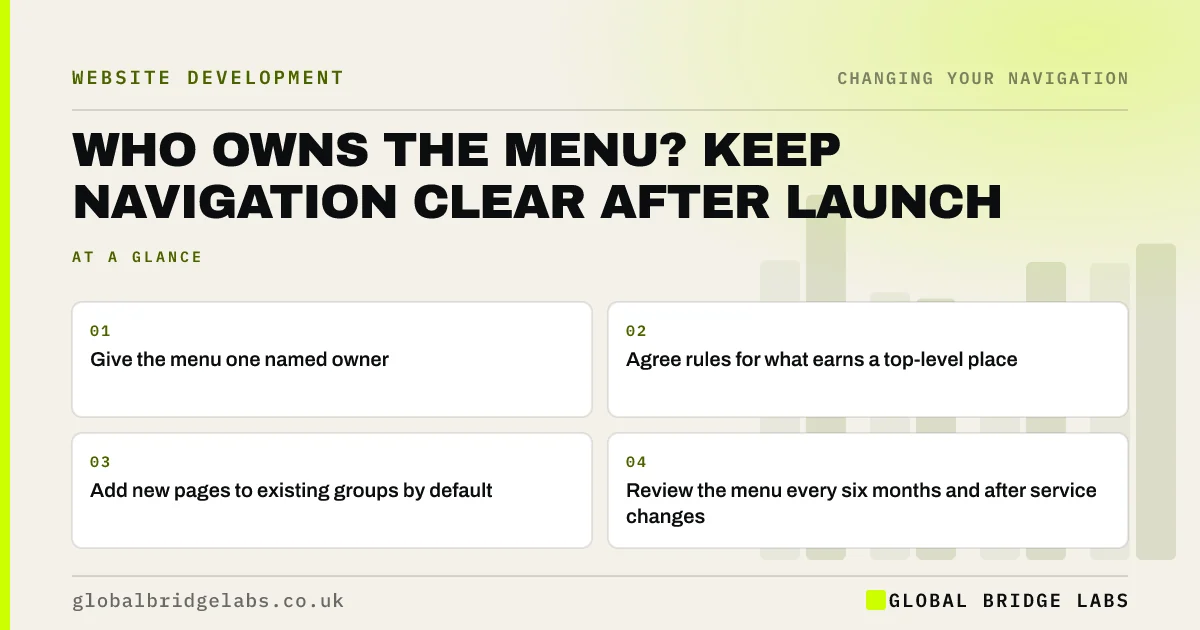
Navigation decays after launch as pages are added one at a time. Prevent it by giving the menu one owner, agreeing a short set of rules for what earns a place, adding new pages to existing groups by default, and reviewing the menu every six months or when a service changes. A one-page navigation policy is enough for most businesses.
- Give the menu one named owner.
- Agree rules for what earns a top-level place.
- Add new pages to existing groups by default.
- Review the menu every six months and after service changes.
Want a simple navigation policy drafted for your team? Message us on WhatsApp.
Chat on WhatsApp →Why does navigation get worse after launch?
Each new page seems to need a menu slot: a new service, a campaign, a careers page, a news section. No single addition is a problem, but over two or three years the menu doubles. Labels drift as different people write them. Without an owner, nobody says no.
Who should own the menu?
One person, usually in marketing or whoever manages the website, with authority to decide what goes in and what stays out. They do not need to be technical. Their job is to apply the rules, keep the word list and run the reviews.
What rules should a navigation policy include?
Keep the rules short enough to remember. These cover most decisions.
- The main menu holds what most visitors need to decide.
- Top-level items stay at about five to seven.
- New pages join an existing group unless evidence says otherwise.
- Labels use the agreed word list and customer language.
- Campaign links are temporary and have an end date.
- Policies, careers and news live in the footer.
- URL changes need redirects and sign-off.
- Menu labels: words visitors understand at a glance
- Seasonal offers in the menu: promote without clutter
Want your navigation rules written and agreed? Message us on WhatsApp and we will discuss your requirements.
Chat on WhatsApp →How often should you review it?
Every six months, and whenever you add or drop a service, launch a new section or redesign. A review takes an hour: score the menu, check menu click data and site search terms, and remove or merge anything that no longer earns its place.
What about multiple editors?
If several people can edit the site, restrict menu editing to the owner or require their approval. Most content management systems allow this through user roles. It prevents well-meant additions that bypass the rules.
What does this look like in practice?
A pattern we see: a site launches with six clear menu items and, two years later, has eleven, including a finished campaign and two blog categories. Nobody owned the menu. Naming an owner and applying three rules brings it back to six and keeps it there.
Navigation governance checklist
- Name a menu owner.
- Write a one-page navigation policy.
- Keep a word list for labels.
- Restrict menu editing rights.
- Review every six months.
- Remove expired campaign links.
Next step
Count your top-level menu items today and compare with the number at launch.
Message us on WhatsApp for a navigation policy review, or book a 30-minute consultation.
Chat on WhatsApp →Sources and further reading
- Menu-design checklist: 17 UX guidelines · Nielsen Norman Group
- Maintain consistency and adhere to standards (usability heuristic #4) · Nielsen Norman Group
- Understanding WCAG 2.2 success criterion 3.2.3: Consistent Navigation · W3C
Frequently asked questions
How do I stop my website menu growing?
Give the menu an owner, agree that new pages join existing groups by default, keep top-level items to about five to seven, and review the menu twice a year. Move non-buying pages such as careers and news to the footer.
Who should be responsible for website navigation?
One named person, usually whoever manages the website or marketing, with authority to approve or refuse menu changes. They apply the agreed rules and run regular reviews.
How often should website navigation be reviewed?
Every six months as a routine, and whenever services, sections or the platform change. A short review using a score, menu click data and search terms is usually enough.
Written by

Global Bridge Labs (GBL) is a UK–Sri Lanka partner for social media, websites and BPO. Everything here comes from client delivery, not theory.