On this page
Key takeaways
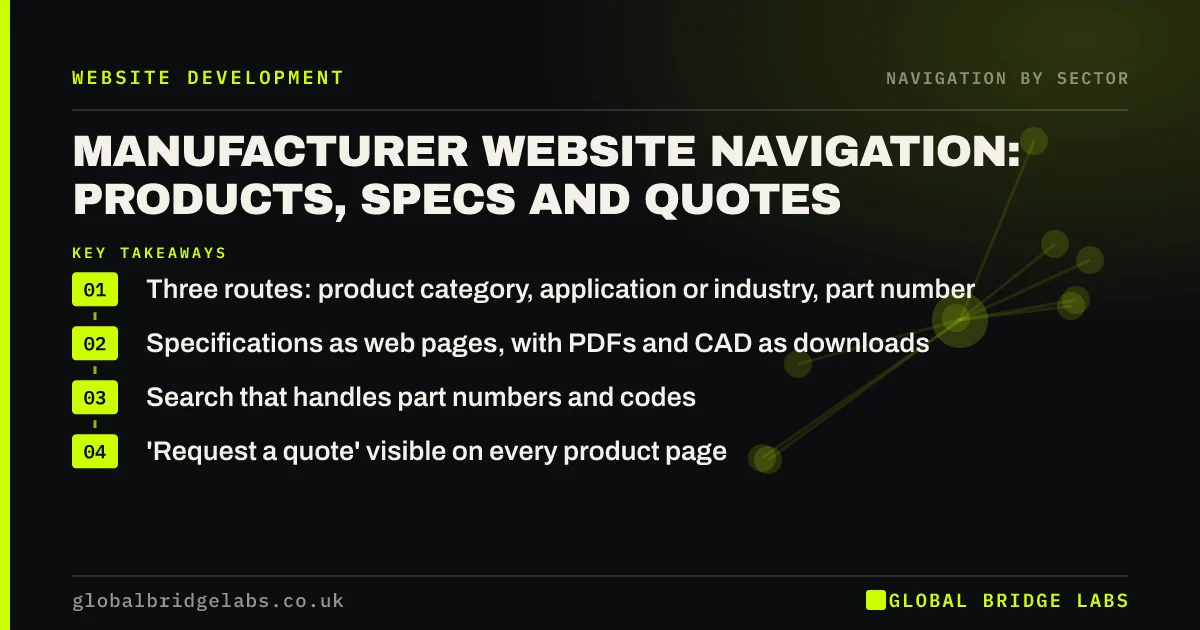
Manufacturer website navigation must serve engineers, buyers and distributors who look for products in different ways: by category, by application or industry and by part number. Offer all three routes, make specifications readable as web pages with downloads beside them, provide search that understands part numbers and make 'Request a quote' visible everywhere.
- Three routes: product category, application or industry, part number.
- Specifications as web pages, with PDFs and CAD as downloads.
- Search that handles part numbers and codes.
- 'Request a quote' visible on every product page.
Want your product catalogue navigation reviewed? Message us on WhatsApp.
Chat on WhatsApp →Who uses a manufacturer's website?
Engineers check specifications and compatibility. Buyers compare lead times, minimum orders and pricing. Distributors look for documentation and stock. Many are part of a buying group with different questions. Navigation that offers only one route serves only one of them.
What routes should the menu offer?
Offer the main ways visitors look for products, and let each lead to the same product pages.
- Products by category, such as valves, fittings, sensors.
- Applications or industries, such as food processing or water.
- Search by part number, with autocomplete.
- Resources: datasheets, CAD files, certificates.
- Request a quote, in the header.
How should technical documents be handled?
Put key specifications on the product page as text, so engineers can read and compare them on any device and search engines can index them. Offer datasheets, CAD files and certificates as clearly labelled downloads beside them, with file type and size. A document library, searchable by product, helps returning users.
- PDFs on a mobile website: why menus and brochures fail
- Resource hubs: navigation for guides, downloads and help
Want your specs and downloads made easy to find? Message us on WhatsApp and we will discuss your requirements.
Chat on WhatsApp →How should search work?
Engineers and buyers often know the part number. Search must match full and partial codes, tolerate missing hyphens and spaces and go straight to the product when there is one exact match. Show part numbers in results.
What does this look like in practice?
A pattern we see: a manufacturer's products are reachable only by category, specifications are in PDFs, and search does not recognise part numbers. Adding an applications route, putting key specs on product pages and tuning search for codes gives engineers and buyers their own routes in.
Manufacturer navigation checklist
- Category, application and part number routes.
- Specs as text on product pages.
- Labelled downloads with file type and size.
- Search tuned for part numbers.
- Request a quote on every product page.
- Distributor or trade login if needed.
Next step
Search your site for one of your part numbers typed without its hyphen, and see what appears.
Message us on WhatsApp for a manufacturer website review, or book a 30-minute consultation.
Chat on WhatsApp →Sources and further reading
- Search: visible and simple · Nielsen Norman Group
- PDF: still unfit for human consumption, 20 years later · Nielsen Norman Group
- Mega menus work well for site navigation · Nielsen Norman Group
Frequently asked questions
How should a manufacturer organise products on its website?
Offer several routes: by product category, by application or industry and by part number search, all leading to the same product pages. Engineers, buyers and distributors look for products differently, so one route rarely serves everyone.
Should product specifications be PDFs?
Put key specifications on the product page as text, so they are readable on any device and indexable. Offer the full datasheet as a labelled PDF download alongside, with its file size.
How should search work on a manufacturer's website?
It should match full and partial part numbers, ignore differences in hyphens and spaces, suggest matches as visitors type and go straight to a product when there is one exact match.
Written by

Global Bridge Labs (GBL) is a UK–Sri Lanka partner for social media, websites and BPO. Everything here comes from client delivery, not theory.