On this page
- 01Key takeaways
- 02What is B2B website lead generation?
- 03Why do B2B websites generate so few leads?
- 04What should a B2B website include?
- 05How should B2B lead forms be designed?
- 06How does content support long B2B cycles?
- 07When is the website not the main B2B channel?
- 08What does this look like in practice?
- 09B2B lead generation checklist
- 10Next step
- 11Sources and further reading
- 12Frequently asked questions
Key takeaways
B2B website lead generation works when the site helps several people in the buying group build the case to buy from you. That means pages for each role's concerns, proof from similar clients, pricing signals, content that supports long decision cycles, and a low-friction first step, with every lead tracked into the CRM.
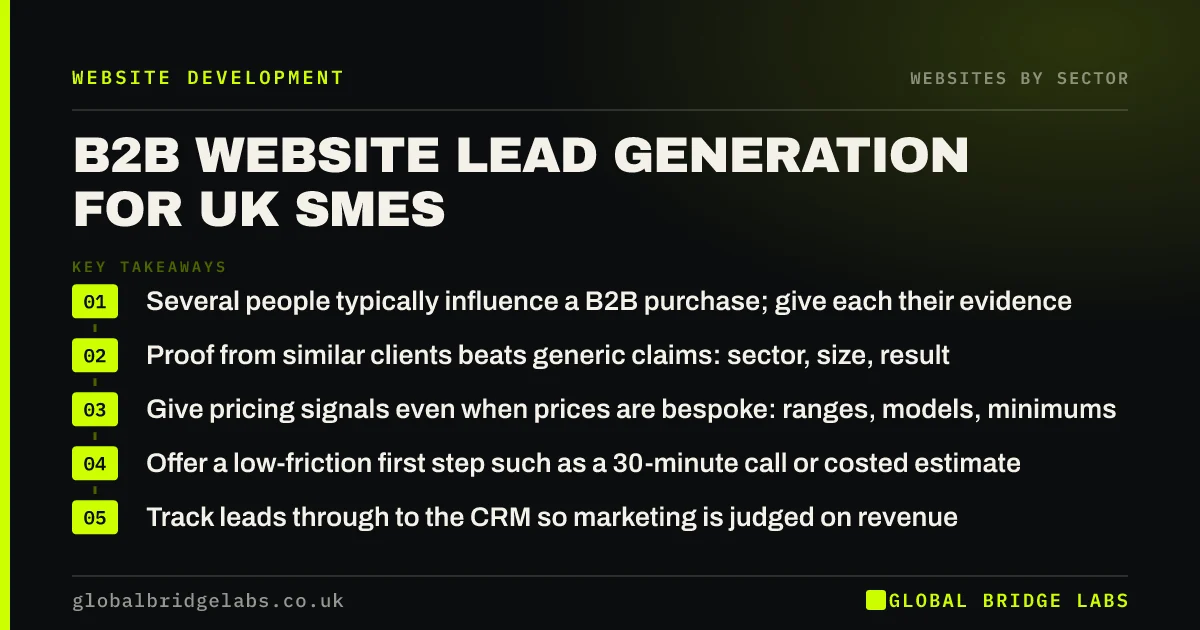
- Several people typically influence a B2B purchase; give each their evidence.
- Proof from similar clients beats generic claims: sector, size, result.
- Give pricing signals even when prices are bespoke: ranges, models, minimums.
- Offer a low-friction first step such as a 30-minute call or costed estimate.
- Track leads through to the CRM so marketing is judged on revenue.
Want your B2B site reviewed for lead generation? Send us the URL on WhatsApp.
Chat on WhatsApp →What is B2B website lead generation?
B2B website lead generation is the use of a business-to-business company's website to attract potential business customers and convert them into qualified enquiries, such as consultation requests, proposal requests or demo bookings.
It differs from consumer lead generation in the size and length of the decision. Purchases are often larger, involve several stakeholders, and can take weeks or months, so the site must support research over several visits.
A single buyer may visit the site five or six times before getting in touch, often from different devices and after forwarding pages to colleagues. Every page therefore needs to stand on its own, stating who you help, what the outcome is and how to take a small next step.
Why do B2B websites generate so few leads?
Many B2B sites describe capabilities rather than outcomes, hide pricing entirely, and offer only a Contact us form that feels like a commitment to a sales process. Buyers researching early have nothing to take away and no low-risk way to engage.
Tracking is also often weak. Leads are counted in analytics but never connected to deals in the CRM, so marketing cannot tell which channels produce revenue.
- Capability language instead of client outcomes.
- No pricing signals at all.
- Proof that is generic or unattributed.
- Only one high-commitment call to action.
- Leads not tracked through to revenue.
What should a B2B website include?
Design for the buying group, not a single visitor.
- Service pages framed around business outcomes and problems.
- Industry pages where you have real sector experience.
- Case studies with sector, size, challenge, approach and result.
- Pricing signals: models, ranges, minimum engagements.
- Content for each role: operations detail, finance ROI, IT security and integration.
- A low-friction first step: a short call, estimate or assessment.
- Named team members and how engagements are run.
How should B2B lead forms be designed?
Keep the first form short: name, work email, company and one question about the need. Qualify later, in the call. Long forms with budget, timeline and headcount fields put off good prospects early in their research.
Offer two levels of commitment: a primary action such as Book a 30-minute call, and a lighter option such as Get a costed estimate by email. State what happens next and how quickly.
Want your B2B enquiry path simplified? Message us on WhatsApp and we will sketch it.
Chat on WhatsApp →How does content support long B2B cycles?
B2B buyers research before contacting suppliers, often through search and increasingly through AI assistants. Content that answers their questions, such as costs, comparisons, implementation and risks, puts you in the shortlist before the first call.
Each piece should link to the relevant service and offer a next step. Track which content is viewed before enquiries, so you know what helps buyers decide.
When is the website not the main B2B channel?
In some B2B markets, most work comes from referrals, frameworks, tenders or account management. There the website is a credibility check buyers use after hearing your name, and proof, credentials and clear capabilities matter more than lead forms.
The trade-off is where to invest. Know whether your site generates leads or validates them, and build it for that job.
What does this look like in practice?
A pattern in B2B service firms: a site describing capabilities in abstract terms, a single Contact us form, and no case studies, while the sales team relies on referrals and the site produces almost no leads.
Rewriting service pages around client outcomes, adding three short case studies, publishing typical engagement models and adding a Book a 30-minute call option gives researching buyers something to act on. Tracking leads into the CRM then shows which pages start real deals.
B2B lead generation checklist
Review your site against these.
- Frame services around outcomes.
- Publish case studies with results.
- Give pricing signals.
- Address each buying role's concerns.
- Offer a low-friction first step.
- Keep the first form short.
- Link content to services.
- Track leads into the CRM.
Next step
If your B2B site describes what you do but does not start conversations, we will review it with you in 30 minutes and map a better lead path.
Message us on WhatsApp for a B2B website review, or book a 30-minute consultation.
Chat on WhatsApp →Sources and further reading
- Structuring forms · GOV.UK Service Manual
- About key events · Google Analytics Help
- Creating helpful, reliable, people-first content · Google Search Central
Frequently asked questions
How do B2B websites generate leads?
By helping the buying group build a case: service pages framed around outcomes, case studies from similar clients, pricing signals, content answering each role's questions, and a low-friction first step such as a short call. Every lead should be tracked through to the CRM to measure revenue.
Should B2B websites show prices?
Where possible, show pricing signals even if every engagement is bespoke: pricing models, typical ranges or minimum engagements. Buyers use them to shortlist suppliers, and firms that give no indication risk being excluded before a conversation starts. Explain what drives the final price.
What is a good B2B website conversion rate?
As a working range, B2B and professional services sites often convert around 1% to 4% of visits into enquiries, with high value per enquiry. The more useful measure is qualified leads and pipeline value by channel, tracked through your CRM over several months.
How long should a B2B lead form be?
Short at first: name, work email, company and one question about the need. Ask qualifying questions in the first call. Long forms asking for budget, timeline and headcount discourage buyers early in their research, which is when many B2B relationships begin.
Written by

Global Bridge Labs (GBL) is a UK–Sri Lanka partner for social media, websites and BPO. Everything here comes from client delivery, not theory.