On this page
- 01Key takeaways
- 02What does live chat staffing involve?
- 03What does in-house live chat cost?
- 04What does outsourced live chat cost?
- 05How fast do chat replies need to be?
- 06When should live chat stay in-house?
- 07When is outsourced live chat the better choice?
- 08What about data and chat transcripts?
- 09Should chat be staffed by people, a bot, or both?
- 10What does this look like in practice?
- 11Live chat cost checklist
- 12Next step
- 13Sources and further reading
- 14Frequently asked questions
Key takeaways
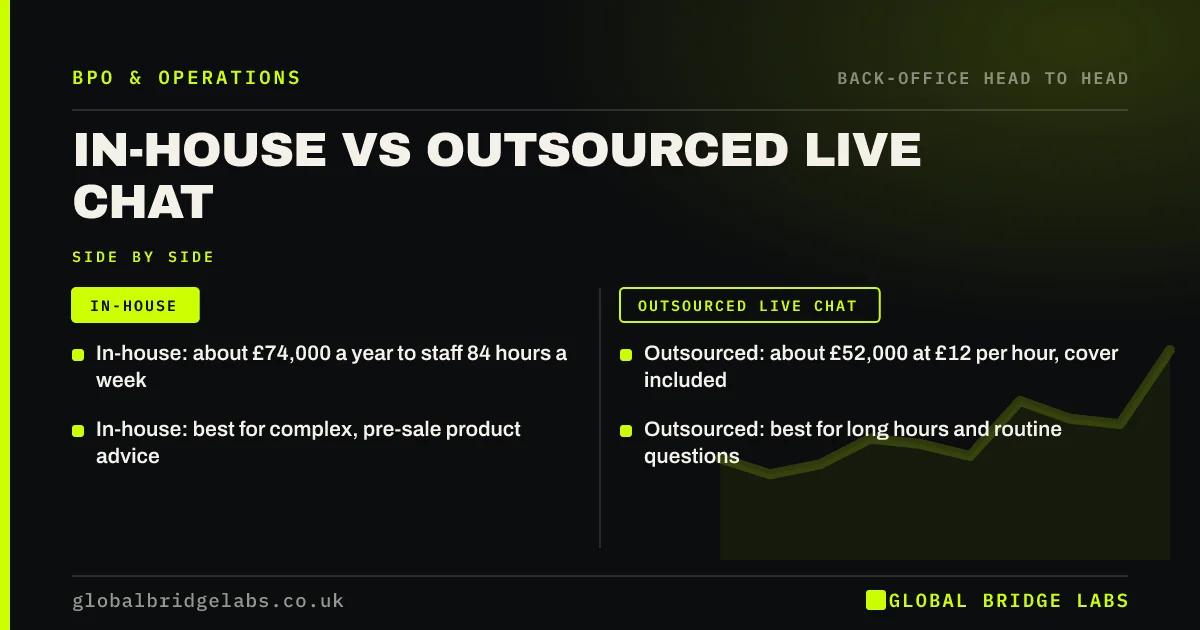
In-house vs outsourced live chat depends on opening hours. Staffing chat 84 hours a week in-house needs about 2.5 full-time agents, roughly £74,000 a year in employment costs alone. An outsourced team at £12 per hour costs about £52,000 for the same hours, and a shared model costs less again.
- In-house: about £74,000 a year to staff 84 hours a week.
- Outsourced: about £52,000 at £12 per hour, cover included.
- In-house: best for complex, pre-sale product advice.
- Outsourced: best for long hours and routine questions.
Want your chat staffing costed? Message us on WhatsApp with your hours and chat volumes.
Chat on WhatsApp →What does live chat staffing involve?
Live chat staffing means having someone ready to reply within seconds or minutes during the hours the chat is shown as online. An experienced agent can often handle two or three simple chats at once. The cost is driven by the hours covered, not only by the number of chats.
What does in-house live chat cost?
Covering 9:00 to 21:00, seven days a week, is 84 hours a week, about 4,368 hours a year. At 1,740 worked hours per full-time agent, that needs about 2.5 agents. At £26,000 each, employment costs are about £74,400 a year, before software seats, overheads and management.
What does outsourced live chat cost?
A dedicated outsourced seat for the same 4,368 hours at an indicative £12 per hour costs about £52,400 a year, with cover included. If chat volume is modest, a shared seat or per-chat pricing can cost much less, because the agent also serves other clients or tasks during quiet periods.
Want dedicated and shared chat options priced? Send us your chat volumes on WhatsApp.
Chat on WhatsApp →How fast do chat replies need to be?
Visitors expect a chat reply within about a minute, far faster than email. That is why chat needs staffed hours rather than a queue. If you cannot staff it, show chat as offline and offer a message form or WhatsApp instead of leaving an online chat unanswered.
When should live chat stay in-house?
When chat is mainly expert pre-sale advice on complex or high-value products, and volume is steady within your business hours. There, product knowledge wins sales and justifies the cost. Out-of-hours chat can still be outsourced.
When is outsourced live chat the better choice?
When you want evenings and weekends covered, when most chats are order status, delivery or account questions, or when volume swings with campaigns. A provider with written answers and an escalation route handles these well and at lower cost.
What about data and chat transcripts?
Chat transcripts contain personal data. An outsourced provider is a processor, so you need a written processor contract, and an offshore team needs a valid transfer safeguard under UK GDPR. Set retention rules for transcripts and restrict who can export them.
Should chat be staffed by people, a bot, or both?
A chatbot can answer simple, repeated questions instantly at any hour, such as opening times or delivery policy. It struggles with anything unusual, emotional or high-value. Many businesses use a bot for the first question and hand over to a person for the rest, with clear rules on when the hand-over happens.
What does this look like in practice?
A pattern we see in UK online retailers: chat is switched off after 17:00 because no one is available, yet many visitors browse in the evening. An outsourced evening and weekend chat team answers delivery and sizing questions and passes complex cases to the in-house team next morning.
Live chat cost checklist
Use these steps to compare.
- Decide the hours chat will show as online.
- Count chats per hour, by hour of day.
- Cost in-house agents for those hours.
- Price dedicated and shared outsourced options.
- Write answers for the 20 most common questions.
- Set an escalation route for complex chats.
Next step
Send us your chat volumes by hour. We will cost in-house, dedicated and shared outsourced options in a 30-minute call.
Message us on WhatsApp for a live chat cost comparison, or book a 30-minute consultation.
Chat on WhatsApp →Sources and further reading
- Rates and thresholds for employers 2026 to 2027 · HM Revenue & Customs
- Workplace pensions: what you, your employer and the government pay · GOV.UK
- Contracts and liabilities between controllers and processors · Information Commissioner's Office
- International transfers of personal data · Information Commissioner's Office
Frequently asked questions
How many live chat agents do I need?
Start from the hours chat will show as online, then check peak volume. Covering 84 hours a week needs about 2.5 full-time agents in-house. An experienced agent can often handle two or three simple chats at once, so peak volume sets the minimum staffing at busy times.
Is outsourced live chat cheaper than in-house?
For long opening hours, usually. Covering 84 hours a week costs about £74,000 a year in in-house employment costs alone, against about £52,000 for a dedicated outsourced seat at an indicative £12 per hour, and less again on a shared model for modest chat volumes.
Can outsourced chat agents sell?
They can answer product questions from written guides, recommend options, share links and pass warm leads to your team with context. For complex, high-value pre-sale advice, keep an in-house expert available during business hours or route those chats to them automatically.
What should I do if I cannot staff live chat?
Show chat as offline outside staffed hours and offer a message form, email or WhatsApp instead, with a clear reply time. An online chat that nobody answers is worse than no chat, because visitors who wait and get no reply often leave and do not come back.
Written by

Global Bridge Labs (GBL) is a UK–Sri Lanka partner for social media, websites and BPO. Everything here comes from client delivery, not theory.